Family office wealth accounting software helps single and multi-family offices keep entity books, consolidate holdings and cash across structures, track partnership and trust activity, produce financial statements, and securely deliver reporting to principals, family members, and advisors. In the current market, the category rarely stops at the general ledger. The stronger platforms also connect accounting to investment data aggregation, performance reporting, document management, bill pay, and stakeholder delivery.
In practice, most family offices are solving three problems at once: they need a ledger that can handle multi-entity wealth structures, a reporting layer that can explain total net worth and investment activity, and workflows for private assets, capital activity, and family expenses without recreating the books in spreadsheets. The best fit depends on what you want as your source of truth first: accounting plus portal publishing, a broader operating system, integrated GL plus performance reporting, or a hybrid platform-plus-services model.
Key takeaways
- Most family offices are not really buying “just accounting software.” They are buying some combination of ledger, aggregation, reporting, workflows, and secure stakeholder delivery.
- If your priority is accounting-grade outputs plus portal publishing from the same workflow, start with FundCount.
- If you want one platform spanning accounting, entity management, tax, workflows, and client reporting, Eton Solutions AtlasFive deserves a close look.
- If you want integrated GL plus performance reporting with multi-entity visibility and an entity-based pricing model, Asset Vantage is a strong contender.
- If you want integrated accounting, aggregation, reporting, and the option to pair software with outsourced support, Archway Platform is a serious option.
Best for (one-line summaries)
- FundCount: Best for accounting-grade family office operations with portfolio and partnership accounting, general ledger, reporting, and portal publishing in one ecosystem.
- Eton Solutions AtlasFive: Best for offices that want a broad operating platform across accounting, entity management, tax, workflows, and client reporting.
- Asset Vantage: Best for offices wanting integrated GL plus performance reporting with multi-entity visibility and predictable entity-based pricing logic.
- Archway Platform: Best for offices wanting integrated accounting, aggregation, and reporting with a hybrid software-plus-services option.
Quick comparison table
| Platform | Best for | What it’s strongest at | Category focus | Portal / sharing |
| FundCount | Offices that need reporting tied to the books | Portfolio + partnership accounting, GL, reporting, portal publishing, family expense workflows | Accounting + reporting + portal | Built-in portal |
| Eton Solutions AtlasFive | Offices wanting a broad operating platform | Core accounting, entity management, tax, workflows, AI-assisted document ops, client reporting | Integrated family office suite | Client reporting + portal-style delivery |
| Asset Vantage | Offices wanting integrated GL + performance reporting | GL, consolidated net worth, performance analytics, partnership accounting, document controls | Accounting + performance | Secure sharing + document workflows |
| Archway Platform | Offices wanting integrated accounting, aggregation, and optional services | Core GL, data aggregation, 200+ report templates, mobile client portal, bill pay approvals | Integrated platform + services | Mobile client portal |
Note: This comparison reflects current official product positioning on FundCount, Eton Solutions, Asset Vantage, and Archway pages. Validate scope, controls, integrations, and workflow depth in live demos.
One platform for family office wealth accounting
Manage entities, investments, and reporting in a single system designed for multi-entity complexity.
What is family office wealth accounting software?
Family office wealth accounting software is software that keeps the books for complex family wealth structures while connecting those books to portfolio data and stakeholder reporting. In stronger platforms, this includes multi-entity consolidation, partnership or trust accounting, bill pay, automated feeds, performance reporting, portals or client delivery, and permissions that let different stakeholders see the right slice of the family balance sheet.
A typical family office wealth accounting stack includes:
- General ledger and financial statements
- Multi-entity ownership mapping and consolidation
- Partnership, trust, or capital account workflows
- Investment data aggregation and reconciliation
- Reporting, dashboards, and secure stakeholder delivery
- Permissions, audit trails, and operational workflows
Why it matters in 2026
Private assets and entity sprawl are what usually break generic accounting stacks. FundCount emphasizes partnership accounting for contributions, distributions, series, and waterfalls plus nested-entity auto-reconciliation and family expense workflows. Eton highlights trust, partnership, and tax ledger support alongside capital call and manager statement extraction. Asset Vantage centers its product on multi-entity visibility across private investments, hedge funds, venture capital, and illiquid assets. Archway emphasizes partnership accounting, direct data integrations, and sophisticated accounting tools for complex family office structures.
Security and governed delivery matter just as much as accounting depth. FundCount highlights bank-grade encryption, MFA, single-tenant deployment, and optional approval workflow in its portal. Eton calls out SSO, MFA, digital audit trails, and multiple ISO and SOC certifications. Asset Vantage highlights TLS in transit, AES-256 at rest, role-based permissions, dual-factor authentication, and full audit trails. Archway emphasizes secure document sharing through its client portal and structured approval flows around bill payment.
Must-have features checklist
Use this as your evaluation rubric when shortlisting family office wealth accounting software.
General ledger and consolidation
- Real general ledger, not just reporting overlays
- Consolidation across trusts, LLCs, partnerships, foundations, and individuals
- Drill-down from consolidated statements to entity and transaction detail
Partnership, trust, and capital accounting
- Contributions, distributions, capital accounts, and partnership allocations
- Trust or fund accounting where relevant
- Clean handling of private investments and capital activity
Data aggregation and investment linkage
- Custodian, bank, and manager data feeds
- Reconciliation workflows and exception handling
- Clear linkage between investment activity and accounting entries
Reporting and stakeholder delivery
- Financial statements plus management reporting
- Scheduled report packs and dashboards
- Portal or secure delivery controls for family members and advisors
Bill pay and operational workflows
- Expense management and payment approvals
- Role-based workflows and task routing
- Support for document-heavy processes such as capital notices and tax files
Security, permissions, and governance
- MFA or SSO, encryption posture, and role-based access
- Audit trails for user activity and data changes
- Controls by entity, stakeholder, and document type
Integrations and extensibility
- APIs or practical export paths
- Excel, PDF, BI, or warehouse support where needed
- Real coverage for your custodians, banks, and document flows
Top 4 family office wealth accounting software options
FundCount: Best for accounting-grade family office wealth accounting plus portal publishing
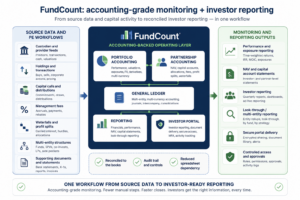
Quick verdict: FundCount is the strongest fit when your family office wants one system-of-record core for portfolio accounting, partnership accounting, a unified general ledger, reporting, data aggregation, and a secure portal. Its family office pages emphasize support for equities, derivatives, private equity, real estate, and debt in one portfolio view; contributions, distributions, series, and waterfalls from the same underlying data; multi-currency and multi-book accounting for IFRS and GAAP; automated data feeds; flexible accounts payable for family expenses; and a portal that publishes statements with bank-grade encryption, MFA, and single-tenant deployment. FundCount also publicly lists Single Family Office pricing starting from $34,099 per year.
Best for
- Single family offices that run accounting workflows internally and want reconcilable outputs
- Offices managing partnership-heavy or alternative-heavy structures
- Teams that want secure report and document delivery without pushing data into a disconnected portal
Standout capabilities
- Portfolio accounting across public and private assets, with performance and attribution support.
- Partnership accounting for contributions, distributions, series, and waterfalls from the same data as reporting.
- General ledger built for investment operations, including multi-currency and multi-book accounting.
- Nested-entity auto-reconciliation and look-through reporting.
- Flexible accounts payable for family expenses, bank accounts, credit cards, and cash management.
- Built-in portal with personalized bulk statements, structured data sharing, bank-grade encryption, MFA, and private cloud or on-prem deployment.
Pros
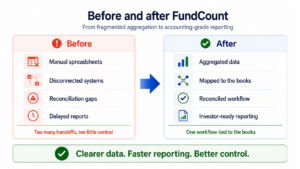
- Clear books-to-reporting story
- Strong fit when financial statements and stakeholder reporting must reconcile
- Good option for families that want portal publishing and accounting in one environment
Integrations to verify
- Custodian, bank, and alternative manager feed coverage
- BI and Excel export requirements
- Portal permissions by entity and stakeholder
- Multi-currency and multi-book needs
Pricing
- Single Family Office: starting from $34,099 / year. Digital transformation and hosting fees apply separately.
Questions to ask during the demo
- “Show a month-end close that produces financial statements from the GL, then trace one number back to underlying transactions.”
- “Show how partnership activity flows into capital statements and family reporting without spreadsheet rebuilds.”
- “Show nested-entity consolidation and the look-through logic.”
- “Show who approves portal publishing and how you prevent the wrong version from being visible.”
Stop managing wealth accounting in spreadsheets
Centralize accounting and reporting so reconciliation and consolidation do not rely on manual effort.
Eton Solutions AtlasFive: Best for integrated family office operations across accounting, entities, and workflows
Quick verdict: Eton Solutions AtlasFive is strongest when accounting is only one part of a broader family office operating model. Official pages position AtlasFive around integrated general ledger, trust, partnership, and tax ledger; entity management; portfolio management and performance reporting; document management; data integration; workflows and audit trail; client reporting; and cybersecurity. Its single-family-office page also highlights bill pay, tax reporting, capital call and manager statement extraction, 50+ out-of-the-box reports, daily automated data processing, Microsoft Azure architecture, SSO, MFA, digital audit trails, and multiple ISO and SOC certifications. Eton also offers an Administrative Family Office service layer built around the platform.
Best for
- Offices that want fewer disconnected systems across accounting, entities, tax, documents, and reporting
- Teams with trust, partnership, and workflow complexity
- Operations leaders who care as much about process control as reporting output
Standout capabilities
- Real-time integrated GL plus trust, partnership, and tax ledger support.
- Unified “single source of truth” positioning across investment, accounting, and tax data.
- Entity management that maps clients, entities, ownerships, portfolios, accounts, and relationships in one place.
- 270+ workflows across investment management, accounting, tax, document management, bill pay, and transaction processing.
- 50+ pre-built reports, client reporting APIs, and Power BI integration.
- Bill pay, capital call processing, manager statement extraction, and tax reporting support for single family offices.
- Security and governance features including SSO, MFA, entity-level visibility, digital audit trails, and ISO 42001, ISO 27001, ISO 27701, SOC 1, and SOC 2 certifications.
- Optional Administrative Family Office services layered on top of AtlasFive.
Pros
- Broadest operating-system feel in this shortlist
- Strong fit when accounting, entity governance, workflows, and reporting all need to live together
- Good option for offices that want technology plus service extensions
Cons / trade-offs
- Broad platforms require careful scoping
- Buyers should validate which workflows are native software, which are service-assisted, and which depend on configuration
Integrations to verify
- Custodian, bank, and statement feed coverage
- Tax and document workflow requirements
- Power BI or other analytics needs
- Permissioning model for staff, family members, and third-party advisors
Pricing
- The official AtlasFive pages reviewed here emphasize demos and contact flows rather than publishing list pricing, so treat procurement as a scoped sales conversation.
Questions to ask during the demo
- “Show end-to-end: transaction ingestion, posting to GL, entity roll-up, and client reporting.”
- “Show trust and partnership accounting in the same environment.”
- “Show workflow controls and digital audit trails for approvals.”
- “Show how capital call notices and manager statements become usable accounting and reporting data.”
Asset Vantage: Best for integrated GL plus performance reporting with multi-entity visibility
Quick verdict: Asset Vantage is strongest when you want integrated general ledger and performance reporting with a family office lens. Official pages highlight multi-entity aggregation across private investments, venture capital, hedge funds, and illiquid assets; full general ledger accounting; document management; consolidated net worth views; IRR, TWR, benchmarks, risk metrics, and drill-down analytics; and security controls including AWS hosting, TLS in transit, AES-256 at rest, role-based access, dual-factor authentication, full audit trails, dedicated URL or database instances, and data residency choice. Asset Vantage also publicly states that its pricing is entity-based rather than AUM- or performance-based.
Best for
- Offices that want accounting and performance reporting in the same system
- Teams that need consolidated net worth and multi-entity visibility
- Buyers that care about pricing aligned to entity complexity rather than asset values
Standout capabilities
- Integrated general ledger and performance reporting platform for family offices.
- Consolidated oversight across partnerships, trusts, entities, and private investments.
- Portfolio analytics using IRR, TWR, benchmarks, and risk metrics, with drill-downs by portfolio, manager, or entity.
- Secure document management plus a single-source-of-truth data model.
- Security controls including AWS hosting, TLS, AES-256, role-based access, dual-factor authentication, and full audit trails.
- Entity-based pricing model that is not tied to AUM or performance.
Pros
- Clear fit for offices that want accounting integrity plus performance visibility
- Strong multi-entity framing
- Pricing model may be attractive for families with growing complexity
Cons / trade-offs
- Validate feed coverage and ongoing data support for your exact institutions
- Be explicit about what is included in core software versus onboarding or managed services
Integrations to verify
- Custodian and bank support for your asset mix
- Reporting export paths and template governance
- Document-to-accounting linkage for private investments
- Security and advisor access controls
Pricing
- Asset Vantage says its pricing is entity-based and does not use AUM-based or performance-based fees.
Questions to ask during the demo
- “Show one consolidated family report and drill back to entity-level sources.”
- “Show how IRR, TWR, benchmarks, and risk metrics are configured.”
- “Show the relationship between performance reporting and posted accounting records.”
- “Explain pricing using our entity structure and what changes cost over time.”
Archway Platform: Best for hybrid accounting, aggregation, and reporting with service optionality
Quick verdict: Archway Platform is strongest when you want integrated accounting, investment data aggregation, and reporting, but also value the option to pair the platform with outsourced operational support. Official family office pages say Archway is trusted by more than 400 wealthy families and unifies accounting, investment detail, and reporting in one platform. The product emphasizes direct data feeds and APIs, support for complex ownership structures, multi-currency charts of accounts, automated close processes, journal entry creation from investment and administrative activity, 200+ report templates, automated report scheduling, a mobile client portal, bill pay approval structures, and partnership administration services.
Best for
- Offices that want integrated accounting, aggregation, and reporting without forcing every workflow fully in-house
- Teams that value software-plus-services flexibility
- Firms that want strong reporting depth and a mature family office accounting posture
Standout capabilities
- Integrated general ledger designed to bridge accounting and investment teams.
- Direct data integrations with custodians, brokers, banks, and other data sources, plus flexible APIs.
- Support for nested structures, look-through reporting, and consolidated data across entities, currencies, managers, and geographies.
- Reporting library with 200+ templates plus automated recurring and ad hoc report packages.
- Mobile client portal with dashboards, configurable views, and secure document sharing.
- Accounts payable tools with check writing, ACH, wire methods, expense reporting, and sophisticated approval structures.
- Optional outsourced support for reconciliation, bill payment, and partnership administration.
Pros
- Strong fit for offices that want accounting depth plus reporting maturity
- Hybrid service model can reduce operational burden on lean teams
- Good option for families that want client-facing reporting without building around a portal-first vendor
Cons / trade-offs
- Validate which tasks you expect to run in-house versus through Archway services
- Buyers should pressure test how daily workflows, close processes, and approval chains actually operate in their environment
Integrations to verify
- Exact direct feed coverage for custodians and banks
- API and export requirements
- Client portal permissions and document-sharing rules
- Service model boundaries for reconciliation, bill pay, and partnership support
Pricing
- The official product pages reviewed here do not publish list pricing. Because Archway explicitly combines software and optional services, expect pricing discussions to be scoped around platform needs and service mix.
Questions to ask during the demo
- “Show a close process across several entities and explain where automated journal entries are created.”
- “Show one recurring report pack and one ad hoc report package.”
- “Show the mobile client portal and secure document-sharing workflow.”
- “Show how your software-only model differs from your hybrid service model.”
How to choose: decision tree
Use this as a fast shortlisting path.
- If reporting must reconcile to the books and you want portal publishing from the same workflow, start with FundCount.
- If you want the broadest operating environment across accounting, entity management, tax, workflows, and client reporting, shortlist Eton Solutions AtlasFive.
- If you want integrated GL and performance reporting with multi-entity visibility and an entity-based pricing model, shortlist Asset Vantage.
- If you want integrated accounting plus aggregation plus reporting with a software-plus-services option, shortlist Archway Platform.
FAQs
What is family office wealth accounting software?
It is software that keeps the books for complex family structures while connecting those books to investment data, reporting, and stakeholder delivery. The stronger platforms combine general ledger, multi-entity consolidation, private asset support, workflows, and controlled sharing.
How is it different from family office reporting or portfolio management software?
Reporting and portfolio tools can show net worth, allocation, or performance. Wealth accounting software has to keep entity books, post entries, reconcile data, support partnership or trust mechanics, and produce accounting-grade outputs that tie back to source transactions. That is why platforms like FundCount, AtlasFive, Asset Vantage, and Archway all lead with integrated accounting or general ledger language rather than dashboards alone.
Which option is best if financial statements must reconcile to the books?
FundCount is the clearest fit in this shortlist for that use case because it ties portfolio accounting, partnership accounting, general ledger, reporting, and portal delivery together in one system.
Which option is best for broad entity management and workflow governance?
Eton Solutions AtlasFive stands out there. Its official pages place entity management, workflows and audit trail, tax support, document management, and client reporting alongside core accounting.
Which option is best for integrated GL plus performance reporting?
Asset Vantage is the clearest match if that is your top priority. Its family office pages explicitly center the product on integrated general ledger plus performance reporting, consolidated net worth, and portfolio analytics across multiple entities.
Which option is best if you want software plus outsourced support?
Archway Platform deserves a close look. The official pages pair the platform with optional outsourced services for reconciliation, bill payment, and partnership administration.
Do these platforms handle partnerships, trusts, and private assets?
Yes, but with different emphasis. FundCount highlights partnership accounting, waterfalls, and alternative assets. Eton highlights trust, partnership, and tax ledger support plus capital-call document workflows. Asset Vantage emphasizes partnerships, private investments, and illiquid assets. Archway highlights partnership administration, private investment reporting, and complex ownership structures.
What should vendors show in a live demo?
Use a repeatable script: ingest one custodian or manager feed, post activity into the GL, consolidate across several entities, generate a report pack, and then review permissions, approvals, and audit trail. That is how you separate true wealth accounting software from a reporting layer with accounting language around it.
Methodology and last updated
How this list was built
- Focus: Accounting-forward platforms relevant to family offices where wealth accounting overlaps with data aggregation, reporting, partnership or trust workflows, bill pay, and stakeholder delivery.
- Evaluation lens: Source-of-truth clarity, multi-entity fit, partnership and trust coverage, reporting depth, workflow controls, security posture, and pricing transparency.
- Why only four: The goal is shortlisting, not a full market map. These four represent four common buying patterns: accounting plus portal publishing, broad operating platform, integrated GL plus performance reporting, and integrated platform plus optional services.
- Sources: Current official product, pricing, security, and solutions pages reviewed for FundCount, Eton Solutions, Asset Vantage, and Archway.
Last updated: April 23, 2026.