Investment aggregation software solutions are platforms that consolidate holdings, transactions, cash, documents, and ownership data across custodians, banks, managers, and alternative investments so firms can analyze performance, report with confidence, and reduce spreadsheet-driven operations. FundCount positions aggregation alongside automated double-entry accounting and reporting, Addepar positions it as centralized data plus analysis and reporting, Masttro emphasizes global aggregation across asset classes and entity structures, and Asset Vantage emphasizes consolidated multi-entity investment data with performance reporting and general ledger support.
In practice, most buyers are solving three problems at once: data aggregation across liquid and illiquid holdings, reporting and analytics stakeholders can trust, and a reliable source of truth for reconciliations, entity rollups, or official books. The best setup depends on what you need first: accounting-grade outputs, consolidated reporting and analytics, or real-time visibility across complex structures.
For this list, “investment aggregation” means institutional-grade aggregation across public and private assets, entities, and documents. It does not mean a retail account-linking app.
Key takeaways
- Most firms do not buy “one tool.” They buy a stack, or choose a platform that covers multiple layers: aggregation, reporting, analytics, accounting workflows, and secure sharing.
- If your priority is accounting-grade outputs plus aggregation tied directly to the books, start with FundCount.
- If your bottleneck is consolidated reporting and analytics across complex, multi-entity portfolios, Addepar deserves a top spot on the shortlist.
- If you need global aggregation and real-time visibility across custodians, jurisdictions, currencies, and alternatives, Masttro is a strong contender.
- If you want aggregation combined with general ledger, performance reporting, and multi-entity oversight in one platform, Asset Vantage is a serious option.
Best for (one-line summaries)
- FundCount: Best for firms that want investment aggregation tied directly to accounting-backed reporting, reconciliations, and secure portal delivery.
- Addepar: Best for firms prioritizing consolidated reporting, custom analytics, and flexible integrations across complex portfolios.
- Masttro: Best for firms prioritizing global aggregation, entity visibility, and alternatives-heavy portfolio oversight.
- Asset Vantage: Best for firms that want multi-entity aggregation plus integrated GL and performance reporting in one system.
Quick comparison table
| Platform | Best for | What it’s strongest at | Category focus | Portal / sharing |
| FundCount | Firms that need reporting tied to the books | Aggregation + portfolio and partnership accounting + GL + portal publishing | Accounting + reporting + portal | Built-in portal |
| Addepar | Firms prioritizing analytics and consolidated reporting | Multi-asset analytics, custom reporting, direct feeds, APIs | Data + reporting | Portal and mobile capabilities |
| Masttro | Firms prioritizing aggregation and visibility | Global data feeds, entity mapping, alternatives workflows, security posture | Aggregation + visibility | Sharing experience varies |
| Asset Vantage | Firms wanting GL plus performance reporting with aggregation | Multi-entity aggregation, full GL, performance views, private investment reporting | Accounting + performance reporting | Secure document workflows |
Note: This comparison is based on current official vendor product positioning and feature descriptions. Validate scope, controls, and integrations in demos.
Investment aggregation software that brings everything into one view
FundCount helps standardize workflows and produce cleaner reports without manual rollups.
What is investment aggregation software?
Investment aggregation software is software that collects and normalizes financial data from multiple institutions and asset classes, then turns that data into usable views for performance, reporting, analysis, and in some cases accounting or secure sharing. In stronger platforms, aggregation is not a standalone feed layer. It is the operating foundation for reporting, ownership modeling, workflow control, and stakeholder delivery.
A typical investment aggregation stack includes data ingestion from custodians, banks, and manager statements; normalization and ownership modeling across entities; performance and reporting workflows; and, depending on the platform, either general-ledger-backed accounting or a portal and sharing layer for stakeholders.
Why it matters in 2026
The current vendor positioning itself tells the story. FundCount sells aggregation alongside automated double-entry accounting and investor delivery, Addepar sells centralized data plus real-time custom reporting and APIs, Masttro sells global custodian connectivity plus alternatives automation, and Asset Vantage sells aggregation combined with GL and performance reporting. That is a sign buyers are no longer evaluating connection counts alone. They are evaluating how normalized data turns into reporting, analysis, and governance.
The practical risk is not just delayed reporting. It is bad normalization, broken look-through, manual re-keying from documents, and confusion about which numbers are official. That is why buyers should test the full workflow: ingestion, normalization, reporting, drill-down, permissions, and export or delivery.
Must-have features checklist
Use this as your evaluation rubric when shortlisting investment aggregation software solutions.
Data ingestion and normalization
- Multiple ingestion methods: direct feeds, files, APIs, and service-assisted workflows
- Support for alternative investments and manager statements, not just liquid accounts
- Exception handling and validation workflows when source data is incomplete or messy
Multi-entity and look-through reporting
- Entity modeling for trusts, LLCs, partnerships, funds, companies, and individuals
- Ownership mapping and consolidated roll-ups
- Explainability from consolidated numbers back to source-level data
Reporting, performance, and books
- Repeatable reporting templates and custom report design
- Performance metrics, benchmarks, and drill-downs
- General-ledger-backed outputs if your team needs accounting-grade reporting
Security, permissions, and governance
- MFA or SSO options, encryption posture, and role-based permissions
- Audit trail visibility into what changed and when
- Final publishing or controlled delivery workflows for stakeholder reports
Integrations and extensibility
- APIs and documentation for custom workflows
- Export path to Excel, BI tools, or data warehouses
- Practical feed coverage for your institutions and asset mix
Top 4 investment aggregation software solutions
FundCount: Best for accounting-grade aggregation tied to the books
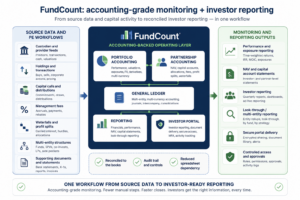
Quick verdict: FundCount is the strongest fit when aggregated investment data needs to flow into the same ecosystem that handles portfolio accounting, partnership accounting, general ledger, reporting, and secure portal delivery. Current product pages emphasize custodian and data-provider feeds, automated double-entry accounting, portfolio accounting across public and private assets, multi-currency and multi-book GL, and an investor portal that sits inside the same ecosystem with bank-grade encryption, MFA, batch workflows, and single-tenant deployment. FundCount also publicly lists Single Family Office pricing starting at $34,099 per year.
Best for
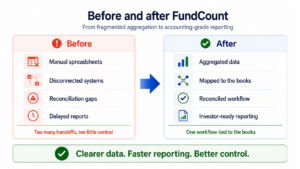
- Firms that want aggregated investment data tied directly to reconciliations, books, and financial statements.
- Teams managing alternatives, partnership activity, or multi-entity structures that do not want a separate analytics layer becoming the system of record.
- Buyers who want secure report or statement delivery from the same workflow that produces the underlying numbers.
Standout capabilities
- Data aggregation from custodians and data providers with instant reporting and automated double-entry accounting.
- Portfolio accounting across equities, derivatives, private equity, real estate, and debt.
- Partnership accounting for contributions, distributions, series accounting, waterfalls, and capital statements from the same underlying data.
- Multi-currency and multi-book GL supporting IFRS and GAAP, with consolidated entity financials.
- Secure portal with bulk personalized statements, structured dashboard data, bank-grade encryption, MFA, batch invitations, and private cloud or on-prem deployment.
Pros
- Clear books-to-reporting story.
- Strong fit when audit-ready outputs matter as much as visibility.
- Broad coverage across aggregation, accounting, reporting, and secure delivery in one ecosystem.
Integrations to verify
- Exact custodian, broker, bank, and alternative-manager feed coverage
- Export path for Excel, PDF, BI, or warehouse workflows
- Portal permissions, approvals, and final publishing controls
- Multi-currency and multi-book requirements
Pricing
- FundCount publicly lists Single Family Office pricing starting from $34,099 / year, with digital transformation and hosting fees applying separately.
Questions to ask during the demo
- “Show one feed moving from source data into reporting and then into a published stakeholder view.”
- “Show a consolidated report, then trace one line item back to source transactions.”
- “Show how alternatives activity flows into both accounting and performance reporting.”
- “Show portal publishing controls, approvals, and what counts as final.”
Aggregate the data. Run the back office
FundCount connects consolidated investment data to accounting and reporting workflows so your team can do more than just view balances.
Addepar: Best for consolidated reporting and analytics across complex portfolios
Quick verdict: Addepar is strongest when the core need is consolidated reporting and analytics across multi-asset, multi-entity, and multi-currency portfolios. Its family office pages emphasize a complete view of all accounts and assets, fast analysis across complex ownership structures, custom reports that update in real time, and a multifaceted security program. Its integrations page highlights direct data feeds across liquid and illiquid assets plus flexible APIs, while its family office fact sheet describes a data platform for aggregation, verification, normalization, enrichment, and asset class modeling, along with custom data access, portal and mobile capabilities, document management, and consolidated reporting.
Best for
- Firms that need one place to centralize complex portfolio data across asset classes, currencies, and legal entities.
- Teams prioritizing custom analytics and stakeholder-ready reporting.
- Buyers that expect API-led extensibility and custom integrations into broader operating workflows.
Standout capabilities
- A complete view of all accounts and assets, no matter the asset class, legal entity, or currency.
- Fast analysis across complex ownership structures, multi-asset classes, and multi-currency scenarios.
- Flexible reporting that supports customized reports updating in real time, with sample report patterns spanning multi-currency, real assets, and private equity exposure.
- Direct data feeds that aggregate liquid and illiquid assets and let users run analysis across the full portfolio.
- Flexible APIs and custom integration options for in-house or third-party systems.
- Platform components that include data aggregation, verification, normalization, enrichment, asset class modeling, portal and mobile access, document management, and consolidated reporting.
Pros
- Strong fit when consolidated reporting is the top pain point.
- Better extensibility story than many closed systems.
- Good option when custom analytics matter as much as feed collection.
Cons / trade-offs
- If you need an accounting system of record, validate what is covered natively versus what depends on external accounting cores.
- Alternatives workflows vary widely in the market, so test exactly how documents become trusted data in your environment.
Integrations to verify
- Data coverage for your exact custodians and banks
- API limits, developer workflow, and warehouse export path
- Alternatives document workflow and operational effort to keep data current
- Permission model for internal teams and external stakeholders
Pricing
- Contact vendor.
Questions to ask during the demo
- “Show consolidated reporting across a realistic entity structure and explain the ownership model.”
- “Show a custom report that updates in real time, and explain what refreshes instantly versus on a batch basis.”
- “Show a liquid feed plus an illiquid asset workflow in the same demo.”
- “Show the API path end to end, not just the integration catalog.”
Masttro: Best for global aggregation and entity-level visibility
Quick verdict: Masttro is strongest when aggregation and visibility come first. Its data-aggregation page emphasizes 650+ global custodian data feeds across 35+ countries, 10m+ daily transactions processed, multi-currency aggregation and reporting, automated reporting tools, and AI-powered alternative investment management. It also positions itself around a panoramic portfolio view and holistic visibility across estate structures. Masttro’s pricing page adds that the platform is not priced on AUM and highlights military-grade encryption, Swiss infrastructure, and private servers.
Best for
- Firms prioritizing real-time aggregation and visibility across many custodians and jurisdictions.
- Teams that want a stronger view of entity structures and global wealth mapping.
- Buyers with alternatives-heavy portfolios that want aggregation plus document and workflow automation.
Standout capabilities
- 650+ global custodian data feeds across 35+ countries.
- 10m+ daily transactions processed.
- Aggregation across traditional and alternative assets, including real estate, private equity holdings, and passion assets.
- AI-powered alternative investment management and automated reporting tools.
- A panoramic portfolio view and holistic visibility into estate structures through a single source of truth.
- Pricing not based on AUM, plus security positioning around military-grade encryption, Swiss infrastructure, and private servers.
Pros
- Strong fit when the primary requirement is aggregation plus visibility.
- Explicit emphasis on global complexity and entity structures.
- Attractive if you want a non-AUM pricing posture.
Cons / trade-offs
- Validate accounting depth if you need full GL, entity books, and audit-ready statements inside the platform.
- “AI-powered alternatives” can mean different levels of automation, so ask for a proof-of-work demo with real documents.
Integrations to verify
- Which custodians are direct feeds versus file imports or service workflows
- How private investment documents become normalized data
- Export path for your reporting stack
- Security and deployment options that match your IT requirements
Pricing
- Contact vendor. Masttro says its pricing model is not based on AUM.
Questions to ask during the demo
- “Show aggregation from two custodians plus one private investment workflow, then show the consolidated view.”
- “Show entity ownership mapping and look-through reporting.”
- “Show what updates automatically, what updates daily, and what still needs manual review.”
- “Show security controls in product, not just in sales materials.”
Asset Vantage: Best for integrated GL plus performance reporting with aggregation
Quick verdict: Asset Vantage is strongest when you want investment aggregation combined with accounting and performance reporting in one platform. Its family office pages say it centralizes investment data aggregation across multiple entities, supports multi-asset portfolios including private investments, venture capital, hedge funds, and illiquid assets, and combines performance reporting, full general ledger accounting, secure document management, and consolidated net-worth visibility. Other product sections highlight IRR, TWR, benchmarks, risk metrics, drill-downs, consolidated views across entities, and alternative investment reporting that stays aligned with accounting systems. Asset Vantage’s pricing page says the model is entity-based, not AUM-based or performance-based, and that core pricing covers portfolio accounting, performance reporting, data aggregation, and multi-entity support.
Best for
- Firms that want a combined GL, performance reporting, and aggregation core.
- Teams that need consolidated views across partnerships, trusts, entities, and private investments.
- Buyers who want pricing tied to operational complexity rather than AUM.
Standout capabilities
- Multi-asset data aggregation across private investments, venture capital, hedge funds, and illiquid assets.
- Performance reporting using IRR, TWR, benchmarks, and risk metrics across asset classes.
- Data visualization with drill-downs by portfolio, manager, or entity, plus consolidated views across multiple entities.
- Full general ledger accounting, secure document management, single-source-of-truth positioning, and consolidated net-worth visibility.
- Alternative and private equity reporting aligned with accounting systems.
- Entity-based pricing that is not tied to AUM or performance, with core coverage including portfolio accounting, performance reporting, data aggregation, and multi-entity support.
Pros
- Clear fit for buyers who want GL plus performance reporting in one platform.
- Explicit multi-entity framing.
- Pricing model may reduce fee shock as asset values rise.
Cons / trade-offs
- Validate feed coverage and the operational effort required to keep aggregation accurate.
- Ensure you understand what is included in core software versus onboarding or managed services.
Integrations to verify
- Custodian and bank feed support for your exact institutions
- Reporting outputs and template governance
- Document workflows for alternatives and how they connect to accounting entries
- Data export capabilities if you maintain a separate BI layer
Pricing
- Asset Vantage says its pricing is entity-based, not AUM-based, and not performance-based. The listed core platform includes portfolio accounting, performance reporting, data aggregation, and multi-entity support.
Questions to ask during the demo
- “Show multi-entity consolidation, then trace one consolidated number back to entity-level sources.”
- “Show the GL workflow and how performance reporting reads from the same data.”
- “Show a private investment workflow with commitments, valuations, and reporting.”
- “Explain pricing inputs using our entity structure and what triggers cost changes.”
How to choose: decision tree
- If reporting must reconcile to the books and you need accounting-grade outputs plus secure delivery from the same workflow, start with FundCount.
- If your top pain is consolidated reporting and analytics across complex portfolios and ownership structures, shortlist Addepar.
- If your priority is global aggregation and visibility across custodians, entities, and alternatives, shortlist Masttro.
- If you want GL plus performance reporting with multi-entity aggregation and a non-AUM pricing model, shortlist Asset Vantage.
FAQs
What is investment aggregation software?
It is software that consolidates holdings, transactions, documents, and ownership data across institutions and asset classes so a firm can produce a consistent view of wealth, performance, and exposure. Some platforms stop at analytics. Others extend into general ledger, portal delivery, or document workflows.
What is the difference between investment aggregation software and portfolio management software?
Portfolio management software usually focuses on exposures, performance, and reporting. Investment aggregation software focuses on collecting, normalizing, and maintaining the data layer those views depend on. In practice, many leading platforms now blur the line by bundling aggregation with analytics, reporting, and sometimes accounting.
Can these platforms handle private investments and alternative assets?
Yes, but the depth varies. FundCount emphasizes alternative investment statement extraction plus partnership accounting, Addepar emphasizes liquid and illiquid aggregation plus asset class modeling, Masttro emphasizes AI-powered alternatives workflows, and Asset Vantage emphasizes private equity and illiquid asset reporting tied to accounting.
Do you need accounting inside the aggregation platform?
Not always. If your main pain is consolidated visibility and analytics, an aggregation and reporting platform may be enough. If your reports must reconcile to the books, platforms like FundCount and Asset Vantage are more relevant because they combine aggregation with GL-backed workflows.
What pricing models are common in this category?
Pricing models vary. FundCount publishes a starting-from price for Single Family Office, Masttro says its pricing is not based on AUM, and Asset Vantage says its pricing is entity-based and not tied to AUM or performance.
What integrations matter most?
The answer depends on the layer. Aggregation tools need direct custodian and bank feeds plus alternatives workflows. Reporting tools need API and export paths. Accounting-backed tools need transaction flows and reconciliation support. In demos, ask the vendor to show one real integration end to end, not just the catalog.
What is a practical demo script for evaluating investment aggregation software?
Use a repeatable script: ingest one custodian feed, ingest one alternative investment document or manager statement, show entity ownership mapping and consolidated roll-ups, produce one stakeholder report pack, and then show permissions, audit trail, and export or delivery controls. This prevents feature touring and forces an end-to-end workflow demonstration.
Methodology and last updated
How this list was built
- Focus: Platforms commonly evaluated when investment aggregation overlaps with reporting, performance analytics, accounting, or secure stakeholder delivery.
- Evaluation lens: Source-of-truth clarity, multi-entity fit, alternative asset workflow support, integrations and extensibility, governance, and security posture signals.
- Why only four: The goal is shortlisting, not a full market map. These four represent four common buying patterns: accounting-connected aggregation, analytics-first consolidated reporting, global aggregation and visibility, and GL plus performance aggregation.
- Sources: Current official product, integration, and pricing pages reviewed for FundCount, Addepar, Masttro, and Asset Vantage.
Last updated: April 22, 2026.