Investor portal software for PE/VC funds is the secure layer where LPs access capital call notices, reports, tax documents, performance data, and fund communications without relying on scattered email attachments. In the current market, the category is broader than a document vault. The leading products now connect the portal to investor reporting, onboarding, fundraising, CRM, or fund accounting workflows.
In practice, most private equity and venture capital firms are solving three problems at once: controlled investor reporting, a cleaner LP experience, and a reliable source of truth behind what investors see. The best setup depends on what you need first: accounting and statement publishing, investor operations and onboarding, or a broader fund software stack. That is why this shortlist starts with FundCount, then separates Juniper Square and Allvue by operating model.
Key takeaways
- Most PE/VC firms do not buy “just a portal.” They buy a connected workflow that spans reporting, onboarding, fundraising, investor communications, or fund administration.
- If your priority is accounting-grade reporting plus portal publishing from the same workflow, start with FundCount.
- If your bottleneck is LP onboarding, publish controls, personalized reporting, and investor operations in one system, Juniper Square deserves a top spot on the shortlist.
- If you want a broader PE/VC stack that combines accounting, portfolio monitoring, investor communications, and a configurable portal, Allvue is a strong contender.
- Security and publishing controls matter as much as design. Validate MFA or 2FA, permissions, auditability, and how documents stay hidden until publish.
Best for (one-line summaries)
- FundCount: Best for PE/VC managers that want investor delivery tied directly to accounting-backed reporting and capital statements.
- Juniper Square: Best for PE/VC firms prioritizing investor operations, onboarding, reporting, and LP experience in one platform.
- Allvue: Best for firms that want a broader PE/VC software stack with investor communications and portal workflows alongside fund accounting and monitoring.
Quick comparison table
| Platform | Best for | What it’s strongest at | Category focus | Portal / sharing |
| FundCount | Firms that need LP reporting tied to the books | Reporting workflow to portal publishing, capital statements, capital activity, deployment control | Accounting + reporting + portal | Built-in portal |
| Juniper Square | Firms prioritizing investor operations and LP experience | Onboarding, publish controls, investor reporting, engagement tracking | Investor operations + portal | Polished LP portal |
| Allvue | Firms wanting a broader PE/VC suite | Fund accounting + monitoring + investor communications + configurable portal | Integrated suite | Out-of-the-box portal |
Note: This comparison is based on current official product positioning and feature descriptions from FundCount, Juniper Square, and Allvue. Validate scope, controls, and integrations in live demos.
Investor reporting without the manual scramble
Produce investor-ready statements and share them securely through an investor portal built into your back office.
What is investor portal software for PE/VC funds?
Investor portal software for PE/VC funds is a secure, permissioned environment where investors can access statements, capital activity notices, tax documents, performance views, and communications in a self-serve way. The stronger products also add publish controls, onboarding, subscriptions, CRM connectivity, and a tighter link to accounting or reporting systems.
A typical PE/VC portal stack includes:
- Secure delivery for statements, capital calls, distribution notices, quarterly reports, and tax documents.
- Investor-specific permissions, branding, dashboards, and communication controls.
- Onboarding, subscriptions, or compliance workflows, depending on the platform.
- A connection to reporting, accounting, CRM, or portfolio data so LPs are not looking at disconnected numbers.
Why it matters in 2026
For PE/VC funds, investor reporting is rarely just a file-sharing problem. Teams need to deliver capital call notices, distribution notices, quarterly summaries, onboarding materials, and tax packages while reducing manual work and version confusion. Juniper Square explicitly positions automated capital calls, distribution notices, K-1 distribution, digital subscriptions, and publish controls as part of its platform, while FundCount emphasizes publishing investor statements and documents directly from reporting. Allvue emphasizes automated investor notice generation, automated report distribution, and secure management of investor-facing documents and preferences.
LP expectations are also higher. Juniper Square says investors can access data rooms, subscribe to funds, review documents, view performance, and update information in one secure platform. FundCount emphasizes personalized statements in bulk and structured data sharing that refreshes dashboards, while Allvue emphasizes branded dashboards, secure self-service data management, and investor monitoring.
Must-have features checklist
Use this as your evaluation rubric when shortlisting investor portal software for PE/VC funds.
Publishing workflow and version control
- Draft versus publish controls
- Approval or reviewer steps before LPs see documents
- Bulk delivery for quarter-end and tax season
Investor-specific access and experience
- Role-based access by fund, entity, investor, or document type
- Branding controls and configurable dashboards
- Communication preferences and engagement visibility
Onboarding and compliance
- Digital subscriptions or onboarding workflows
- KYC and AML support where relevant
- A clean process for collecting documents and investor data
Source-of-truth and integration posture
- A clear flow from books, CRM, or reporting into the portal
- Minimal manual re-keying
- API or export paths for the rest of your stack
Security and auditability
- Encryption, MFA or 2FA, and SSO where relevant
- Audit logging and permission controls
- Protection for sensitive reports and investor data
Top 3 investor portal software options
FundCount: Best for accounting-backed portal publishing for PE/VC funds
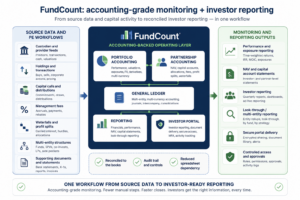
Quick verdict: FundCount is the strongest fit when the investor portal needs to live inside the same ecosystem that produces official books, capital statements, and reports. Its official pages say the portal lives inside the FundCount ecosystem so data flows from the accounting engine to investors without manual re-keying. It can publish NAV statements and documents straight from the reporting workflow, support personalized statements in bulk, and protect access with bank-grade encryption, MFA, and single-tenant deployment on private cloud or on-premises. FundCount’s private equity pages also emphasize contributions, distributions, waterfalls, capital call letters, and a custom-branded GP-LP website.
Best for
- PE/VC funds that need investor statements and portal views to reconcile back to the books.
- Teams handling capital calls, distributions, partnership accounting, or structured fund reporting.
- Managers who want a branded GP-LP portal without creating a separate investor data layer.
Standout capabilities
- The portal sits inside the FundCount ecosystem, so data flows from accounting to investors without manual re-keying.
- FundCount can publish NAV statements and documents directly from its reporting workflow.
- It supports batch uploads, batch invitations, bulk statement delivery, and structured data sharing.
- Branding controls include logo, colors, and a custom URL, with an optional approval workflow for compliance sign-off.
- Security positioning includes bank-grade encryption, MFA, and single-tenant deployment on private cloud or on-premises.
- The Private Equity package highlights support for equity, loan, convertible, and hybrid structures.
Pros
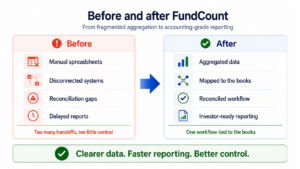
- Clear books-to-portal story.
- Strong fit when auditability matters as much as investor experience.
- Good option for CFO and finance-led buying decisions where reporting governance is the main pain point.
Integrations to verify
- CRM and fundraising handoffs.
- Permissions by fund, entity, investor class, and document type.
- Export paths for PDFs, spreadsheets, and downstream analytics.
- Deployment requirements if private cloud or on-premises control matters.
Pricing
- FundCount publicly lists Private Equity pricing starting from $34,899 / year, with digital transformation and hosting fees applying separately.
Questions to ask during the demo
- “Show one investor statement move from source transactions to approved report to portal delivery.”
- “Show how one corrected document is reissued without exposing the wrong version.”
- “Show branding changes, access controls, and approval settings in the same workflow.”
- “Show how capital calls, distributions, and partnership reporting feed the final investor view.”
Deliver PE statements faster and more consistently
FundCount helps teams streamline reporting and distribute it through a secure portal each period.
Juniper Square: Best for PE/VC investor operations, onboarding, and LP experience
Quick verdict: Juniper Square is strongest when the portal is part of a connected investor-operations stack. Its private equity and venture capital pages position the platform around fundraising, onboarding, investor management, and fund administration, while the portal page highlights data rooms, subscriptions, documents, performance views, and investor profile updates in one secure environment. Juniper Square’s reporting, investor services, and AML/KYC pages extend that into automated investor reporting, onboarding support, K-1 dissemination, and connected compliance workflows.
Best for
- PE/VC firms that want portal, onboarding, reporting, and investor communications in one environment.
- IR teams that want visibility into LP engagement, not just document posting.
- Managers that want a shared system for IR, finance, compliance, and investor servicing.
Standout capabilities
- Investors can access data rooms, subscribe to funds, review documents, view performance, and update their information in one secure platform.
- IR and finance teams share portal, CRM, and reporting workflows in a single platform.
- Entities, transactions, documents, and updates can stay hidden until the GP chooses to publish.
- Permissioning tools control who can invite contacts, create and publish reports, manage transactions, and change portal settings.
- Reporting tools support automated capital calls, contribution and distribution notices, K-1 distribution, and personalized summaries.
- Investor services include portal configuration, onboarding support, asset data uploads, and K-1 dissemination.
- AML/KYC workflows support LP identification, sanctions screening, risk assessments, and connected data collection in the Juniper Square workspace.
- Security includes annual SOC 1 Type 2 and SOC 2 Type 2 assessments, encryption, 2FA for all end users, SSO for enterprise customers, role-based permissions, encrypted PDFs, and automatic audit logging.
Pros
- Strong fit when LP experience and investor operations matter as much as document delivery.
- Better visibility into engagement than many portal-only tools.
- Good governance story around publish controls and permissions.
Cons / trade-offs
- If books-to-statement reconciliation is the core buying criterion, validate exactly how official accounting data flows into reports and portal views.
- Evaluate software scope and service scope together if you expect Juniper Square to support onboarding, K-1s, or AML/KYC workflows.
Integrations to verify
- Accounting and reporting data flows into portal views.
- API and export requirements for your internal reporting stack.
- Permission design for IR, finance, compliance, and external service providers.
- AML/KYC and digital subscription workflows for your LP base.
Pricing
- Contact vendor.
Questions to ask during the demo
- “Show the full quarterly cycle from report generation to approval to publish to LP access.”
- “Show what stays hidden until publish, and who controls that.”
- “Show one onboarding flow with subscriptions and AML/KYC status visibility.”
- “Show engagement tracking for one LP and one reporting pack.”
Allvue: Best for a broader PE/VC suite with investor communications and portal workflows
Quick verdict: Allvue is strongest when the investor portal is one module inside a broader PE/VC software stack. Its private equity page says Allvue combines fund accounting, portfolio monitoring, and an out-of-the-box investor portal in one integrated offering. Its venture capital page positions the suite around accounting, portfolio monitoring, investor management, fundraising, and investor portal functionality for firms of different sizes, including Essentials packages for emerging managers. The investor portal page adds branding, automated report distribution, secure data management, configurable dashboards, and white-label controls.
Best for
- PE/VC managers that want portal functionality inside a broader stack that also covers accounting, monitoring, and investor relations.
- Emerging managers that want packaged PE or VC solutions without stitching together as many point tools.
- Firms that care about branded dashboards, secure document sharing, and automated investor communications.
Standout capabilities
- Allvue positions its PE software around fund accounting, portfolio monitoring, and an out-of-the-box investor portal in one integrated offering.
- Its VC suite includes accounting, portfolio monitoring, investor portal, fundraising, and investor management for firms of different sizes and strategies.
- The portal automates investor notice generation and report distribution, tailored to LP delivery preferences.
- Investors can securely manage banking details, FATCA information, financial documents, and communication preferences.
- GPs can track investor access and interactions, including document views, report requests, and commitments.
- Allvue supports highly configurable dashboards and white labeling with logos, colors, images, and content access controls.
- The VC and PE pages both position Allvue for managers that want integrated growth without adding as much headcount.
- Security materials highlight 24/7/365 monitoring, SOC 1 and SOC 2 Type I and Type II audits, and encryption of data at rest and in transit.
Pros
- Strong option if you want investor portal capabilities inside a wider PE/VC operating platform.
- Good fit for growing firms that expect to add more modules over time.
- Attractive for teams that want a branded LP experience without commissioning a custom build.
Cons / trade-offs
- Validate what is truly out of the box versus what needs configuration, services, or additional modules.
- The broader the suite, the more important it is to test data lineage and workflow governance across modules.
Integrations to verify
- Fund accounting to portal and reporting flow.
- Power BI, Excel, API, or broader Microsoft ecosystem requirements.
- Investor relations and fundraising handoffs.
- Content access controls and dashboard configuration limits.
Pricing
- Contact vendor.
Questions to ask during the demo
- “Show the investor portal pulling live data from accounting and monitoring, not just static uploads.”
- “Show how one LP sees a different dashboard and document set from another LP.”
- “Show automated notice distribution and communication preference controls.”
- “Show what an Essentials deployment includes versus what requires added modules or services.”
How to choose: decision tree
- If LP reports must reconcile to the books and you want portal publishing from the same reporting workflow, start with FundCount.
- If your top pain is onboarding, publish controls, KYC/AML, personalized reporting, and LP engagement in one platform, shortlist Juniper Square.
- If you want a broader PE/VC suite that combines fund accounting, monitoring, investor communications, and portal workflows, shortlist Allvue.
FAQs
What is investor portal software for PE/VC funds?
It is software that gives LPs self-service access to notices, reports, performance data, tax documents, and communications while giving GPs control over permissions, publishing, and investor-specific access. The stronger platforms also extend into onboarding, CRM, fundraising, or accounting-connected reporting.
What is the difference between an accounting-connected portal and an investor-operations-led portal?
An accounting-connected portal is designed to publish outputs from the same environment that maintains the books and produces investor statements. FundCount is the clearest example in this shortlist. An investor-operations-led portal puts more weight on onboarding, subscriptions, communications, reporting workflows, and investor servicing. Juniper Square is the clearest example there, while Allvue leans toward a broader suite model that combines portal capabilities with accounting, monitoring, and investor communication tools.
Which option is best if LP reports must reconcile to the books?
FundCount is the strongest fit in this shortlist for that use case because it explicitly ties investor delivery to the same accounting and reporting ecosystem that produces the statements.
Which option is best for onboarding, subscriptions, and compliance workflows?
Juniper Square is the strongest fit here. Its platform combines subscriptions, investor onboarding, AML/KYC workflows, investor services support, and connected reporting inside one environment.
Which option is best for emerging PE/VC managers that want a broader suite?
Allvue deserves a close look. Its PE Essentials and VC Essentials positioning is explicitly aimed at emerging managers that want accounting, reporting, and investor communication tools in a more integrated stack.
Can these platforms handle capital calls, distributions, and tax documents?
Yes, but the depth varies. FundCount highlights capital call letters, capital statements, contributions, distributions, and partnership outputs. Juniper Square highlights automated capital call and distribution notices plus K-1 delivery. Allvue emphasizes automated investor notices, secure financial document handling, and automated report distribution tied to LP preferences.
What should vendors show in a live demo?
Use a repeatable script: generate or upload one reporting pack, permission one LP group, publish the pack, show what the investor sees, replace a corrected document, and then review the audit or publish trail. After that, make the vendor show the source system connection behind the portal view. That is how you separate a polished frontend from a controlled investor workflow.
Methodology and last updated
How this list was built
- Focus: Platforms commonly short-listed by PE/VC funds where portal delivery intersects with reporting, onboarding, investor operations, or broader fund software needs.
- Evaluation lens: Source-of-truth clarity, publishing controls, LP experience, PE/VC workflow coverage, security posture, and integration fit.
- Why only three: The goal is shortlisting, not a full market map. These three represent three common buying patterns: accounting-connected portal publishing, investor-ops-led portal strategy, and suite-led portal strategy.
- Sources: Current official product, security, and pricing pages for FundCount, Juniper Square, and Allvue.
Last updated: April 22, 2026.