Private equity partnership accounting software is the system-of-record layer that handles contributions, distributions, allocations, waterfalls, investor-level books and records, and the official statements that come out of them. FundCount, Allvue, and SS&C TNR all position their products around that accounting core, even though they differ in how broad the surrounding platform becomes.
This category is narrower than generic “private equity software.” The focus here is not CRM, sourcing, or KPI monitoring. It is the accounting engine that keeps capital activity, investor balances, general ledger activity, and final reporting aligned. Most PE firms still use a stack, but the partnership-accounting layer is usually where official books, capital statements, and close outputs must reconcile.
Key takeaways
- Most PE firms do not buy one system for everything, but partnership accounting is usually the source-of-truth layer for capital activity, allocations, and official investor statements.
- Start with FundCount if your priority is partnership accounting tied to a real-time general ledger, customizable capital statements, and investor delivery from the same workflow.
- Shortlist Allvue Fund Accounting if you want a cloud-based PE accounting core with a true general ledger, automated carried-interest waterfall calculations, investor-level books and records, and management company accounting integration.
- Shortlist SS&C TNR Solution if you want a broader private-markets platform with partnership accounting, investor reporting, CRM-style investor relations modules, and support for complex structures such as SPVs, blockers, and master-feeder funds.
- Treat auditability as a live demo requirement: reruns, corrected statements, allocation traceability, and drill-through from report to underlying activity should all be demonstrated, not assumed.
Best for (quick shortlist)
- FundCount: Best for accounting-grade partnership accounting plus reporting and investor delivery from one ecosystem.
- Allvue Fund Accounting: Best for cloud-based PE fund accounting with a true general ledger, automated waterfalls, and investor-level books and records.
- SS&C TNR Solution: Best for firms that want a single book of record across complex private investment structures, plus investor reporting and portal access.
Quick comparison table
| Platform | Best for | What it’s strongest at | Category focus | Partnership accounting depth* | Waterfalls + allocations* | Investor reporting / statements* |
| FundCount | PE firms that want accounting, reporting, and investor delivery tied together | GL-backed partnership accounting, capital statements, portal publishing | Accounting-first PE core | Strong | Strong | Strong |
| Allvue Fund Accounting | Firms that want cloud-based PE accounting with broader back-office standardization | True general ledger, investor-level books and records, carried-interest waterfalls | Cloud PE fund accounting | Medium | Strong | Strong |
| SS&C TNR Solution | Firms that want a broader private-markets operating platform | Single book of record, complex structures, investor reporting, portal access | Front-to-back private-markets platform | Medium | Medium to Strong | Strong |
* “Strong / Medium / Varies” are editorial shorthand to speed up shortlisting. They are not lab-tested scores, and they should be validated in live demos.
Table basis: FundCount’s partnership accounting materials explicitly reference NAV, waterfall structures, contributions, distributions, series of shares, P&L allocations, investor data import, a real-time general ledger, and customizable capital statements. Allvue’s fund accounting materials explicitly reference a true general ledger, partnership accounting, a multi-currency general ledger, investor-level books and records, automated carried-interest waterfall calculations, and quarter-end reporting. SS&C’s TNR materials explicitly reference a single book of record, partnership accounting, investor capital balances, investor reporting, portal access, and support for structures such as master-feeders, blockers, holding companies, SPVs, and AIVs.
One platform for PE accounting, reporting, and investor portal
Consolidate accounting, reporting, and investor delivery into a single source of truth with FundCount.
What is private equity partnership accounting software?
Private equity partnership accounting software is the accounting layer that manages fund and investor capital activity over the life of the fund. That includes contributions, distributions, allocations, waterfall logic, investor-level books and records, and the capital statements and financial reports that need to come out of the close. FundCount and Allvue describe that scope directly, and SS&C TNR frames it as part of a broader single book of record for private investment operations.
A good way to separate this category from broader PE software is to ask where the official numbers live. If the answer is “in the partnership-accounting engine,” then you are in the right category. If the answer is “somewhere in a reporting layer” or “across multiple spreadsheets,” then the firm still has an unresolved accounting core problem.
Why it matters in 2026
Private equity operations keep getting more complex at the entity and investor level. FundCount explicitly highlights unit, series, and equalization frameworks, waterfall calculations, call allocations, and investor specific capital call letters and statements. Allvue highlights fund- and investor-level books and records, investor transfer workflows, and management company accounting integration. SS&C TNR highlights complex multi-level structures such as master-feeders, blockers, holding companies, SPVs, and AIVs, plus investor reporting and portal access. That is why partnership accounting still matters so much: the hard part is not only producing a report, it is keeping the books and the investor records aligned across complexity.
There is also a control reason. Once firms have to rerun statements, explain allocation outcomes, or prove how a distribution moved through the books, weak accounting cores become obvious. All three platforms in this shortlist position themselves around official books-and-records workflows rather than only summary dashboards, which is why they belong in a partnership accounting comparison.
Must-have features checklist
1) Capital activity and investor accounting
Look for explicit support for contributions, distributions, transfers, investor-level books and records, and final investor statements. FundCount directly references contributions, distributions, series of shares, investor data import, and capital statements. Allvue directly references fund- and investor-level books and records plus investor-transfer workflow. SS&C TNR directly references investor capital balances, investor relations modules, and portal delivery of partner capital statements.
2) Allocations, waterfalls, and partnership logic
The system should handle profit-and-loss allocations, waterfalls, and the partnership logic your actual agreements require. FundCount explicitly calls out waterfall structures and P&L allocations, while Allvue explicitly calls out automated carried-interest waterfall calculations. If a vendor cannot show the calculation path in the demo, assume the “automation” still depends on spreadsheet shadow work.
3) Accounting core and multi-entity controls
Require a true general ledger, support for funds plus related entities, and, where relevant, multi-currency handling. Allvue explicitly says it provides a true general ledger and a multi-currency general ledger. FundCount explicitly says partnership accounting is integrated with a real-time general ledger. SS&C TNR explicitly says it fuses fund, investment, and investor general ledger functionality and supports complex structures such as master-feeders, blockers, SPVs, and AIVs.
4) Reporting outputs and investor delivery
The software should produce capital statements, financial reports, and investor-facing outputs without rebuilding them outside the accounting engine. FundCount explicitly positions customizable capital statements and performance reports plus an investor portal integrated with CRM and LP access. Allvue explicitly positions quarter-end reporting support and investor reporting from fund accounting. SS&C TNR explicitly positions standard reports, dynamic dashboards, report writers, and a web-enabled investor portal where LPs can download capital call notices, distribution notices, K-1s, and partner capital statements.
5) Governance, approvals, and reruns
The strongest products preserve history, support reruns after corrected inputs, and make it possible to explain how a statement changed. Current public materials vary in how directly they spell this out, so make reruns, corrected statements, and allocation restatements a non-negotiable demo requirement. This is where many firms discover whether a platform is truly a system of record or only a partial workflow layer.
6) Integrations and extensibility
Private equity accounting rarely lives alone. FundCount explicitly ties partnership accounting to portfolio accounting, general ledger, reporting, investor portal, and capital-call functionality. Allvue emphasizes an API ecosystem, broader back-office integration, and management-company accounting links. SS&C TNR positions itself as modular, with investor relations, CRM, reporting, and portal functionality inside the same broader platform. In practice, buyers should verify where the source of truth lives and where data crosses system boundaries.
Top 3 private equity partnership accounting software options (ranked)
FundCount: Best for accounting-grade partnership accounting tied to reporting and investor delivery
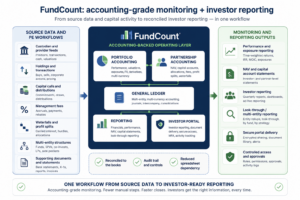
Quick verdict: FundCount is the strongest fit when partnership accounting needs to stay inside an accounting and reporting ecosystem. Its materials describe partnership accounting that handles single- and multi-class partnerships, NAV, waterfalls, contributions, distributions, series of shares, investor data import, and P&L allocations, all tied to a real-time general ledger and customizable capital statements. The private equity product materials extend that with capital call functionality, call allocations, automatic management fee calculations, profit split tracking, and portal-connected investor communications.
Best for
- PE firms that want partnership accounting, reporting, and investor delivery tied to one core system.
- Teams with complex allocation, waterfall, and capital call workflows that want fewer spreadsheets.
- Organizations that want a portal-connected reporting workflow, not only a back-office ledger.
Standout capabilities (testable)
- Manages accounting and reporting for single- and multi-class partnerships.
- Calculates NAV, tracks waterfall structures, and handles contributions, distributions, and series of shares.
- Imports investor data, accelerates P&L allocations, and streamlines workflows from data input to NAV calculation.
- Combines portfolio accounting and partnership accounting in one system, integrated with a real-time general ledger.
- Generates customizable capital statements and performance reports.
- Supports call allocations, capital-call letters and statements, profit-split tracking, and automatic management-fee calculations in the broader PE workflow.
- Integrates CRM and investor portal access for GP-LP communication and secure data sharing.
Pros
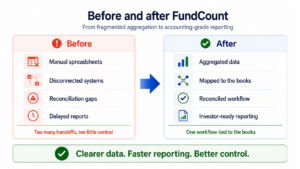
- The clearest accounting-first control layer in this comparison.
- Strong linkage between partnership accounting and investor-facing outputs.
- Public PE pricing gives buyers a visible starting point for scoping.
Integrations to verify
- How CRM, investor portal, and reporting share a single source of truth.
- How multi-entity and unit/series/equalization structures are configured in your exact fund model.
- BI, Excel, and downstream export path for LP reporting and finance workflows.
- How corrected capital activity flows into revised statements without losing history.
Pricing
FundCount’s current PE pricing page lists a published starting point of $34,899 / year, with digital transformation and hosting fees applying separately.
Questions to ask during the demo
- Show one capital call workflow from allocation to final letter and investor statement.
- Show one waterfall or P&L allocation calculation and explain how it is audited.
- Show a fund plus SPV or blocker example and how the roll-up works.
- Show how a corrected investor activity item affects statements and preserved history.
- Show the portal publishing workflow for final statements and permissions.
Make private equity operations easier to scale
Standardize accounting workflows across funds and SPVs with FundCount as your back-office core.
Allvue Fund Accounting: Best for cloud-based PE fund accounting with a true general ledger and automated waterfalls
Quick verdict: Allvue is the strongest fit when you want a cloud-based PE fund-accounting core with a true general ledger, investor-level books and records, automated carried-interest waterfalls, and management-company accounting integration. Its current fund-accounting materials position it squarely around private-equity fund structures, detailed financial reporting, workflow standardization, and quarter-end investor reporting.
Best for
- Firms that want cloud-based PE fund accounting with a true general ledger at the center.
- Teams that need investor-level books and records plus investor-transfer workflow support.
- Buyers who want management company accounting or debt subledger integration alongside the fund books.
Standout capabilities (testable)
- Cloud-based private equity fund accounting software built to manage complex fund structures and financial reporting requirements.
- Automated carried-interest waterfall calculations.
- Integration of fund books and records with management company accounting or a debt sub ledger.
- A true general ledger with a robust library of financial reports and a flexible report writer.
- Partnership accounting, detailed financial statement reporting, a multi-currency general ledger, cash management, and workflow standardization in one system.
- Fund- and investor-level books and records, investor-transfer workflow support, and automated close across multiple funds.
- Positioning around reducing the quarter-end reporting cycle and delivering timely, presentation-quality reports to investors.
Pros
- Very strong fit for buyers who want a standardized cloud PE accounting core.
- Explicit waterfall support is a major plus for this category.
- Good fit when management-company accounting needs to connect directly to fund accounting.
Cons / trade-offs
- Suite-oriented products can feel heavier if you only need a tight partnership accounting layer.
- Public pricing is not listed, so commercial fit and scope need direct validation.
Integrations to verify
- Management company and debt subledger integration path.
- API and data-platform approach for reporting and BI.
- Security controls and evidence behind SOC1 / SOC2 alignment claims.
- How investor reports or statements move to any portal or investor-communications layer.
Pricing
Editorial assessment: current public materials appear quote-based.
Questions to ask during the demo
- Show one carried-interest waterfall from source activity to investor-facing output.
- Show investor-level books and records for one investor transfer event.
- Show a close process across multiple funds with preserved history.
- Show management-company accounting integration in a real workflow.
- Show how quarter-end reporting is produced and delivered.
SS&C TNR Solution: Best for firms that want a broader private-markets operating platform with partnership accounting inside it
Quick verdict: SS&C TNR Solution is the broadest product in this shortlist. Current SS&C materials position it as an integrated, front-to-back platform for private-equity and real-asset fund operations, data management, investor reporting, partnership accounting, CRM-style investor relations, fundraising, and portal access. That makes it a strong option when you want partnership accounting inside a broader operating platform, not as a narrow accounting-only tool.
Best for
- Firms that want a single book of record across complex private-investment structures.
- Teams that want partnership accounting plus investor reporting and investor-relations workflows.
- Buyers who need support for master-feeders, blockers, holding companies, SPVs, and AIVs.
Standout capabilities (testable)
- Fuses fund, investment, and investor general ledger functionality into one platform with portfolio management, partnership accounting, and CRM functionality.
- Creates a single book of record across closed-ended, open-ended, and hybrid structures.
- Supports complex structures including master-feeder funds, blockers, holding companies, SPVs, and AIVs.
- Fund-raising and investor-relations modules track investor capital balances and correspondence preferences.
- Comprehensive reporting through standard reports, dynamic dashboards, and report writers.
- Web-enabled investor portal that gives LPs access to account information and documents such as capital call notices, distribution notices, K-1s, and partner capital statements.
Pros
- Strongest breadth in the list.
- Good fit when accounting, investor reporting, and investor-relations workflows need to live close together.
- Particularly relevant for firms with complex private-market structures.
Cons / trade-offs
- If you mainly want a tight partnership-accounting engine with less platform sprawl, FundCount or Allvue may feel more focused.
- Some supporting public materials for TNR are terse, so buyers should insist on a detailed workflow demo rather than rely on broad positioning language alone.
Integrations to verify
- How CRM-style investor relations modules share the same source of truth as accounting.
- How portal-delivered notices and partner capital statements are generated and archived.
- BI, Excel, and report-writer exports.
- Multi-entity configuration and rerun behavior after corrected activity.
Pricing
Editorial assessment: current public materials appear quote-based.
Questions to ask during the demo
- Show one capital call or distribution notice flowing from books to portal delivery.
- Show one investor capital-balance workflow and statement output.
- Show a master-feeder or fund-plus-SPV structure and how accounting rolls up.
- Show how a corrected capital statement is rerun with preserved history.
- Show where partnership accounting stops and where broader CRM or IR workflows begin.
How to choose: decision tree
If your first priority is accounting-grade partnership accounting tied to a real-time GL, with reporting and investor delivery from the same workflow, start with FundCount. That is the clearest accounting-first control layer in this comparison.
If your first priority is cloud-based PE fund accounting with a true GL, automated waterfalls, and integrated management-company accounting, start with Allvue Fund Accounting.
If your first priority is a single book of record across complex private-investment structures with broader front-to-back coverage, start with SS&C TNR Solution.
If you also need CRM, portfolio monitoring, or deal-team workflows, assume you are evaluating a stack, not one universal platform. That is usually the more honest buying frame in private equity software.
FAQs
What is private equity partnership accounting software?
It is the accounting core that manages investor capital activity, allocations, waterfalls, and the official statements that come out of the close. In demos, ask vendors to show where the source of truth lives for investor balances and statements, not just where the report is rendered.
What is the difference between partnership accounting software and private equity fund accounting software?
They overlap heavily, but partnership accounting is the part of fund accounting that focuses on capital activity, allocations, investor balances, and partnership-style logic. Fund accounting may also include broader financial reporting, entity accounting, cash management, or management company accounting. In demos, ask which workflows are core and which are adjacent.
What should a PE CFO look for in partnership accounting software?
Start with the ledger, investor books and records, waterfalls, statements, and rerun controls. Then validate multi-entity handling, close workflow, and how investor-facing outputs are delivered. A dashboard without this accounting core will not solve the hardest operational problems.
How do these platforms handle capital calls and distributions?
FundCount explicitly positions call allocations, capital-call letters and statements, contributions, and distributions as core workflows. SS&C TNR explicitly references capital call and distribution notices in its investor portal. Allvue’s fund-accounting positioning is broader, but it clearly emphasizes investor-level records and close workflows. In demos, require a capital-call-to-statement walkthrough.
How do private equity accounting platforms support waterfalls and carried interest calculations?
FundCount explicitly references waterfall structures, and Allvue explicitly references automated carried-interest waterfall calculations. The practical difference is not only whether the product supports waterfalls, but whether the vendor can explain and rerun the math with your own fund logic.
What is the role of a general ledger in PE partnership accounting?
The GL is what makes the accounting system official. It ties investor activity, entity-level accounting, and financial reporting together. FundCount explicitly ties partnership accounting to a real-time general ledger, Allvue explicitly says it has a true general ledger, and SS&C TNR explicitly says it fuses fund, investment, and investor GL functionality.
Can these platforms support multi-entity structures like SPVs, blockers, and management companies?
Yes, but scope differs. Allvue explicitly references management company accounting integration, while SS&C TNR explicitly references master feeders, blockers, holding companies, SPVs, and AIVs. FundCount’s broader PE materials emphasize multi-entity allocations and capital-call workflows across entities. Ask each vendor to show your real structure, not a simplified example.
How do these tools generate investor statements and capital account reports?
FundCount explicitly references customizable capital statements and investor portal delivery. Allvue explicitly positions its fund-accounting system around investor-level books and records and investor reporting. SS&C TNR explicitly references partner capital statements, capital call notices, distribution notices, and portal access. In demos, ask to see both the statement creation workflow and the delivery workflow.
What audit-trail and approval controls should partnership accounting software include?
At minimum: preserved history, rerun capability, role-based permissions, and a clear trail from a statement back to the underlying activity. Current public materials vary in how deeply they spell this out, so buyers should require a corrected-statement demo and not assume the controls are there.
How do these platforms handle reruns, restatements, or corrected statements?
The system should preserve the original history, reflect the correction, and make the revised statement reproducible. This is precisely the type of workflow that reveals whether the software is truly acting as a system of record. Ask for one late correction and one restated investor statement in every demo.
What integrations matter most for PE partnership accounting software?
Usually: CRM, investor portal, management company accounting, reporting tools, and any BI or Excel workflow the finance team still depends on. The important question is not only whether the integration exists, but which system remains the source of truth after the handoff.
Can partnership accounting software support tax and K-1 workflows?
Yes, at least in this shortlist. FundCount explicitly references IRS-approved partnership tax accounting and K-1 generation, and SS&C TNR explicitly references K-1 delivery in its portal materials. If tax outputs matter to you, ask the vendor to show the workflow instead of treating it as a checkbox.
How should firms evaluate security and permissions in PE accounting software?
Start with role-based access, approval paths, and how investor-facing outputs are permissioned. If a portal is part of the workflow, ask how corrected statements, archived statements, and investor-specific access are controlled. Security becomes operationally meaningful only when it is tied to actual report and statement workflows.
What should I ask vendors to demonstrate in a partnership accounting software demo?
Use one repeatable script: capital call, distribution, allocation or waterfall, investor statement, corrected rerun, and one multi-entity structure. If the vendor cannot show the end-to-end workflow with your actual fund complexity, assume manual work is still hiding somewhere.
Methodology and last updated
How this list was built
This is a narrow shortlist for private equity partnership accounting, not a generic private equity software list. The focus is specifically on products that position themselves around partnership accounting, investor accounting, general ledger backed workflows, and official investor reporting, rather than CRM or monitoring-first tools.
Evaluation criteria
The comparison prioritized partnership-accounting depth, allocations and waterfalls, investor reporting, multi-entity controls, auditability, and integration clarity. That is why FundCount ranks highest for accounting-first control, Allvue ranks highly for a cloud PE accounting core with waterfall support, and SS&C TNR ranks highly for breadth across complex private-markets structures.
Sources
This article relies mainly on current official product pages and pricing pages from FundCount, Allvue, and SS&C.
Last updated: May 24, 2026