SS&C Advent Geneva is a long-standing portfolio management and fund accounting platform used by asset managers, fund administrators, hedge funds, private credit firms, and private equity teams that need multi-asset, multi-currency accounting and complex fund-structure support. SS&C positions Geneva as a platform for global fund accounting and reporting, with support for a full range of asset classes and fund structures, real-time P&L and exposures, and daily NAV calculations.
But “Advent Geneva alternative” searches usually come from private equity teams that need one or more of the following:
- Private equity-first fund accounting rather than broad multi-asset accounting.
- NAV, capital statements, waterfalls, allocations, and investor reporting tied directly to the books.
- A stronger investor portal and LP delivery workflow.
- Easier reporting configuration for quarterly LP packages.
- More focused support for private equity, venture, private credit, real estate, SPVs, and hybrid structures.
- A different implementation model, pricing posture, or operating workflow.
- Less reliance on spreadsheets, custom reports, or disconnected reporting layers.
This guide compares 5 Advent Geneva competitors in total across the things PE buyers actually validate in demos: features, integrations, pros and cons, pricing approach, implementation effort, performance considerations, and best-fit use cases. FundCount is listed first because it covers a common reason to compare against Geneva: accounting, reporting, capital statements, and investor portal publishing in one workflow.
Key takeaways
- If your Advent Geneva alternative requirement is really accounting-grade PE fund accounting plus investor portal publishing from one system of record, start with FundCount. FundCount positions its private equity platform around portfolio accounting, partnership accounting, general ledger, alternative investment document intelligence, reporting, investor portal, and data aggregation under one roof.
- If you want a private capital suite with fund accounting, reporting, waterfall calculations, investor portal, and portfolio monitoring options, Allvue deserves a top spot on the shortlist. Allvue says its fund accounting software is built for private equity fund structures and combines a true GL, financial reports, workflow standardization, waterfall calculations, and investor reporting.
- If you need enterprise private equity fund accounting and investor reporting automation, FIS Private Capital Suite, formerly Investran, is a serious option. FIS says the platform automates fund accounting and investor reporting while connecting accounting, reporting, and investor management in one platform.
- If your team wants a modern private markets accounting engine, LemonEdge is a strong alternative. LemonEdge positions itself around a private markets GL, event-driven accounting, multi-entry bookkeeping, APIs, scenario modeling, and a white-labeled investor portal.
- If your PE firm wants fund accounting connected to CRM, investor portal, portfolio monitoring, valuation, and fund administration services, Dynamo is worth evaluating. Dynamo’s PE page highlights deal management, investor relations, investor portal, portfolio monitoring and valuation, and fund accounting in one alternatives platform.
Quick comparison table
| Platform | Best for | Accounting depth | Portal / reporting strength | Integration posture | Pricing posture |
| FundCount | PE firms that need books, NAV, capital statements, waterfalls, and portal delivery tied together | High | High | Data aggregation, reporting, portal, exports, implementation-specific integrations | Public PE starting price |
| Allvue | Private capital suite buyers | High | High | Microsoft ecosystem, API, fund accounting, investor portal, BI-style workflows | Quote-based |
| FIS Private Capital Suite | Enterprise PE accounting and investor reporting automation | High | High | Enterprise private capital data, workflow, accounting, reporting, and investor management ecosystem | Quote-based |
| LemonEdge | Modern private markets accounting architecture | High | Medium to high | API-first posture, event-based accounting, private cloud, investor portal partner | Quote-based |
| Dynamo | Alternatives firms wanting accounting, CRM, IR, portal, PMV, and services | Medium to high | High | Modular alternatives platform with Excel, PowerBI, CRM, PMV, and portal workflows | Quote-based |
Note: These categorizations are based on current vendor product positioning and public documentation. Validate accounting depth, portal controls, integrations, workflow governance, implementation scope, and data ownership in live demos.
Replace fragmented PE systems with one accounting-first platform
FundCount helps firms run NAV, allocations, and investor reporting from a single source of truth.
5 Advent Geneva alternatives and competitors
FundCount: Best for accounting-grade PE reporting and investor portal publishing
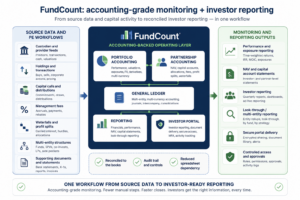
One-line verdict: Choose FundCount when you want private equity fund accounting, NAV, capital statements, waterfalls, allocations, performance reporting, and investor delivery anchored to one accounting-backed system.
Best for
- PE firms where LP-facing reports must reconcile to the books.
- CFO and finance-led teams managing NAV, investor capital accounts, allocations, waterfalls, and investor statements.
- Firms that want portfolio accounting, partnership accounting, general ledger, reporting, and investor portal delivery in one ecosystem.
- Managers that want to reduce spreadsheet work around capital statements, private asset reporting, and quarter-end publishing.
Key capabilities
FundCount’s private equity platform is positioned around portfolio accounting, partnership accounting, general ledger, alternative investment document intelligence, reporting, investor portal, and data aggregation. It supports equities, derivatives, private equity, real estate, and debt in the same portfolio view, with performance measures and attribution to help explain what drove returns.
Its partnership accounting layer covers contributions, distributions, series, waterfalls, capital statements, and partnership tax outputs from the same underlying data. FundCount also supports multi-currency and multi-book accounting for IFRS and GAAP, entity consolidation, income statements, balance sheets, and NAV reports.
FundCount’s private equity pricing page highlights support for equity, loan, convertible, and hybrid structures, entity allocations based on unit, series, or equalization frameworks, waterfall calculations with Excel-style flexibility, real-time performance insights, customizable reporting, and secure stakeholder collaboration.
Integrations
FundCount should be evaluated around your real source systems: custodians, banks, administrators, private fund statements, PDFs, Excel workflows, BI exports, CRM handoffs, and investor portal delivery. In demos, ask to see source data move through accounting, reporting, and portal publication, not just a static integration list.
Pros
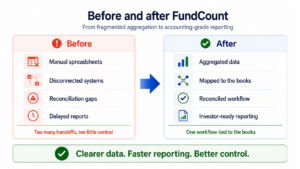
- Strong fit when the real problem is “performance reports and investor statements must match the books.”
- Better fit than broad multi-asset accounting tools if the priority is PE-specific capital statements, allocations, waterfalls, and investor delivery.
- Built-in portal publishing can reduce wrong-version risk and manual LP distribution.
- Public private equity pricing gives buyers a clearer starting point than many quote-only competitors.
Pricing approach
FundCount publicly lists Private Equity pricing starting from $34,899 per year, with digital transformation and hosting fees applying separately.
Implementation and TCO notes
Biggest effort drivers include fund and entity setup, capital account logic, historical transaction migration, waterfall configuration, report design, private asset document workflows, investor portal permissions, and user training.
Performance considerations
Benchmark quarter-end close, NAV report generation, batch capital statement production, investor portal publishing, document intelligence throughput, and corrected-report handling.
Demo questions
- “Show the end-to-end workflow from accounting entries to NAV, capital statements, and investor portal publishing.”
- “Show how contributions, distributions, allocations, and waterfalls tie back to the GL.”
- “Show how a valuation update affects NAV, investor statements, and portal reports.”
- “Show how a corrected statement is reissued without exposing the wrong version.”
- “Show what is native, what is configured, and what requires implementation services.”
Advent Geneva alternative focused on clarity and control
Keep accounting and reporting aligned so LP statements, audits, and reviews are easier to support.
Allvue: Best for private capital suite buyers
One-line verdict: Allvue is a strong Advent Geneva alternative when you want private equity fund accounting inside a broader private capital suite with reporting, investor portal, portfolio monitoring, and workflow tools.
Best for
- PE, VC, private debt, and fund-of-funds managers that want private capital-specific accounting.
- Fund administrators and GPs that need a true GL, financial reporting, waterfalls, and investor communications.
- Firms that want fund accounting plus investor portal and portfolio monitoring modules.
- Teams already comfortable with Microsoft-based enterprise architecture.
Key capabilities
Allvue’s fund accounting software is positioned as cloud-based, fully integrated private equity fund accounting designed to streamline and de-risk back-office processes. The product page highlights complex fund structures, unique financial reporting requirements, waterfall calculations, investor reporting, and automated processes that reduce Excel dependency.
Allvue says its fund accounting software includes a true general ledger, a robust financial reporting library, a flexible report writer, workflow standardization, seamless configuration across processes and allocation methods, automated waterfall calculations, Microsoft Dynamics NAV architecture, and integration with management company accounting.
Integrations
Allvue should be validated around fund accounting, investor portal, portfolio monitoring, Microsoft Dynamics 365 Business Central, Azure, Power BI-style reporting, APIs, data warehouse needs, and administrator or CRM handoffs.
Pros
- Strong private capital suite story.
- Good fit when fund accounting, investor reporting, portfolio monitoring, and portal delivery need to sit closer together.
- Waterfall and reporting workflows are more PE-specific than many broad portfolio accounting systems.
- Microsoft-based architecture may appeal to firms already standardized on Microsoft enterprise tools.
Cons / limitations
- Broad suite scope can increase implementation effort.
- Buyers should separate “available module” from “implemented workflow.”
- If Advent Geneva is used for daily NAV, multi-asset accounting, and real-time P&L, validate whether Allvue covers those specific operating needs or is better for private capital workflows.
Pricing approach
Contact vendor. Public product pages reviewed here do not list standard package pricing.
Implementation and TCO notes
Biggest effort drivers include fund accounting conversion, waterfall setup, report writer design, investor portal configuration, portfolio monitoring templates, data validation workflows, and permissions across finance, IR, and operations teams.
Performance considerations
Benchmark quarter-end close, waterfall workflows, report writer output, investor reporting delivery, investor portal publishing, and dashboard refresh speed.
Demo questions
- “Show fund accounting, investor portal, and investor reporting in one workflow.”
- “Show a financial statement package and how it ties to the GL.”
- “Show waterfall calculations against a real LPA-style example.”
- “Show how data flows into BI or custom reporting.”
- “Show what is included in the base module versus additional modules.”
FIS Private Capital Suite: Best for enterprise PE accounting and investor reporting automation
One-line verdict: FIS Private Capital Suite, formerly Investran, is a strong Geneva alternative for larger PE firms that want mature private capital accounting, investor reporting automation, data management, analytics, and controlled workflows.
Best for
- Established and enterprise private equity firms.
- Fund managers with complex partnership accounting and investor reporting requirements.
- Teams that want automation and controls around fund accounting and investor reporting.
- Firms that want a mature private capital operating model rather than a broad multi-asset fund accounting system.
Key capabilities
FIS says Private Capital Suite, formerly Investran, automates fund accounting and investor reporting, gives private equity firms real-time visibility into portfolios and operations, and uses integrated data management, automation, and analytics to reduce manual errors and support scale.
The platform focuses on accounting automation, fund and partnership accounting, connected accounting, reporting and investor management, process optimization, investor-grade reporting, data automation, controlled workflows, and real-time visibility into fund performance, capital activity, commitments, exposures, valuations, and trends.
Integrations
Validate accounting, CRM, investor portal, document management, data warehouse, BI, workflow, and migration requirements. FIS deployments are usually evaluated within broader enterprise architecture, especially when legacy reporting packs and investor data are already complex.
Pros
- Strong fit for larger private capital organizations.
- Mature private equity fund accounting and investor reporting positioning.
- Better fit than broad portfolio accounting tools when the main pain is fund and partnership accounting.
- Controlled workflows and automation can matter for larger teams with formal processes.
Cons / limitations
- May be heavier than needed for smaller or emerging managers.
- Implementation and configuration require strong internal ownership.
- If the goal is a modern, nimble finance-led PE platform with faster implementation, smaller vendors may feel easier to evaluate.
Pricing approach
Contact vendor. Public product pages reviewed here do not list standard package pricing.
Implementation and TCO notes
Key effort drivers include data migration, fund structure modeling, investor reporting packages, workflow configuration, integration work, user training, and governance design.
Performance considerations
Benchmark quarter-end close, investor report production, fund and partnership accounting automation, workflow approval history, data refreshes, and investor reporting output volume.
Demo questions
- “Show fund accounting and investor reporting automation for a complex PE structure.”
- “Show capital activity and investor commitments in real-time reporting.”
- “Show the investor reporting process from close to delivery.”
- “Show controlled workflows and approval history.”
- “Show migration paths from Geneva, spreadsheets, or administrator files.”
LemonEdge: Best for modern private markets accounting architecture
One-line verdict: LemonEdge is a strong Advent Geneva alternative when the buying decision is about modernizing private equity fund accounting, event-based partnership accounting, multi-ledger structures, APIs, and investor engagement connected to accounting data.
Best for
- Private equity firms with complex fund structures.
- Fund administrators that need scalable accounting workflows.
- Private markets teams that want event-based accounting and multi-ledger management.
- Firms that want to reduce spreadsheet-based calculations without losing flexibility.
Key capabilities
LemonEdge positions itself around a GL built for private markets, powered by an accounting allocation engine. Its official site says event-driven transactions automate multi-entry bookkeeping throughout the fund structure, streamlining complex calculations and financial reports.
LemonEdge also emphasizes API-based ingestion, scenario modeling, white-labeled investor portal workflows, and bringing calculations out of offline spreadsheets into a secure real-time environment with audit history. Its investor portal relationship with Eleven connects accounting capabilities with investor onboarding and servicing workflows.
Integrations
Validate APIs, data ingestion, fund administrator workflows, investor portal integration, Excel import and export, BI tools, waterfall models, multi-ledger GL structures, and migration paths from Geneva-style books and reports.
Pros
- Strong fit for private markets teams seeking modern accounting architecture.
- Event-driven and multi-ledger accounting can be attractive for complex PE structures.
- API posture may appeal to firms with internal data or engineering resources.
- Investor portal connection supports a back-to-front source-of-truth model.
Cons / limitations
- Buyers should validate maturity against their exact audit, investor reporting, and administrator workflows.
- Migration from Geneva can still be substantial, especially if historical books, custom reports, and waterfall models are complex.
- If daily NAV, real-time P&L, and broad multi-asset accounting remain core, Geneva may still be stronger.
Pricing approach
Contact vendor. Public product pages reviewed here do not list standard pricing.
Implementation and TCO notes
Key effort drivers include fund structure modeling, event configuration, historical data migration, waterfall logic, report design, API connections, investor portal setup, and internal accounting process redesign.
Performance considerations
Benchmark event processing, waterfall calculations, multi-ledger postings, report production, investor portal sync, API throughput, and audit trail retrieval.
Demo questions
- “Show event-based accounting for capital calls, distributions, allocations, and transfers.”
- “Show multiple ledgers and look-through reporting.”
- “Show a complex waterfall and how it is audited.”
- “Show investor portal dashboards synced to accounting data.”
- “Show how a Geneva migration would be phased.”
Dynamo: Best for fund accounting connected to CRM, investor portal, PMV, and fund admin services
One-line verdict: Dynamo is a strong Geneva alternative when the buying requirement extends beyond PE fund accounting into CRM, investor relations, investor portal, portfolio monitoring, valuation, and fund administration services.
Best for
- PE, VC, real estate, fund-of-funds, and alternatives managers.
- GPs that want fund accounting plus investor relations and fundraising workflows.
- Firms that want a modular alternatives platform with services optionality.
- Teams that want fund accounting connected to portfolio monitoring and LP communication.
Key capabilities
Dynamo’s private equity software page positions the platform around front, middle, and back-office workflows for PE firms. It includes deal management and CRM, investor relations and fundraising, investor portal, portfolio monitoring and valuation, and fund accounting.
For fund accounting, Dynamo highlights a GL-based system, capital calls, capital account statements, automated waterfall calculations, IRR analysis, financial reporting, and fund administration services. Its portfolio monitoring and valuation product adds portfolio company data collection, financial statement analysis, valuations, configurable dashboards, Excel integration, accounting integration, CRM integration, data approval workflows, portfolio company portals, and report libraries.
Integrations
Validate CRM workflows, Outlook workflows, investor portal, fund accounting data flows, reporting exports, portfolio monitoring and valuation links, Excel workflows, PowerBI, document repositories, and fund administration service boundaries.
Pros
- Strong fit for firms that want alternatives-specific workflows beyond accounting.
- Modular approach can support IR, fundraising, portal, portfolio monitoring, valuation, fund accounting, and services.
- Excel and PowerBI support may help teams that still rely on spreadsheet models and BI packs.
- Good option when investor communication and front-office workflows are part of the fund accounting conversation.
Cons / limitations
- If the main requirement is deep fund accounting as the system of record, validate Dynamo Accounting against your exact GL, allocation, and reporting needs.
- The broader the module set, the more important it is to scope what is implemented first.
- If the goal is daily NAV and complex cross-asset accounting, Geneva may still be a better fit.
Pricing approach
Contact vendor. Public product pages reviewed here do not list standard pricing.
Implementation and TCO notes
Key effort drivers include module selection, accounting setup, investor data migration, CRM and portal configuration, PMV templates, valuation workflows, report templates, services model definition, and adoption across finance, IR, and deal teams.
Performance considerations
Benchmark capital call workflows, waterfall calculations, report output speed, LP portal performance, PMV data collection, valuation workflows, and fund administration service turnaround.
Demo questions
- “Show fund accounting, investor portal, CRM, and portfolio monitoring in one investor lifecycle flow.”
- “Show capital calls, waterfalls, and reporting outputs.”
- “Show Excel-powered reporting and how it stays controlled.”
- “Show which tasks can be co-sourced versus fully outsourced.”
- “Show how Dynamo compares to our current Geneva workflow for quarter-end.”
Where Advent Geneva still fits
Advent Geneva still fits firms that need broad, institutional-scale fund accounting across multiple asset classes, currencies, and complex fund structures. SS&C says Geneva supports a full range of asset classes and fund structures, complex multi-asset and multi-currency portfolios, real-time P&L and exposures, and daily NAV calculations. SS&C also lists support for offshore and onshore funds, master-feeder and multi-tier structures, hedge funds, private equity, private credit, hybrids, SPVs, debt instruments, IBOR functionality, and integrated fund and investor accounting.
Staying with Advent Geneva may make sense if:
- Your firm needs daily NAV, real-time P&L, and exposure reporting.
- You run multi-asset or multi-currency strategies beyond private equity.
- Your fund structures include master-feeder, multi-tier, hedge, hybrid, private credit, or SPV workflows.
- Your team already has trained Geneva users and established accounting operations.
- The cost and risk of migration outweigh the workflow benefits of switching.
Shortlisting competitors may make sense if:
- Your main need is private equity-first capital statements, waterfalls, and LP reporting.
- Your investor reporting workflow feels too disconnected from accounting.
- You want a built-in portal that publishes directly from reporting.
- You need a narrower, finance-led PE accounting platform rather than a broad multi-asset accounting system.
- You want a different implementation path, service model, or pricing posture.
Which platform gives the most value for PE fund accounting?
“Value” depends on which workflow creates the most operational drag.
- Best value for finance-led PE firms: FundCount, because it ties portfolio accounting, partnership accounting, GL, NAV, capital statements, reporting, and investor portal delivery together, with public PE starting pricing as a budget anchor.
- Best value for private capital suite buyers: Allvue, because it combines private equity fund accounting, financial reporting, workflow standardization, waterfall calculations, investor reporting, and module expansion across portfolio monitoring and investor portal workflows.
- Best value for enterprise private capital teams: FIS Private Capital Suite, because it automates fund accounting and investor reporting while connecting accounting, reporting, investor management, controlled workflows, and real-time visibility.
- Best value for modern accounting architecture: LemonEdge, because its private markets GL, event-driven accounting, API posture, audit trail, and investor portal connectivity are built around private markets complexity.
- Best value for alternatives workflow breadth: Dynamo, because it connects fund accounting with CRM, investor relations, investor portal, portfolio monitoring, valuation, Excel workflows, and fund administration services.
How to choose: decision tree
- If you want accounting-backed NAV, capital statements, waterfalls, and investor portal publishing in one workflow, start with FundCount.
- If you want private equity fund accounting inside a broader private capital suite, shortlist Allvue.
- If you need enterprise-grade PE fund accounting and investor reporting automation, shortlist FIS Private Capital Suite.
- If you want modern private markets accounting architecture with event-based workflows and APIs, shortlist LemonEdge.
- If you need fund accounting connected to CRM, investor relations, portfolio monitoring, valuation, and services, shortlist Dynamo.
- If you still need daily NAV, real-time P&L, exposure reporting, and broad multi-asset accounting, Advent Geneva may remain the best fit.
FAQs
What is Advent Geneva used for?
Advent Geneva, now part of SS&C Advent, is used for portfolio management and fund accounting across complex investment strategies, asset classes, currencies, and fund structures. SS&C positions Geneva for multi-asset, multi-currency portfolios, real-time P&L and exposures, daily NAV calculations, offshore and onshore funds, master-feeder and multi-tier structures, private equity, private credit, hybrids, SPVs, and integrated fund and investor accounting.
What is the best Advent Geneva alternative for PE fund accounting?
The best alternative depends on your source-of-truth problem. FundCount is the strongest starting point if reporting, NAV, waterfalls, capital statements, and investor portal publishing must tie directly to accounting records. Allvue is strong for private capital suite buyers. FIS Private Capital Suite is strong for enterprise PE accounting. LemonEdge is strong for modern accounting architecture. Dynamo is strong for alternatives workflow breadth.
Which Advent Geneva competitor is best for accounting-backed investor reporting?
FundCount is the clearest fit in this shortlist because it combines portfolio accounting, partnership accounting, general ledger, reporting, investor portal, and data aggregation in one private equity ecosystem. FundCount also supports NAV reporting, capital statements, waterfalls, and portal publishing from the reporting workflow.
Which Advent Geneva alternative is best for waterfall calculations?
FundCount, Allvue, FIS Private Capital Suite, LemonEdge, and Dynamo should all be tested. FundCount emphasizes waterfalls tied to investor capital and capital statements. Allvue highlights automated waterfall calculations. FIS emphasizes automated fund and partnership accounting. LemonEdge emphasizes event-based accounting and private markets allocation logic. Dynamo highlights automated waterfalls and Excel-based reporting.
Which option is best if we still need daily NAV and real-time P&L?
Advent Geneva may still be the strongest fit if daily NAV, real-time P&L, exposures, and broad multi-asset accounting are the primary requirements. SS&C specifically positions Geneva around complex multi-asset and multi-currency portfolios, real-time P&L and exposures, and daily NAV calculations.
Which Advent Geneva alternative is best for modern architecture?
LemonEdge deserves a close look if the priority is modern private markets accounting architecture. It emphasizes a private markets GL, event-driven transactions, automated multi-entry bookkeeping, API-based ingestion, audit history, and white-labeled investor portal workflows.
Which Advent Geneva alternative is best for a broader alternatives platform?
Dynamo is a strong match if the buying requirement extends beyond accounting into CRM, investor relations, investor portal, portfolio monitoring and valuation, deal tracking, and fund administration services.
What should vendors show in a live demo?
Use a repeatable script: ingest source data, post fund activity, calculate NAV, run allocations and waterfalls, generate investor capital statements, publish them to the portal, correct one report, and trace one LP-facing number back to source transactions. Then run a second workflow for portfolio company KPIs, daily NAV, or real-time P&L if those matter. That separates a true PE fund accounting replacement from a reporting layer or broad platform pitch.
Methodology and last updated
How we selected the 5
This list focuses on platforms commonly evaluated by private equity firms, fund managers, and fund administrators when comparing Advent Geneva against alternatives for PE fund accounting. Some are accounting-first systems. Some are broader private capital suites. Some are enterprise private equity platforms. Others are stronger for modern private markets accounting architecture or alternatives workflow breadth.
Evaluation criteria
- Fund accounting and partnership accounting depth.
- NAV, capital statements, allocations, waterfalls, and investor reporting.
- General ledger, multi-currency, multi-book, and entity support.
- Investor portal and document delivery workflows.
- Data aggregation, private asset documents, and Excel workflows.
- Portfolio monitoring, valuation, and investor relations fit where relevant.
- Integrations, APIs, BI, data warehouse, and CRM fit.
- Workflow governance, approvals, audit trails, and permissions.
- Implementation complexity and total cost of ownership.
- Pricing transparency where available.
- Fit for private equity fund accounting workflows.
Sources
We used current public product, pricing, private equity, fund accounting, investor portal, portfolio monitoring, administration, and platform pages from SS&C Advent Geneva, FundCount, Allvue, FIS, LemonEdge, and Dynamo. The article structure, tone, and sectioning were modeled on the attached alternatives article.
Last updated: May 2, 2026.