Family office wealth management software helps single and multi-family offices consolidate data across entities and asset classes, track performance, manage accounting and reporting, and securely share information with family members and advisors. In the current market, the category overlaps with portfolio reporting, data aggregation, general-ledger workflows, document management, and controlled stakeholder delivery.
In practice, most family offices are solving three problems at once: data aggregation and look-through across banks, custodians, and alternatives; reporting and performance views stakeholders can trust; and operational control across complex entity structures. The best setup depends on what you need as your source of truth first: accounting and statements, consolidated reporting and analytics, real-time wealth aggregation and visibility, or an integrated operating platform. That is why this shortlist starts with FundCount, then separates Addepar, Masttro, and Eton Solutions by operating model.
Key takeaways
- Most family offices are not really buying one tool. They are buying a platform or stack that spans aggregation, reporting, workflows, accounting, and secure sharing.
- If your priority is accounting-grade outputs plus portal publishing from the same workflow, start with FundCount.
- If your bottleneck is multi-asset, multi-entity reporting and analytics, Addepar deserves a top spot on the shortlist.
- If you need real-time wealth aggregation with global coverage and a strong security posture, Masttro is a strong contender.
- If you want an integrated operating platform that combines entity management, accounting, workflows, and client reporting, Eton Solutions AtlasFive deserves a close look.
Best for (one-line summaries)
- FundCount: Best for accounting-grade family office operations with reporting and portal publishing tied to the books.
- Addepar: Best for consolidated reporting and analytics across complex portfolios and ownership structures.
- Masttro: Best for wealth aggregation and visibility across asset classes, jurisdictions, currencies, and entity structures.
- Eton Solutions AtlasFive: Best for integrated family office operations across entity management, accounting, workflows, and client reporting.
Quick comparison table
| Platform | Best for | What it’s strongest at | Category focus | Portal / sharing |
| FundCount | Offices that need reporting tied to the books | Portfolio and partnership accounting, reporting, portal publishing | Accounting + reporting + portal | Built-in portal |
| Addepar | Offices prioritizing analytics and consolidated reporting | Multi-asset analytics, configurable reporting, alternatives workflows, integrations | Data + reporting | Portal and mobile experience |
| Masttro | Offices prioritizing aggregation and visibility | Aggregation, global wealth mapping, security posture, alternatives workflows | Aggregation + visibility | Secure sharing experience |
| Eton Solutions AtlasFive | Offices wanting an integrated operating platform | Entity management, accounting, workflows, document management, client reporting | Integrated operations | Client reporting capabilities |
This table reflects current vendor positioning on official product, pricing, and integrations pages. Validate scope, controls, and integrations in live demos.
One platform for managing family wealth
Bring accounting, reporting, and multi-entity structures into one system built for complex portfolios.
What is family office wealth management software?
Family office wealth management software is any platform that helps a family office consolidate and govern wealth data across multiple entities such as trusts, LLCs, partnerships, foundations, and individuals, while also managing multiple asset classes such as public markets, private equity, venture, hedge funds, real estate, credit, and personal assets. The stronger platforms do not stop at dashboards. They also connect reporting, accounting, workflows, document handling, and secure sharing.
A typical family office wealth management stack includes data aggregation, portfolio and net-worth views, performance reporting, entity-level accounting where needed, and secure delivery for family members, advisors, and trustees. The main difference between vendors is where they anchor the workflow first. FundCount starts from accounting and publishing, Addepar from reporting and analytics, Masttro from visibility and aggregation, and Eton from integrated operating workflows.
Why it matters in 2026
Private assets, entity sprawl, and security expectations are what usually break spreadsheet-based operations. Addepar positions alternatives data management as a core workflow, Masttro emphasizes 650+ direct connections and secure reporting across complex structures, Eton highlights 270+ workflows plus digital audit trails, and FundCount emphasizes multi-entity financial management with encrypted portal publishing.
The practical risk is not only delayed reporting. It is weak data lineage, fragmented permissions, manual re-keying, and no clean answer when a principal asks where a number came from. That is why the strongest platforms now foreground source-of-truth clarity, stakeholder access controls, workflow governance, and auditability instead of simple dashboard aesthetics.
Must-have features checklist
Use this as your evaluation rubric when shortlisting family office wealth management software.
Data aggregation and normalization
- Custodian and bank feeds, plus document-heavy alternatives workflows
- Validation and reconciliation controls
- A clear process for handling exceptions and bad data
Multi-entity and consolidation
- Entity modeling for trusts, LLCs, partnerships, foundations, and individuals
- Ownership and look-through reporting
- Consolidated net-worth views with drill-down
Reporting and stakeholder delivery
- Flexible report templates and dashboards
- Secure sharing for family members, advisors, trustees, and accountants
- Version control over what counts as final
Accounting and workflow depth
- A real accounting core if you run books internally
- Support for transaction processing, approvals, and operational workflows
- Clear linkage between accounting records and published outputs
Security and governance
- MFA or SSO
- Role-based permissions
- Audit trails and approval workflows
Integrations and extensibility
- Practical custodian, bank, and document workflow integrations
- APIs or export paths for BI and warehouse use
- Excel and PDF outputs where the office still needs them
Top 4 family office wealth management software solutions
FundCount: Best for accounting-grade family office operations plus portal publishing
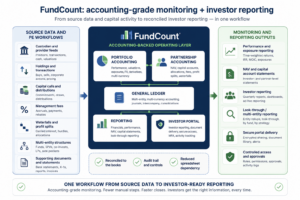
Quick verdict: FundCount is strongest when your family office needs a system-of-record core: portfolio accounting, partnership accounting, family office reporting, and a secure portal that can publish statements and documents from the same ecosystem. It is most compelling when reporting must reconcile to the books, not just look good on a dashboard.
Best for
- Single family offices that run accounting workflows internally and want reconcilable outputs
- Offices managing partnership-heavy structures, capital activity, or formal reporting packs
- Teams that want secure statement and document delivery without bolting on a separate portal
Standout capabilities
- Family office positioning built around a full financial-management stack rather than a reporting overlay.
- Secure investor portal workflow where data flows from the accounting environment to the portal without manual re-keying.
- Statement and document publishing from the reporting workflow, with encryption and MFA.
- Public Single Family Office pricing starting from $34,099 per year.
Pros
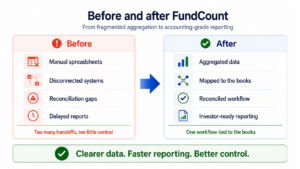
- Clear books-to-reporting story
- Strong fit when financial statements and stakeholder reporting must reconcile
- Better fit than many reporting-first tools if secure publishing is part of the workflow
Integrations to verify
- Custodian and data-provider coverage for your exact institutions
- Export path to Excel, PDF, and internal BI
- Portal permissions by entity and stakeholder
- Authentication, approvals, and publishing controls
Pricing
- Single Family Office: starting from $34,099 / year. Digital transformation and hosting fees apply separately.
Questions to ask during the demo
- Show a month-end close that produces financial statements and a stakeholder report pack from the same data
- Show how a corrected report is reissued without exposing the wrong version
- Show portal permissions for family members versus outside advisors
- Show one custodian-feed workflow end-to-end
Stop managing wealth across disconnected tools
FundCount centralizes accounting and reporting so your team can operate more efficiently and with greater control.
Addepar: Best for consolidated reporting and analytics across complex portfolios
Quick verdict: Addepar is strongest when the core need is consolidated reporting and analytics across multi-asset, multi-entity, and multi-currency portfolios. Its official family office, integrations, and alternatives pages emphasize a complete view of all accounts and assets, flexible custom integrations, alternatives data management, and reporting that can be shared through portal and mobile experiences.
Best for
- Offices that need one place to analyze and visualize portfolio data across entities and asset classes
- Teams that want bespoke reporting and a modern stakeholder experience
- Offices that expect to build or customize integrations via APIs
Standout capabilities
- A consolidated view across asset class, legal entity, and currency.
- Flexible APIs and custom integrations for in-house and third-party systems.
- Alternatives data management that aims to centralize and verify alternative investment data.
- Family office reporting materials that are customizable, scalable, portal-ready, and tied to online portal or mobile access.
Pros
- Strong fit when consolidated reporting is the top pain point
- Good option for offices that want reporting flexibility without leading with accounting
- Stronger extensibility story than many closed systems
Cons / trade-offs
- If you need a true accounting system of record, validate what is native versus what depends on another accounting core
- Alternatives workflows vary, so insist on a live document-to-data walkthrough
Integrations to verify
- Custodian and bank coverage for your actual institutions
- API limits, data-model access, and warehouse export path
- Alternatives document workflow and manual review requirements
- Portal access model for family members and external advisors
Pricing
- Contact vendor.
- Show a custom report that updates in real time and explain what refreshes instantly versus on batch
- Show look-through reporting across a realistic trust, LLC, and partnership structure
- Show a PDF statement becoming validated, reportable data
- Show the API path end to end, not just the integration catalog
Masttro: Best for wealth aggregation and global visibility across entity structures
Quick verdict: Masttro is strongest when wealth aggregation and visibility come first. Its official family office and pricing pages emphasize 650+ direct connections, all-asset and multi-currency coverage, real-time secure reporting, interactive wealth mapping, alternatives automation, and a pricing model that is not based on AUM.
Best for
- Offices prioritizing real-time visibility across custodians, entities, and jurisdictions
- Teams that want a global wealth map instead of siloed records
- Privacy-sensitive offices that care deeply about secure reporting
Standout capabilities
- 650+ direct connections and support for assets in any currency.
- A Global Wealth Map designed to visualize assets, entities, and ownership structures in real time.
- Security positioning built around military-grade encryption, multi-factor authentication, private cloud architecture, and Swiss-based infrastructure.
- Pricing page states the model is not based on AUM.
Pros
- Strong fit when the primary requirement is aggregation plus a clear, consolidated wealth view
- Explicit focus on entity structures and global complexity
- Security posture is easier to evaluate than many competitors because Masttro surfaces it prominently
Cons / trade-offs
- Validate accounting depth if you need full entity books and formal financial statements inside the same platform
- “Alternatives AI” can mean different degrees of automation, so require proof with your real documents
Integrations to verify
- Which institutions are direct feeds versus imports or service workflows
- How private-investment documents become normalized data
- Export path for report packs, BI, and warehouse workflows
- Secure sharing and permissioning rules for different stakeholder types
Pricing
- Contact vendor, but the official pricing page says Masttro is not AUM-based.
- Show two custodians, one private-investment workflow, and one consolidated net-worth view
- Show entity ownership mapping and look-through reporting
- Show what truly real-time is, what is daily, and what still needs manual review
- Show permissions and security controls in the product, not only in the pitch
Eton Solutions AtlasFive: Best for integrated family office operations
Quick verdict: Eton Solutions AtlasFive is strongest when you want a broad operating platform across entity management, portfolio management, accounting, workflows, document management, and client reporting. Official AtlasFive and single-family-office pages position it as a unified digital ecosystem with 270+ workflows, integrated accounting, workflow audit trails, SSO, MFA, and digital auditability.
Best for
- Offices that want fewer disconnected systems across operations
- Teams with trust, partnership, accounting, and workflow complexity
- Operations leaders who care as much about governance as reporting output
Standout capabilities
- AtlasFive integrates entity management, portfolio management, GL and fund accounting, transaction processing, and document management in one platform.
- The platform is positioned around 270+ workflows across investment management, accounting, tax, bill pay, document management, and more.
- Eton’s single-family-office materials highlight SSO, MFA, dynamic permissions, digital audit trails, and ISO/SOC certifications.
- Eton also highlights tailored, white-labeled client reporting.
Pros
- Strong fit for offices that want an operating system, not just a reporting layer
- Better choice when workflow governance and operational standardization are major priorities
- Broad enough to appeal to teams that want accounting, documents, and reporting under one roof
Cons / trade-offs
- Broad platforms require careful scoping
- Buyers should validate which workflows are native product features versus service-assisted or highly configured
Integrations to verify
- Custodian, bank, and document-flow coverage
- Client reporting and white-labeling requirements
- Permissioning for staff, family members, and outside advisors
- Workflow approval rules around bill pay, transaction processing, and reporting
Pricing
- Contact vendor.
- Show transaction ingestion, posting, workflow approval, and client reporting in one flow
- Show trust and partnership accounting inside the same environment
- Show user permissions and digital audit trails in the UI
- Show how a bill-pay or transaction-processing workflow works end to end
How to choose: decision tree
- If reporting must reconcile to the books and you want secure portal publishing from the same workflow, start with FundCount.
- If your top pain is multi-entity reporting, custom analytics, and open integration flexibility, shortlist Addepar.
- If your priority is total-wealth visibility across global custodians, entities, and private assets, shortlist Masttro.
- If you want one platform for entity management, accounting, workflows, and client reporting, shortlist Eton Solutions AtlasFive.
FAQs
What is family office wealth management software?
It is software that consolidates wealth data across entities and asset classes and turns it into repeatable reporting, performance views, workflows, and secure sharing. Some platforms focus on aggregation and analytics, while others also include accounting and operational controls.
How is it different from portfolio management software?
Portfolio management software usually centers on investments, performance, and reporting. Family office wealth management software goes wider: entity structures, stakeholder permissions, accounting, documents, workflows, and family-level governance.
Do you need a true accounting core?
Not always. If your main pain is consolidated visibility and flexible reporting, Addepar or Masttro may be enough. If your reports must reconcile to the books, FundCount and Eton are stronger starting points because they position accounting and reporting inside the same operating environment.
Can these platforms handle private investments and alternatives?
Yes, but the depth varies. FundCount emphasizes accounting-connected reporting and secure publishing, Addepar emphasizes alternatives data management, Masttro emphasizes alternatives automation and multi-source aggregation, and Eton emphasizes integrated workflows across accounting, documents, and transaction processing.
What security controls matter most?
Look for MFA or SSO, role-based permissions, encryption, audit trails, and final publishing controls. FundCount highlights encryption and MFA in its portal, Masttro foregrounds encryption, MFA, and private-cloud architecture, and Eton highlights SSO, MFA, permissions, digital audit trails, and certifications.
What pricing models are common in this category?
Pricing models vary. FundCount publicly lists a starting annual price for Single Family Office, Masttro says its pricing is not based on AUM, and the official Addepar and Eton product pages reviewed here do not surface public list pricing, so expect scoped sales conversations there.
Do you need a portal for family members and external advisors?
A portal or controlled client-sharing layer can reduce ad hoc email chains and make permissions easier to manage. FundCount, Addepar, Masttro, and Eton all surface some version of secure stakeholder delivery, but the operational details still need to be validated in a live demo.
Methodology and last updated
How this list was built
- Focus: Family office wealth management platforms commonly evaluated where reporting, aggregation, accounting, and secure delivery overlap.
- Evaluation lens: Source-of-truth clarity, multi-entity fit, private-asset workflow support, reporting flexibility, integration posture, and security controls.
- Why only four: The goal is shortlisting, not a full market map. These four represent four common buying patterns: accounting-led, analytics-led, aggregation-led, and integrated-platform-led.
- Sources: Current official product, pricing, integrations, and security pages reviewed for FundCount, Addepar, Masttro, and Eton Solutions.
Last updated: May 24, 2026.