
FIS Private Capital Suite, formerly Investran, is widely used by private equity firms for fund accounting, investor reporting, fund and partnership accounting, investor management, controlled workflows, and real-time portfolio visibility. FIS positions the platform around automating fund accounting and investor reporting while connecting accounting, reporting, and investor management on one unified platform.
But “Investran alternative” searches usually come from teams that need one or more of the following:
- A more modern accounting and reporting workflow without heavy legacy configuration
- Investor portal delivery tied directly to reporting and books
- Better flexibility for private equity, private credit, venture, real estate, fund-of-funds, or hybrid structures
- Lower implementation friction or clearer pricing posture
- A different balance of fund accounting, investor relations, portfolio monitoring, and administration services
- A platform that is easier to adapt as fund structures, investor demands, and reporting expectations change
This guide compares 7 alternatives and competitors across the things buyers actually validate in demos: features, integrations, pros and cons, pricing approach, implementation effort, performance considerations, and best-fit use cases. FundCount is listed first because it covers a common “reason to switch” from Investran-style systems: accounting-grade reporting plus investor portal delivery in one workflow.
Key takeaways
- If your “Investran alternative” requirement is really fund accounting plus investor portal publishing from one accounting-backed system, FundCount is the most direct fit in this list. FundCount positions its private equity platform around portfolio accounting, partnership accounting, general ledger, document intelligence, reporting, investor portal, and data aggregation under one roof.
- If your priority is a broader private capital suite with fund accounting, portfolio monitoring, investor portal, and Power BI-style reporting, Allvue is a common shortlist.
- If you want fund administration services plus connected software rather than pure software licensing, Juniper Square is a strong contender.
- If you need multi-asset, multi-currency accounting with daily NAV, real-time P&L, and exposure reporting, SS&C Geneva deserves a close look.
- If your firm wants a broader enterprise private markets platform with risk, performance, and whole-portfolio visibility, BlackRock eFront may fit better than a narrow fund accounting replacement.
- If your main frustration is legacy bookkeeping complexity and you want a modern accounting engine for private markets, LemonEdge is worth evaluating.
- If your team wants an alternative investment platform that combines CRM, deal management, investor relations, portal, portfolio monitoring, fund accounting, and fund administration services, Dynamo is a serious option.
Quick comparison table
| Platform | Best for | Accounting depth | Portal / reporting strength | Pricing posture |
| FundCount | Reporting, books, NAV, capital statements, and portal delivery in one workflow | High | High | Public starting price for PE |
| Allvue | Private capital suite buyers | High | High | Quote-based |
| Juniper Square | GPs wanting software-enabled fund administration services | Medium to high, service-led | High | Quote-based |
| SS&C Geneva | Multi-asset fund accounting and daily NAV at scale | High | Medium | Quote-based |
| BlackRock eFront | Enterprise private markets platform buyers | Medium to high | High | Quote-based |
| LemonEdge | Modern private markets fund accounting engine | High | Medium to high | Quote-based |
| Dynamo | Alternatives platform with fund accounting, IR, CRM, portal, and services | Medium to high | High | Quote-based |
Note: These categorizations are based on current vendor product positioning and public documentation. Validate accounting depth, portal controls, integrations, workflow governance, and implementation scope in live demos.
Replace fragmented PE systems with one accounting-first platform
FundCount helps firms run NAV, allocations, and investor reporting from a single source of truth.
7 Investran alternatives and competitors (ranked)
1) FundCount: Best for accounting-grade fund accounting plus investor portal publishing in one workflow
One-line verdict: Choose FundCount when you want fund accounting, performance reporting, capital statements, and investor delivery anchored to the same accounting system, not a reporting layer that has to reconcile back to separate books.
Best for
- Private equity firms that need NAV, allocations, waterfalls, and capital statements tied to the books
- Fund managers who want investor reporting and portal delivery from the same workflow
- Fund administrators and finance teams that need multi-asset, multi-entity, multi-currency reporting
- Firms replacing spreadsheets or legacy reporting workflows around Investran-style accounting
Key capabilities
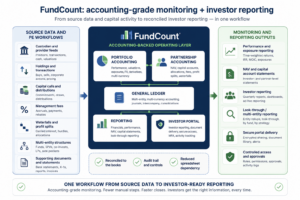
FundCount’s private equity platform is positioned around portfolio accounting, partnership accounting, general ledger, alternative investment document intelligence, reporting, investor portal, and data aggregation. Its PE page highlights support for equities, derivatives, private equity, real estate, and debt in the same portfolio view, with performance measures and attribution to explain returns.
FundCount’s partnership accounting supports contributions, distributions, series, waterfalls, capital statements, and partnership tax outputs from the same underlying data. Its general ledger supports multi-currency and multi-book accounting for IFRS and GAAP, entity consolidation, income statements, balance sheets, and NAV reporting.
Its investor portal sits inside the FundCount ecosystem, so data can flow from the accounting engine to investors without manual re-keying. The portal supports personalized bulk statements, structured performance data, encryption, MFA, batch workflows, and secure delivery.
Integrations
FundCount’s AppUniverse is positioned around connecting operational applications into one system, with solution areas including partnership accounting, general ledger, reporting, investor portal, data aggregation, and portfolio accounting. In demos, buyers should validate custodian feeds, administrator files, PDF and Excel workflows, BI exports, and any custom API requirements.
Pros
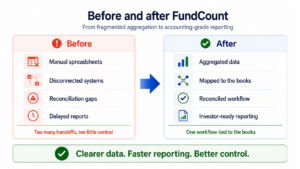
- Strong fit when “reporting must match the books” is the core buying requirement.
- Built-in portal publishing reduces manual distribution and wrong-version risk.
- Useful for PE firms managing capital accounts, waterfalls, NAV reporting, and investor statements.
- Public pricing gives buyers a clearer budgeting starting point than many quote-only vendors.
Pricing approach
FundCount publicly lists its Private Equity package starting from $34,899 / year, with digital transformation and hosting fees applying separately.
Implementation and TCO notes
Biggest effort drivers include chart of accounts design, entity and fund structure setup, historical data migration, waterfall and allocation logic, report package configuration, and investor portal permissioning.
Performance considerations
Benchmark quarter-end workflows: NAV reporting speed, batch capital statement generation, investor portal publishing, document intelligence throughput, and the audit trail for corrected reports.
Demo questions
- “Show the end-to-end workflow from source transactions to NAV, capital statements, and investor portal publishing.”
- “Show how contributions, distributions, waterfalls, and capital statements tie back to the GL.”
- “Show how a corrected statement is reissued without exposing the wrong version.”
- “Show document intelligence on a real private fund statement and how exceptions are handled.”
- “Show what is native, what is configured, and what requires custom services.”
An Investran alternative focused on clarity and control
Keep accounting and reporting aligned so LP statements, audits, and reviews are easier to support.
2) Allvue: Best for private capital firms that want a broader suite
One-line verdict: Allvue is a strong Investran alternative when you want private capital fund accounting plus portfolio monitoring, investor portal, client hub, API integration, Microsoft Power BI reporting, and broader fund lifecycle modules in one suite.
Best for
- Private equity and credit fund managers looking for a suite approach
- Fund administrators that need accounting, reporting, investor communications, and client collaboration
- Firms that want fund accounting plus portfolio monitoring and investor portal modules
- Teams already comfortable with Microsoft-based workflows and Power BI-style reporting
Key capabilities
Allvue’s fund administration page positions the platform around advanced accounting, investor communications, investor portal, API integration, and robust reporting via Microsoft Power BI. It also emphasizes reduced manual entry, automated workflows, and scalability for fund administrators.
Allvue’s fund accounting product is built for private equity fund structures and financial reporting requirements. The page highlights a true general ledger, financial reports, flexible report writer, workflow standardization, optional waterfall module, cloud-based architecture, and integration with management company accounting.
Allvue also offers portfolio monitoring for PE and VC managers, with financial and operating KPI collection, real-time dashboards, self-service reporting, drill-down analysis, and integration with fund accounting and investor reporting.
Integrations
Allvue emphasizes API integration, Microsoft Power BI reporting, Microsoft Dynamics 365 Business Central, Microsoft Azure, and a broader private capital module ecosystem. Validate API coverage, Power BI data model access, CRM integration, fund accounting to portal flows, and data warehouse exports.
Pros
- Strong private capital suite story.
- Fund accounting, investor portal, portfolio monitoring, and reporting can be evaluated together.
- Good fit for firms that want one vendor across multiple fund lifecycle modules.
- Useful for larger teams that want configurable workflows, dashboards, and reporting outputs.
Cons / limitations
- Broad suites require careful scoping.
- Buyers should separate “available module” from “implemented workflow.”
- Implementation effort can rise quickly if fund accounting, monitoring, investor portal, CRM, and BI are all in scope at once.
Pricing approach
Quote-based. Public product pages reviewed do not list standard package pricing.
Implementation and TCO notes
Key effort drivers include fund accounting conversion, workflow configuration, report writer setup, Power BI dashboards, investor portal setup, portfolio monitoring templates, and staff training.
Performance considerations
Benchmark close speed, waterfall calculation workflows, Power BI refresh cycles, investor report generation, API throughput, and report-pack delivery during quarter-end.
Demo questions
- “Show fund accounting, waterfall calculations, investor portal, and portfolio monitoring in one workflow.”
- “Show a financial statement package and how it ties to the GL.”
- “Show how data moves from fund accounting to Power BI and investor reports.”
- “Show what is out of the box versus configured.”
- “Show API and data export paths for our internal reporting stack.”
3) Juniper Square: Best for software-enabled fund administration services
One-line verdict: Juniper Square is a strong alternative when your real requirement is not only software, but a fund administration partner with connected technology, investor portal, treasury, onboarding, AML/KYC, and investor services.
Best for
- Private equity, venture capital, commercial real estate, and private credit GPs
- Firms that want to outsource fund accounting and investor services
- Managers who want a modern LP portal and investor experience
- Teams that want fewer internal admin hires while maintaining better transparency
Key capabilities
Juniper Square positions its fund administration solution as a combination of administration talent and technology for private markets GPs. The platform supports fund accounting, treasury services, investor services, investor onboarding, AML/KYC, management company accounting, and loan administration.
Juniper Square says its administration services support everything from SMAs to large global cross-jurisdictional funds and references more than $200B of assets on its administration page. It also says its portal is trusted by more than 650,000 LPs with over $1T of equity.
Integrations
Juniper Square is best evaluated as a connected platform plus services model. Validate data exports, GP access to accounting data, investor portal configuration, CRM and fundraising workflows, treasury approvals, AML/KYC coverage, and migration from your current administrator or Investran environment.
Pros
- Strong fit if you want software plus people.
- Good LP portal and investor experience positioning.
- Helps GPs scale accounting, treasury, onboarding, and investor services without building every function internally.
- Useful for firms that want a modern operating model rather than a pure Investran replacement.
Cons / limitations
- Not a pure software-only replacement.
- Buyers should clarify data ownership, export rights, service-level agreements, and transition options.
- If you want full internal control over the accounting system of record, validate how much of the workflow your team directly operates.
Pricing approach
Quote-based. Pricing typically depends on fund structure, services scope, investor count, complexity, and implementation needs.
Implementation and TCO notes
Key effort drivers include fund onboarding, historical data migration, waterfall and allocation review, investor data transfer, portal setup, treasury workflow setup, and coordination with prior administrators.
Performance considerations
Benchmark onboarding time, statement turnaround, capital call workflows, investor portal adoption, issue resolution speed, and quality of data exports.
Demo questions
- “Show the GP view across fund accounting, treasury, investor services, and portal reporting.”
- “Show a capital call from preparation to investor delivery and payment tracking.”
- “Show who owns each task: Juniper Square’s team versus our internal finance team.”
- “Show the full data export we get if we ever move administration in-house or to another provider.”
- “Show how investor statements are prepared, approved, and delivered.”
4) SS&C Geneva: Best for multi-asset fund accounting and daily NAV at scale
One-line verdict: SS&C Geneva is a strong Investran alternative when the requirement is institutional-scale fund accounting across complex multi-asset, multi-currency portfolios, especially where daily NAV, P&L, exposures, and broad instrument coverage matter.
Best for
- Large fund managers and fund administrators
- Hedge funds, hybrid funds, private credit, private equity, SPVs, master-feeder funds, and multi-tier structures
- Firms that need daily NAV, real-time P&L, and exposure reporting
- Teams with debt, derivatives, swaps, fixed income, and cross-asset accounting needs
Key capabilities
SS&C says its fund accounting capabilities leverage the Geneva platform and support a full range of asset classes and fund structures. The Geneva platform is positioned for complex multi-asset, multi-currency portfolios, real-time P&L, exposures, and daily NAV calculations.
SS&C also lists support for offshore and onshore funds, master-feeder and multi-tier structures, hedge funds, private equity, private credit, hybrids, SPVs, debt instruments, IBOR functionality, and integrated fund and investor accounting.
Integrations
Validate prime broker, custodian, bank, market data, administrator, data warehouse, IBOR, ABOR, NAV, and reporting integrations. Geneva is often part of a broader institutional stack, so workflow and data architecture matter as much as feature fit.
Pros
- Strong fit for complex multi-asset accounting.
- Good option for daily NAV and real-time exposure workflows.
- Deep relevance for administrators and asset servicers.
- Strong fund-type coverage across hedge, private equity, private credit, hybrids, and SPVs.
Cons / limitations
- Investor portal and LP experience should be validated separately.
- Implementation can be heavier for smaller teams.
- May be more platform than needed if your primary requirement is private equity partnership accounting and investor statements only.
Pricing approach
Quote-based.
Implementation and TCO notes
Key effort drivers include instrument coverage, historical books, trade capture, reconciliations, NAV workflows, reporting setup, integrations, and operational change management.
Performance considerations
Benchmark daily NAV speed, high-volume transaction handling, reconciliation workflows, P&L explain, exposure reporting, and report delivery under realistic volume.
Demo questions
- “Show daily NAV for a multi-asset, multi-currency fund.”
- “Show real-time P&L, exposure, and IBOR workflows.”
- “Show accounting for master-feeder and multi-tier structures.”
- “Show private credit, derivatives, swaps, and fixed income coverage.”
- “Show how investor accounting outputs are produced and delivered.”
5) eFront: Best for enterprise private markets platform buyers
One-line verdict: eFront is a strong alternative when you need a broader private markets platform for investment lifecycle, reporting, risk, analytics, and performance visibility, especially if your organization is also thinking about public and private portfolio views together.
Best for
- Enterprise PE firms, asset owners, and asset managers
- Teams that need broader private markets investment lifecycle workflows
- Firms that care about performance, risk, data, analytics, and regulatory reporting
- Organizations already evaluating the Aladdin and BlackRock private markets ecosystem
Key capabilities
eFront’s private equity software page says PE professionals need a solution to streamline and centralize the investment cycle, optimize processes, and enhance data and reporting. It also describes six modular products designed to help alternative investment professionals make fact-based decisions, mitigate risk, maximize performance, and respond to investor reporting needs.
BlackRock’s Aladdin and eFront page positions the combined platform around managing public and private asset classes on a single platform, whole-portfolio views, performance evaluation across the entire portfolio, risk views, and a single source of data.
Integrations
Validate how eFront fits with your accounting, risk, data warehouse, reporting, CRM, investor portal, and public markets systems. If Aladdin is part of your enterprise architecture, the integration story may be a major reason to shortlist eFront.
Pros
- Strong fit for enterprise private markets teams.
- Broader than a fund accounting tool if you need analytics, performance, risk, and investment lifecycle coverage.
- Good option for firms trying to unify public and private market views.
- Strong ecosystem story through BlackRock and Aladdin.
Cons / limitations
- May be broader and heavier than a direct fund accounting replacement.
- Buyers should validate fund accounting depth, LP reporting workflow, and accounting-system-of-record needs against their current Investran use case.
- Enterprise implementations require strong internal ownership.
Pricing approach
Quote-based.
Implementation and TCO notes
Key effort drivers include module selection, data migration, investment lifecycle workflows, data governance, reporting design, integration with enterprise systems, and user adoption across investment, finance, and IR teams.
Performance considerations
Benchmark dashboard responsiveness, portfolio-level analytics, data refresh cycles, regulatory reporting workflows, and cross-asset reporting performance.
Demo questions
- “Show the private equity investment lifecycle from portfolio data to investor reporting.”
- “Show how eFront handles fund accounting versus performance analytics.”
- “Show the whole-portfolio view and how it connects to private assets.”
- “Show data lineage from a report number back to the source.”
- “Show which workflows require Aladdin integration and which stand alone.”
6) LemonEdge: Best for a modern private markets accounting engine
One-line verdict: LemonEdge is a strong Investran alternative when your main pain is legacy accounting complexity, and you want a modern, event-driven fund accounting engine built for private markets.
Best for
- Private equity firms with complex fund structures
- Fund administrators who need automation across many clients and entities
- Private markets teams that want multi-ledger, event-driven accounting
- Buyers who want a modern architecture rather than a legacy fund accounting model
Key capabilities
LemonEdge positions itself as next-generation fund accounting software for private markets, with an accounting engine built for complexity, event-driven transactions, multi-ledger management, and process automation.
Its private equity page describes a full event-based partnership accounting system, lot-level multi-currency support, multi-ledger charts of accounts, real-time fund structure processing, look-through, professional reporting, automated ILPA and investor financial reporting, and investor engagement through an integrated portal.
LemonEdge also says its investor portal partner connects the portal to LemonEdge’s accounting engine, with digital onboarding, KYC, AML screening, holdings views, documents, performance, and dashboards synced to accounting data.
Integrations
Validate API coverage, data ingestion, fund administrator workflows, investor portal partner integration, Excel import/export, BI integration, waterfall models, and migration paths from Investran-style data structures.
Pros
- Strong fit for firms seeking modern accounting automation.
- Event-driven and multi-ledger design is attractive for complex fund structures.
- Good option for private capital teams that want configurability and process automation.
- Investor portal connection is aligned with accounting data rather than being a detached document hub.
Cons / limitations
- As a more modern architecture, buyers should validate maturity against their exact reporting, audit, and operational needs.
- Migration from legacy systems can still be substantial.
- Validate ecosystem depth, administrator familiarity, and local support requirements.
Pricing approach
Quote-based.
Implementation and TCO notes
Key effort drivers include fund structure modeling, event configuration, allocation paths, historical migration, integration setup, report design, and internal accounting process redesign.
Performance considerations
Benchmark event processing, multi-ledger postings, batch reporting, investor reporting output, API throughput, and exception handling.
Demo questions
- “Show event-driven accounting for capital calls, distributions, and allocations.”
- “Show simultaneous postings across multiple ledgers and entities.”
- “Show ILPA-style reporting and investor financials.”
- “Show investor portal data syncing directly from accounting.”
- “Show how a legacy Investran data migration would be phased.”
7) Dynamo: Best for alternatives teams that want fund accounting plus IR, CRM, portal, and services
One-line verdict: Dynamo is a strong Investran alternative when the buying requirement extends beyond fund accounting into CRM, deal management, investor relations, investor portal, portfolio monitoring, valuation, fund administration services, and investor lifecycle workflows.
Best for
- Private equity, venture capital, real estate, fund-of-funds, and alternatives managers
- GPs that want fund accounting plus investor relations and fundraising workflows
- Firms that want a modular platform with services optionality
- Teams focused on investor lifecycle management, not just back-office accounting
Key capabilities
Dynamo’s private equity software page positions the platform around deal management and CRM, investor relations and fundraising, investor portal, portfolio monitoring and valuation, and fund accounting. It also says private equity professionals can manage relationships and deals, track investor relations, monitor existing investments, and meet fund accounting and fund administration requirements.
Dynamo’s fund accounting page highlights fund accounting for private equity, venture capital, real estate, and fund-of-funds professionals, with capital calls, waterfalls, Excel-powered reporting, and configurable dashboards.
Dynamo’s fund administration services page positions its model around software plus services, with fund accounting, reporting, partner management, LP portal, built-in reports including ILPA standards, AI-assisted processing, capital calls, distributions, lifecycle management, and flexible service models.
Integrations
Validate CRM integrations, Outlook workflows, investor portal, fund accounting data flows, reporting exports, portfolio monitoring and valuation links, document automation, and data warehouse needs.
Pros
- Strong fit for firms that want alternatives-specific workflows beyond accounting.
- Modular approach can support IR, fundraising, portfolio monitoring, and fund accounting.
- Software plus services option may help lean teams.
- Good fit when investor communication is a major part of the pain.
Cons / limitations
- If your main requirement is deep fund accounting as the system of record, validate Dynamo Accounting against your exact GL, allocation, and reporting needs.
- The broader the module set, the more important it is to scope what is implemented first.
- Confirm whether you want software-only, co-sourced, or fully serviced workflows.
Pricing approach
Quote-based.
Implementation and TCO notes
Key effort drivers include module selection, accounting setup, investor data migration, CRM and portal configuration, report templates, services model definition, and team adoption across finance, IR, and deal professionals.
Performance considerations
Benchmark capital call workflows, waterfall calculations, report output speed, LP portal performance, investor communication workflows, and fund administration service turnaround.
Demo questions
- “Show fund accounting, investor portal, CRM, and portfolio monitoring in one investor lifecycle flow.”
- “Show capital calls, waterfalls, and reporting outputs.”
- “Show Excel-powered reporting and how it stays controlled.”
- “Show which tasks can be co-sourced versus fully outsourced.”
- “Show how Dynamo compares to our current Investran workflow for quarter-end.”
When to stay with Investran versus switch
FIS Private Capital Suite, formerly Investran, remains relevant for firms that want a mature private equity accounting and investor reporting platform with automation, controlled workflows, fund and partnership accounting, investor management, and real-time visibility.
Staying may make sense if:
- Your current FIS / Investran implementation is stable.
- Your team already has trained users and established report packages.
- The cost of migration is higher than the workflow pain.
- Your biggest issues can be solved through modernization, reporting cleanup, or integrations.
Switching may make sense if:
- Quarter-end still depends on too many spreadsheets.
- Investor reporting is disconnected from accounting.
- Your team cannot easily adapt workflows to new fund structures.
- Portal publishing, document automation, or private asset data ingestion are recurring bottlenecks.
- You need a different service model, pricing model, or implementation path.
How to choose: decision tree
- If you want fund accounting, NAV, capital statements, reporting, and portal publishing in one accounting-backed system, start with FundCount.
- If you want a broader private capital software suite with fund accounting, portfolio monitoring, investor portal, and Power BI-style reporting, shortlist Allvue.
- If you want technology plus outsourced fund administration services, shortlist Juniper Square.
- If you need institutional multi-asset accounting, daily NAV, real-time P&L, and exposure reporting, shortlist SS&C Geneva.
- If you want enterprise private markets analytics, risk, performance, and whole-portfolio views, shortlist BlackRock eFront.
- If you want a modern event-driven accounting engine for private markets, shortlist LemonEdge.
- If you want fund accounting plus CRM, investor relations, portfolio monitoring, portal, and fund administration services, shortlist Dynamo.
FAQs
What is Investran called now?
Investran is now positioned by FIS as FIS Private Capital Suite, formerly Investran. FIS describes the suite as private equity fund and investor management software that automates fund accounting and investor reporting.
What is the best Investran alternative for PE firms?
For firms that want accounting-grade fund accounting, capital statements, reporting, and investor portal publishing in one workflow, FundCount is the strongest starting point in this shortlist. For broader suite buyers, Allvue and Dynamo are also relevant. For outsourced fund administration, Juniper Square is a stronger fit.
What is the best Investran alternative for fund administrators?
It depends on the operating model. FundCount is strong for integrated accounting, reporting, and portal delivery with public starting pricing. Allvue is strong for private capital fund administrators that want advanced accounting, investor portal, API integration, and Power BI reporting. SS&C Geneva is strong for multi-asset accounting and daily NAV at scale.
What features should an Investran alternative include?
At minimum, evaluate fund accounting, partnership accounting, capital calls, distributions, allocations, waterfalls, NAV, investor capital statements, investor reporting, portal delivery, audit trails, integrations, and role-based permissions. For PE firms, also validate portfolio monitoring, valuation workflows, and investor relations requirements.
Is Juniper Square an Investran replacement?
Not exactly. Juniper Square is better understood as a connected fund administration services and software model rather than a pure accounting software replacement. It can replace parts of an operating model if you want to outsource fund accounting, treasury, investor services, onboarding, and AML/KYC.
Is SS&C Geneva better than Investran?
It depends on your fund type. SS&C Geneva is especially strong for multi-asset, multi-currency fund accounting, real-time P&L, exposures, and daily NAV. If your main use case is private equity partnership accounting and investor reporting, validate Geneva against private capital-specific workflows before deciding.
Is LemonEdge a modern Investran alternative?
Yes, for buyers focused on private markets fund accounting modernization. LemonEdge emphasizes event-driven transactions, multi-ledger management, process automation, private equity fund accounting, reporting, and an investor portal connected to the accounting engine.
What should vendors show in a live demo?
Use a repeatable script: ingest source data, post fund accounting activity, calculate NAV, run allocations and waterfalls, generate capital statements, publish to the investor portal, correct one report, and then trace one LP-facing number back to source transactions. That separates a true Investran alternative from a reporting layer with accounting language around it.
Methodology and last updated
How we selected the 7
This list focuses on platforms commonly evaluated by private equity firms, fund managers, and fund administrators when replacing or supplementing Investran-style workflows. Some are accounting-first systems. Some are broader private capital suites. Some combine software and services. Some are better for institutional fund accounting, and others are better for investor lifecycle workflows.
Evaluation criteria
- Fund accounting and partnership accounting depth
- NAV, capital statements, allocations, waterfalls, and investor reporting
- Investor portal and document delivery workflows
- Portfolio monitoring, valuation, and KPI workflows
- Integrations, APIs, BI, and data warehouse fit
- Workflow governance, audit trails, approvals, and permissions
- Implementation complexity and TCO
- Pricing transparency where available
- Fit for PE firms, fund managers, and fund administrators
Sources
We used current public product, pricing, fund accounting, investor portal, administration, and platform pages from FundCount, FIS, Allvue, Juniper Square, SS&C, BlackRock eFront, LemonEdge, and Dynamo. The article structure, tone, and sectioning were modeled on the attached alternatives article.
Last updated: April 25, 2026