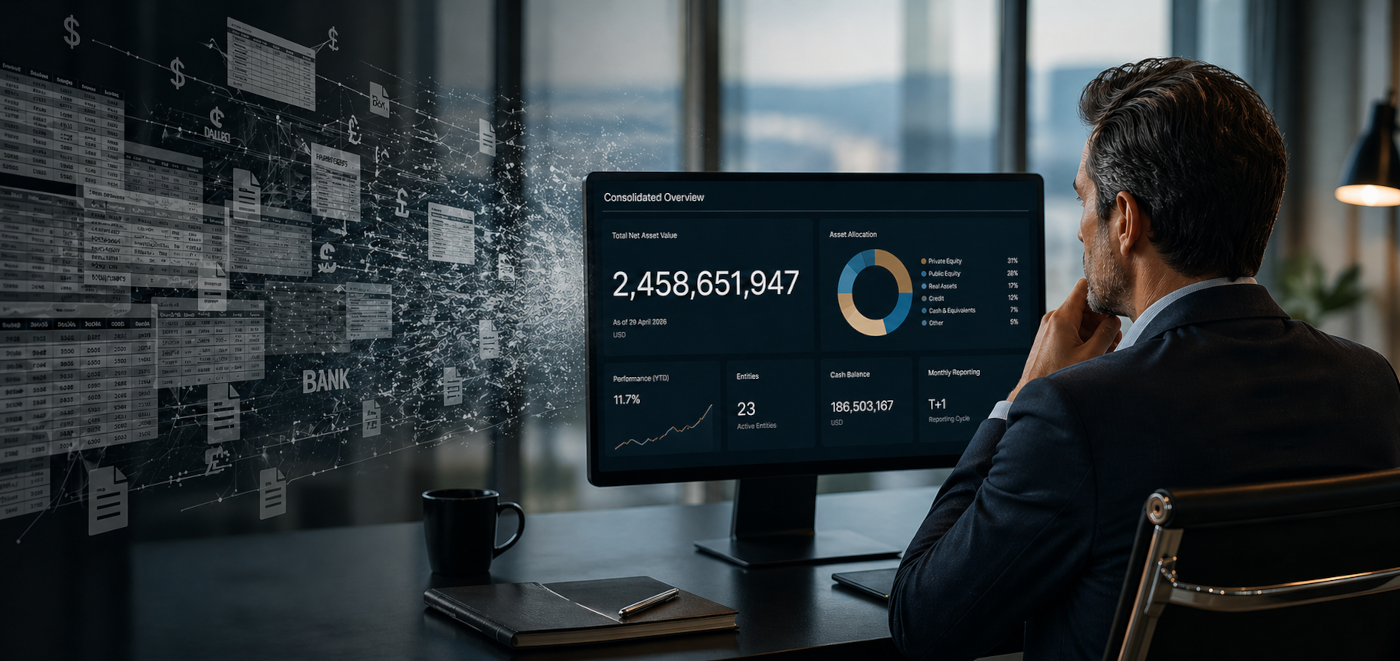
Fund administrators already process their LP clients’ capital calls, distributions, and capital account statements. Look-through reporting extends that work one level down: what each client’s funds own, combined across managers. For administrators that serve family offices, funds of funds, and other LPs, it builds on documents they already collect.
This guide covers what LP clients ask for, how to scope the service, the operating model and controls behind it, and the mistakes that make it hard to run at scale.
Key takeaways
- The source is already in the inbox. The schedule of investments sits in the GP financial statements administrators collect for their clients.
- Scope it in tiers. Summary exposure, holding-level look-through, and ongoing monitoring are different services with different effort.
- Controls make it sellable. Every figure should trace to a source page, tie to the client’s NAV, and carry its as-of date.
- Keep clients separate. GP holdings data is confidential to each client, and the process has to respect that.
- Automation decides the margin. Extraction and mapping are the expensive steps; they are also the ones software can take over.
What LP clients ask for
Exposure views
- Sector, country, and currency exposure across all funds.
- Combined with the client’s public holdings where you have them.
Top company exposures
- The largest companies across managers and co-investments.
- Overlap between funds.
Quarterly changes
- New holdings, exits, and marks that moved.
- Comments the board can read.
Data delivery
- Files or feeds into the client’s own systems.
- Consistent formats every quarter.
These are the outputs of look-through analysis, delivered as a service instead of built in-house by each client.
Scope the service in tiers
| Tier | Scope | Inputs | Typical delivery |
|---|---|---|---|
| Summary exposure | Sector and country mix from each fund’s reported breakdowns | Quarterly reports and schedules of investments | Quarterly report |
| Holding-level look-through | Every holding scaled to the client’s share, with company-level exposure | Schedules of investments, capital account statements | Quarterly report and data file |
| Monitoring | Holding-level look-through plus quarter-over-quarter movements, limits, and alerts | All of the above, every quarter | Report, data feed, and exception notes |
Price and staff each tier by the number of funds, the variety of GP formats, the reporting frequency, and the depth of detail. Clients with many small funds may need the summary tier for the tail and the holding-level tier for their largest positions.
The operating model behind look-through reporting
-
Intake
Collect GP financial statements, quarterly reports, and capital account statements for every client fund, from portals and email.
-
Extraction
Capture every schedule of investments line: name, security type, industry, country, shares or principal, cost, and fair value.
-
Mapping
Map GP industry names and countries to the client’s taxonomy, and code names and holding companies to the operating business.
-
Scaling
Apply each client’s share of each fund, or the LP ownership percentage per investment where the GP reports it.
-
Quality control
Tie each fund’s look-through total to the client’s NAV, check totals against the GP’s statements, and review large movements.
-
Delivery
Publish the report and data file, label the as-of date of every fund, and keep prior versions when a GP restates.
Questions to agree with each client
Settle these before the first report. They decide the workload and prevent disputes later.
- “Which funds, feeders, and co-investment vehicles are in scope?”
- “Which sector and country taxonomy should holdings be mapped to?”
- “How should we treat funds that have not reported by the deadline?”
- “Who receives the reports, and may the data be used for anything else?”
- “Do you want public holdings from your custodians in the same view?”
Controls and data rights
- Traceability. Every figure links back to the page of the GP document it came from.
- Maker-checker review. A second person reviews extraction, mapping changes, and material movements.
- Mapping governance. Changes to the taxonomy or company mappings are logged and approved, because they change history.
- Client isolation. Each client’s data stays in its own book; aggregated insights across clients need explicit permission.
- Confidentiality. LPAs restrict how GP information is used and shared. Agree the scope of use with each client.
What makes the service hard to run
- Late GP documents. The service can only be as current as the slowest GP. Agree how to handle funds that have not reported.
- Condensed schedules. Some GPs name only positions above 5% of net assets. Set expectations before the first report.
- Funds of funds. A second layer of holdings arrives later and in less detail. See our guide to fund of funds look-through.
- Scope creep. Ad hoc questions from client boards can turn a quarterly service into a continuous one. Price the monitoring tier for it.
How FundCount supports administrators offering look-through
FundCount AI Document Intelligence collects statements from your investor portals and email, converts them into accounting-ready data, and posts them to your books, with the source document one click from each posted figure. It now also extracts the schedule of investments from GP financial statements, which covers the extraction step of the operating model.
- Extracts asset-level data from GP financial statements: security name, industry, country, round or share class, shares, cost, and fair value.
- Tracks quarter-over-quarter movements in cost and fair value for each holding.
- Shows exposure by industry, country, and share class, filtered by year, quarter, fund, and holding company.
- Shows where the same security appears across different GPs.
- Keeps co-investments, valued from their own schedules of investments, next to fund holdings.
The extracted data sits in the same platform that runs FundCount’s portfolio accounting, partnership accounting, and reporting, used by family offices and by the fund administrators that report to LPs.
For administrators, FundCount runs client books on one ledger with each client’s book logically isolated, gives clients’ LPs a white-label investor portal, and produces identical-format client output. The platform is SOC 2 Type II examined. See FundCount for fund administrators.
Watch-outs
- FundCount extracts what each GP discloses. Grouped lines in a condensed schedule stay grouped until the GP provides the names.
- Holdings data covers what each fund owns and what it is worth. Company KPIs such as revenue and EBITDA come from GP portfolio company updates.
Add look-through reporting to your client services
In a guided walkthrough on real-world scenarios, we extract schedules of investments for a client’s funds, scale them to the client’s share, and show the exposure report.
FAQs
What is look-through reporting?
Reporting that shows what an investor’s funds own, scaled to the investor’s share and combined across managers, by company, sector, and country.
Why would a fund administrator offer look-through reporting?
Because the source documents, the GP financial statements, already pass through the administrator, and LP clients want exposure views they cannot easily build themselves.
What data does look-through reporting need?
Each fund’s schedule of investments, the client’s capital account statements for scaling, and a taxonomy for industries, countries, and company names.
How do administrators keep look-through data accurate?
By tracing every figure to its source page, tying each fund’s total to the client’s NAV, reviewing mapping changes, and labelling as-of dates.
Can administrators share holdings data across clients?
Not without permission. GP holdings data is confidential to each LP under the fund documents.
How often is look-through reporting delivered?
Usually quarterly, after the GP schedules of investments arrive, with monitoring tiers adding interim updates for capital activity.
Sources and methodology
Sources: FASB ASC 946-210-50 on schedules of investments, as quoted in SEC staff correspondence; ILPA Quarterly Reporting Standards, Best Practices, version 1.0 (October 2011), including the LP ownership column; FundCount’s fund administration page for platform capabilities, reviewed in October 2026.
Scope: general information, not investment, accounting, or legal advice.
Published: October 2026.