Hedge accounting compliance software helps teams document hedging relationships, test effectiveness, generate accounting entries, support disclosures, and preserve audit evidence through a controlled workflow.
Scope matters here. Most buyers using this term are really looking for treasury hedge accounting tools under ASC 815 or IFRS 9, which is where Kyriba, GTreasury, and FIS Treasury and Risk Manager – Quantum Edition fit most directly. FundCount belongs in the conversation for a different reason: some compliance reviews sit inside hedge fund or alternative investment accounting, where the core question is whether books, NAV, statements, and published reports reconcile cleanly and remain governed end to end.
Key takeaways
- Most firms are not choosing “the best hedge accounting platform” in the abstract. They are choosing the best fit for the compliance scope, which may be treasury hedge accounting or accounting-connected hedge fund reporting.
- For auditors and controllers, the real differentiator is evidence quality: designation support, testing outputs, journal entries, approvals, and rerun history that can survive walkthroughs and re-performance.
- FundCount is the accounting-first option in this list. Kyriba, GTreasury, and FIS are the direct treasury hedge accounting specialists.
- Effectiveness testing, de-designation handling, OCI reclassification, and exception reporting should all be live demo items, not assumptions.
- Integration quality matters because hedge accounting often breaks at the handoff points between exposures, valuations, accounting entries, and reporting.
Best for (quick shortlist)
- FundCount: Best for hedge fund or alternative investment accounting compliance where reports, NAV, and statement delivery need to stay tied to a multi-currency general ledger and controlled publishing workflow.
- Kyriba: Best for direct treasury hedge accounting under ASC 815 and IFRS 9, with workflow support for designation, documentation, testing, automated entries, de-designation, and reclassification.
- GTreasury: Best for hedge accounting lifecycle automation plus advisory and managed services support through Hedge Trackers.
- FIS Treasury and Risk Manager – Quantum Edition: Best for enterprise treasury teams that want hedge accounting inside a broader treasury and risk platform with audit tracking, exception reporting, and broad data connectivity.
Quick comparison table
| Platform | Best for | What it’s strongest at | Auditability fit* | Hedge docs + testing* | Accounting + reporting* |
| FundCount | Hedge fund and alternative investment accounting compliance | Multi-entity accounting, shadow NAV, reporting, portal controls | Strong | Varies | Strong |
| Kyriba | Direct treasury hedge accounting compliance | Designation, testing, automated entries, de-designation, reclassification | Strong | Strong | Strong |
| GTreasury | Hedge accounting automation plus services | Lifecycle automation, testing, ERP integration, dashboards, policy reporting | Strong | Strong | Strong |
| FIS Treasury and Risk Manager – Quantum Edition | Enterprise treasury and risk programs | Daily derivative reporting, hedge accounting, audit tracking, exception reporting, APIs | Strong | Medium to Strong | Strong |
*These are editorial shorthand labels to speed up shortlisting. They are based on current official vendor materials and should be validated in demos, especially for failed-test handling, reruns, ERP posting logic, and approval evidence.
Table basis: FundCount describes a multi-currency general ledger, full financials, shadow accounting, and portal publishing from the same ecosystem; Kyriba describes derivative and hedge accounting workflows under ASC and IFRS with documentation, testing, and accounting-engine support; GTreasury describes lifecycle automation, effectiveness testing, ASC 815 / IFRS 9 support, ERP integration, and Hedge Trackers managed services; FIS describes a treasury and risk platform with hedging and compliance breadth, API integration, and current materials that reference audit tracking and exception reporting.
One platform for hedge fund accounting, reporting, and portal
Consolidate accounting, reporting, and investor delivery into a single source of truth with FundCount.
What is hedge accounting compliance software?
In the treasury sense, hedge accounting compliance software helps teams support designation, documentation, effectiveness testing, accounting entries, disclosure support, and compliance with standards such as ASC 815 and IFRS 9. That is the core problem Kyriba, GTreasury, and FIS are positioned to solve.
In an accounting-connected investment environment, the compliance problem can look different. The question becomes whether hedge-related or alternative investment accounting outputs, such as NAV, capital statements, fee calculations, and investor reports, stay tied to the books and move through a controlled workflow to final publication. That is the lens where FundCount fits best in this article.
Why it matters in 2026
Compliance pressure usually shows up where systems hand off to one another. Kyriba frames hedge accounting as part of faster financial reporting, GTreasury frames it as a lifecycle from exposure identification to compliance reporting, and FIS frames Quantum around hedging, compliance, data integration, and automated reporting. That is a strong signal that the real operational risk is not just the accounting rule itself, but the workflow that carries it into the close.
Documentation burden is also getting heavier. Kyriba explicitly highlights workflow for hedge definition, documentation upload, designation choices, testing methods, reclassification, and de-designation. GTreasury highlights effectiveness testing, policy compliance, and managed services support through Hedge Trackers. Buyers should treat those as control requirements, not bonus features.
FundCount matters here for a different reason. In hedge fund and alternative investment environments, compliance often means proving that reported outputs reconcile to the ledger, that administrator data can be shadowed or challenged, and that statements reach investors through governed delivery rather than ad hoc publishing. FundCount’s hedge fund, shadow-accounting, and portal materials all point to that broader control environment.
Must-have features checklist
1) Hedge designation and documentation
The system should support a controlled designation workflow, central storage of supporting documents, clear version history, and exportable evidence for auditors. Kyriba is the clearest reference point here because it explicitly describes a step-by-step hedge workflow with documentation upload and designation choices. GTreasury also positions documentation and compliance reporting as part of the operating flow.
2) Effectiveness testing and methodology
You should be able to see the methodology, assumptions, frequency, and treatment of failed tests. Kyriba explicitly calls out effectiveness-testing methods and assessment settings, while GTreasury explicitly highlights automated effectiveness testing and related reporting. If the vendor cannot show one pass case and one failure case in the demo, assume the control story is weak.
3) Accounting entries and reporting outputs
The platform should either generate entries or govern the entry flow into ERP, preserve history, and support reruns without losing evidence. Kyriba explicitly highlights a separate accounting engine for journal entry calculation and ERP integration, GTreasury highlights ERP-connected journal workflows, and FIS positions Quantum around automated daily derivative reporting, hedge accounting, and risk disclosures.
4) Audit trail and governance
Look for approvals, who-changed-what visibility, preserved history, and exportable evidence. FIS explicitly highlights audit tracking and exception reporting in current official materials, Kyriba highlights audit trail in financial transactions workflow, and FundCount highlights approvals, encryption, MFA, and maker-checker style controls in reporting and portal workflows.
5) Integrations and close workflow
Hedge accounting compliance often fails at the handoff points, not the calculation engine. Kyriba highlights ERP integration and a developer portal, GTreasury highlights ERP integration plus connectivity, FIS highlights API integration with ERP, trading, market data, banking, and payment systems, and FundCount highlights a ledger-to-reporting-to-portal chain where the delivery layer stays inside the accounting ecosystem.
6) Scope fit: treasury hedge accounting vs accounting-connected reporting
This is the easiest place to make a bad software decision. Kyriba, GTreasury, and FIS are treasury-first hedge accounting platforms. FundCount is strongest when the compliance lens is broader and tied to hedge fund or alternative investment accounting, shadow NAV, multi-entity close, and governed statement delivery. If you ignore that distinction, you will either overbuy the treasury workflow or underbuy the accounting control.
Top 4 software solutions for hedge accounting compliance (ranked)
FundCount: Best for accounting-connected hedge fund and investment-reporting compliance
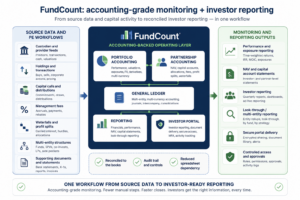
Quick verdict: FundCount is the strongest fit in this list when the compliance review is anchored in hedge fund or alternative investment accounting, not only treasury designation. It is built around portfolio accounting, partnership accounting, a multi-currency general ledger, shadow accounting workflows, and portal-based report delivery, which makes it useful when the real compliance question is whether reported outputs reconcile to the books and remain governed through final publication.
Best for
- Funds or administrators that want hedge-related reporting, NAV, and capital statements tied directly to a multi-currency general ledger.
- Teams that shadow fund administrators and want to test data, fees, or report accuracy with a parallel control layer.
- Organizations that want secure investor statement publishing from the same ecosystem as the accounting engine.
Standout capabilities (testable)
- A single integrated multi-currency general ledger for investor and portfolio accounting activity.
- Full financial outputs including P&L, balance sheet, cash flow, NAV, and capital statements.
- Public hedge fund pricing materials that highlight striking NAVs by funds, classes, side pockets, partners, or series and automating fee structures across partnership vehicles.
- Shadow Hedge Fund / Shadow NAV positioning for validating administrator data, reports, and fees.
- Portal workflow inside the FundCount ecosystem so data flows from the accounting engine to investors without manual re-keying.
- Maker-checker style controls, approvals, encryption, and MFA in portal and reporting workflows.
Pros
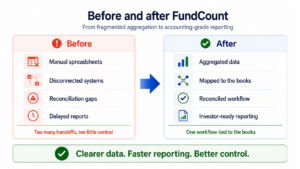
- Strongest accounting-to-reporting control story in this list.
- Relevant to audit work where the key issue is whether statements and reports reconcile to the books.
- Public pricing is available, which at least makes initial commercial scoping easier.
Integrations to verify
- Custodian, administrator, and bank data handoffs.
- Excel and BI export workflows for audit or management reporting.
- Portal permissions, SSO path, approval chain, and latest-version behavior.
- Restatement handling when a revised administrator file or capital statement arrives.
Pricing: FundCount publicly lists hedge fund pricing starting from $34,099 / year, with additional digital transformation and hosting fees noted.
Questions to ask during the demo
- Show a shadow-accounting workflow against one administrator file and explain how differences are investigated.
- Show a multi-entity roll-up from ledger activity to NAV to investor statement.
- Show a draft-to-final publishing workflow, including approvals and version visibility in the portal.
- Show the audit trail for a corrected value.
- Show how one fee or allocation change affects downstream reporting.
Hedge fund software, simplified
Accounting + reporting + investor portal in one platform.
Kyriba: Best for direct hedge accounting compliance under ASC 815 and IFRS 9
Quick verdict: Kyriba is the clearest treasury hedge accounting platform in this comparison. Its current materials explicitly describe derivative and hedge accounting support for ASC and IFRS compliance, a workflow for designation and documentation, effectiveness-testing settings, a separate accounting engine for journal entries, and support for reclassification and de-designation.
Best for
- Treasury and controllership teams with formal hedge accounting compliance under ASC 815 or IFRS 9.
- Auditors who need a direct workflow for designation, documentation, testing, and posting.
- Organizations that need ERP-integrated journal logic instead of spreadsheet-based posting.
Standout capabilities (testable)
- Support for cash flow, fair value, and net investment hedges.
- Step-by-step hedge workflow including linking exposure and derivative, hedge type, exposures being hedged, effectiveness testing methods, assessment frequency, regulatory standards, and documentation upload.
- Drag-and-drop upload of hedge documentation into a central repository.
- Separate accounting engine for journal-entry calculation, generation, and ERP integration.
- Workflow support for designation, documentation, and reclassification of balances.
- Commodity risk materials that also describe an end-to-end workflow with market valuations, accounting entries, and hedge accounting, which reinforces the platform’s broader accounting depth.
Pros
- The most directly compliance-oriented hedge accounting feature set in this list.
- Good fit for audit testing because the workflow steps are clearly described.
- Strong ERP posting story.
Cons / trade-offs
- Less relevant than FundCount when the audit scope is hedge fund books, NAV, or governed investor reporting rather than treasury hedging relationships.
- Buyers still need to validate the quality of upstream exposure and valuation data. Kyriba can govern a workflow, but bad inputs still create bad evidence.
Integrations to verify
- ERP export path for journal entries.
- API coverage and audit-log export.
- Data sources for exposure and valuation inputs.
- Security and access controls around designation and posting workflows.
Pricing: Editorial assessment: current public materials do not show standard list pricing, so expect a quote-based process.
Questions to ask during the demo
- Show one hedge from designation through effectiveness testing to journal entry.
- Show a failed-test scenario and what changes in the workflow.
- Show a de-designation or reclassification example.
- Show the audit history for a changed designation choice.
- Show the ERP export and how the posting is reconciled.
GTreasury: Best for hedge accounting lifecycle automation plus managed services support
Quick verdict: GTreasury is strongest when you want hedge accounting automation plus the option of advisory or managed services support. Its current product materials emphasize lifecycle automation from exposure identification to compliance reporting, effectiveness testing, policy compliance, valuation transparency, ERP integration, and support from Hedge Trackers.
Best for
- Treasury teams that want hedge accounting compliance embedded in a broader risk workflow.
- Organizations that need ASC 815 or IFRS 9 support with ERP-connected journal processes.
- Teams that value software plus advisory or managed services.
Standout capabilities (testable)
- Streamlined process from exposure identification to compliance reporting.
- Automated hedge-effectiveness testing and reporting.
- Customizable reports and limit tracking for policy compliance.
- Valuation transparency for stakeholder reporting and financial disclosure support.
- Interest-rate-risk materials that explicitly say GTreasury automates compliance with ASC 815 and IFRS 9 and integrates journal entries directly with ERP.
- Hedge Trackers advisory and managed services support for optimizing hedge performance and mastering hedge accounting.
Pros
- Strong blend of software and services.
- Strong fit for teams that need policy compliance and testing in the same place.
- Practical ERP integration story.
Cons / trade-offs
- Less relevant than FundCount if the real compliance problem is fund accounting and investor-statement control.
- Buyers should validate what is standard software vs what depends on managed services scope.
Integrations to verify
- ERP and general ledger posting workflow.
- Exposure and valuation-source integration.
- Export path for compliance and audit reporting.
- Division of responsibility between internal staff and Hedge Trackers services.
Pricing: Editorial assessment: current public materials appear quote-based.
Questions to ask during the demo
- Show one exposure-to-entry-to-report workflow.
- Show a failed-test example and the remediation path.
- Show ERP posting and approval controls.
- Show how managed services outputs remain visible and auditable inside the system.
- Show policy-compliance reporting tied to an actual hedge program.
FIS Treasury and Risk Manager – Quantum Edition: Best for enterprise treasury and risk programs with hedge accounting controls
Quick verdict: FIS is the broadest treasury platform in this comparison. Its current product page emphasizes cash, liquidity, risk management, debt, investments, hedging, compliance, built-in security, and API integration. Current official FIS materials also state that Quantum can automate daily derivative reporting, hedge accounting, and risk disclosures with audit tracking and exception reporting.
Best for
- Enterprise treasury teams that want hedge accounting inside a larger treasury and risk operating model.
- Organizations that need strong data connectivity and centralization across many bank or treasury systems.
- Audit teams that care about exception reporting and audit tracking alongside broader treasury visibility.
Standout capabilities (testable)
- Current product page says the platform spans cash, liquidity and risk management, debt and investments, hedging, and compliance.
- Current product page highlights built-in security features and API integration with ERP, trading, market data, banking, and payment systems.
- Official FIS materials say Quantum can automate daily derivative reporting, hedge accounting, and risk disclosures with audit tracking and exception reporting.
- Current product page positions the product as cloud-native and built on proven enterprise treasury functionality.
- FIS also frames the broader Treasury, Risk and Payment Suite around fluctuating interest and FX rates, hedge accounting, and liquidity and risk exposures on a single platform.
Pros
- Strong enterprise breadth when hedge accounting is only one piece of a larger treasury program.
- Clear official positioning around audit tracking and exception reporting.
- Strong integration story for complex treasury environments.
Cons / trade-offs
- Broader treasury platforms can be heavier than a narrower hedge accounting-only project needs.
- Buyers should validate which hedge accounting controls are standard vs configured, because current public materials emphasize breadth more than workflow detail.
Integrations to verify
- ERP, bank, and external data source connectivity.
- Audit-log and exception-report exports.
- Security and cloud operating model.
- Reporting automation and user configurability.
Pricing: Editorial assessment: current public materials appear quote-based.
Questions to ask during the demo
- Show daily derivative reporting and one exception workflow.
- Show how hedge accounting outputs become disclosures or management reports.
- Show source-system connectivity for one bank or ERP integration.
- Show the audit trail behind a revised hedge-related output.
- Show what is standard workflow vs configured behavior.
How to choose: decision tree
If the scope is treasury hedge accounting compliance under ASC 815 or IFRS 9, start with Kyriba, GTreasury, and FIS Treasury and Risk Manager – Quantum Edition. Kyriba is the clearest direct fit if you want a highly specific workflow around designation, documentation, testing, and entries. GTreasury is strong if you want lifecycle automation plus advisory depth. FIS is strong if you want hedge accounting inside a broader enterprise treasury and risk platform.
If the scope is hedge fund or alternative investment accounting compliance, and the key question is whether books, NAV, statements, and final published reports reconcile from one governed system, start with FundCount. That is the clearest place where its hedge fund, shadow-accounting, and portal workflows matter.
If you need software plus hands-on advisory support, give extra weight to GTreasury because Hedge Trackers advisory and managed services are part of the current product story. If you need broad treasury and risk functionality beyond hedge accounting, give extra weight to FIS.
FAQs
What is hedge accounting compliance software?
It is software that helps teams document hedging relationships, run testing, produce accounting outputs, and preserve evidence for close and audit support. In practice, some buyers mean treasury hedge accounting software, while others mean broader accounting-connected platforms where hedge-related reporting must still reconcile to the books.
What is the difference between hedge accounting software and hedge fund accounting software?
Treasury hedge accounting software is purpose-built around designation, effectiveness testing, valuation, posting, and compliance. Hedge fund accounting software is built around books, NAV, allocations, statements, and investor reporting, even if those outputs are part of a broader compliance review.
What should auditors look for in hedge accounting compliance software?
Start with the control evidence: documentation history, testing outputs, journal entries, approvals, and rerun logic. Then test the handoffs between source systems, because that is where many compliance failures actually occur.
Does hedge accounting software support ASC 815 and IFRS 9?
Dedicated treasury platforms typically do. Kyriba explicitly references ASC and IFRS compliance, and GTreasury explicitly references automating compliance with ASC 815 and IFRS 9 in its current risk materials.
What effectiveness testing methods should hedge accounting software support?
That depends on your policy, but the software should make the chosen method visible and reproducible. Kyriba explicitly references configurable testing methods and settings, while GTreasury explicitly positions automated effectiveness testing and related reporting as a core workflow.
How do platforms handle hedge designation and documentation?
The better ones treat designation and documentation as workflow steps, not side files. Kyriba explicitly describes hedge definition, documentation upload, and designation-related settings, which is a good benchmark for what “controlled” should look like in a demo.
Can hedge accounting software automate journal entries and OCI reclassification?
Yes, in the treasury platforms in this list that is a core part of the value proposition. Kyriba explicitly references a separate accounting engine and reclassification workflow, GTreasury references ERP-connected compliance workflows, and FIS references automated derivative reporting, hedge accounting, and risk disclosures.
What audit-trail controls should hedge accounting software include?
At minimum, you want who-changed-what visibility, approvals, preserved history, and exportable evidence. FIS explicitly references audit tracking and exception reporting, Kyriba references audit trail in financial transactions workflow, and FundCount references maker-checker and approval-oriented controls in portal and reporting workflows.
9) How do hedge accounting platforms handle de-designation and reruns?
The best platforms make those events visible, not buried. Kyriba is the clearest example because its current materials explicitly reference the de-designation and reclassification of balances. Regardless of vendor, ask to see a rerun in the demo and how the previous result is preserved.
What integrations matter most for hedge accounting compliance software?
Usually, the critical integrations are ERP or ledger, market data, exposure sources, and downstream reporting. Kyriba, GTreasury, and FIS all emphasize integration in different ways, so the practical test is whether the vendor can show the full handoff, not just list connectors.
How should auditors evaluate security and permissions in hedge accounting tools?
Ask for the permission model, approval gates, MFA or SSO options, and audit-log exportability. FundCount explicitly references MFA, encryption, and approval controls for publishing workflows, while FIS emphasizes built-in security features in the current product page.
What is the difference between treasury hedge accounting software and accounting-connected reporting software?
Treasury hedge accounting software governs hedging relationships and standards compliance directly. Accounting-connected reporting software governs books, reports, statements, and delivery, which matters when the compliance lens is broader and tied to hedge fund or alternative investment reporting.
How long does implementation usually take for hedge accounting software?
It varies with scope, integrations, and how much policy and data cleanup you need. A better evaluation question is: what must be configured, which workflows go live first, and what evidence remains inside the system if services are involved. GTreasury’s current managed services messaging is a reminder that delivery models can differ significantly.
What should auditors ask vendors to demonstrate in a hedge accounting software demo?
Ask for one full example from designation to testing to posting, then ask for a changed assumption, a failed test, or a rerun. If the vendor cannot show an end-to-end workflow with traceability and controls, the compliance story is probably weaker than the slide deck suggests.
Methodology and last updated
What “best” means here
“Best” means best fit for the compliance scope, not a universal winner. This category is fragmented. Some tools are direct treasury hedge accounting platforms, while others are accounting-connected systems that matter when the real compliance review covers hedge fund or alternative investment accounting, reporting, and publishing controls.
Evaluation criteria
The comparison prioritized designation and documentation workflow, effectiveness testing, accounting entries, auditability, integrations, reporting controls, and security posture. That is why Kyriba, GTreasury, and FIS rank highly for treasury hedge accounting compliance, while FundCount ranks highly for accounting-connected hedge fund and investment-reporting compliance.
Sources
This article relies primarily on current official vendor product pages, pricing pages, product sheets, and platform materials from FundCount, Kyriba, GTreasury, and FIS.
Last updated: April 21, 2026