
If you look closely at how single-family offices actually run, a pattern emerges.
It’s not that they lack capability. It’s that their world is layered in a way that makes even simple outcomes harder than they should be.
Where the friction comes from
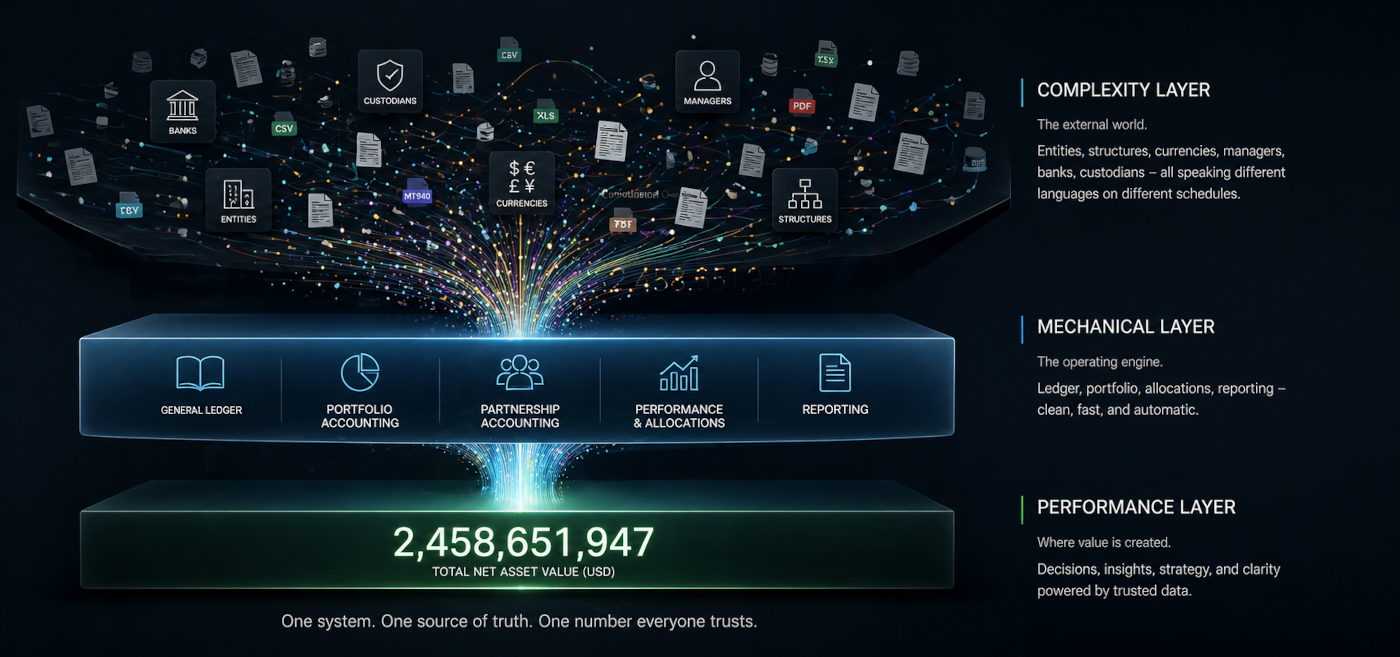
Every office operates across three distinct layers.
The first is the complexity layer. This is the external world — entities, structures, currencies, managers, banks, custodians — all operating on different timelines and producing data in different formats. It’s not unusual, and it’s not going away. In fact, it’s what defines a single-family office.
The second is the mechanical layer. This is where the work should become structured — the ledger, portfolio accounting, allocations, reporting. In principle, this layer should be clean, controlled, and largely automatic.
Then there is the performance layer. This is where the office actually delivers value — supporting decisions, advising the family, managing risk, and providing clarity.
The issue most offices run into is not within any one of these layers. It’s how they interact.
In many cases, the mechanical layer is forced to absorb the complexity of the external world. Teams end up using accounting systems, reporting tools, and spreadsheets to reconcile inconsistent inputs, rather than relying on them to produce consistent outputs.
That’s what creates the operational drag. Time shifts toward assembling and validating data. Spreadsheets fill the gaps between systems. And gradually, the performance layer — the part that should matter most — becomes constrained by process.
A different way to approach it
The offices that break out of this pattern tend to change how they think about the problem.
Instead of trying to improve each layer independently, they focus on the outcome first. The goal is not better reporting, or faster reconciliation, or cleaner workflows in isolation. The goal is a system where the layers work together by design.
This is the approach FundCount is built around.
At the complexity layer, the focus is on intake. Data from banks, custodians, and managers is brought in, standardized, and reconciled automatically, so the external world does not carry its inconsistencies into the system.
At the mechanical layer, everything lives in one place. The general ledger, portfolio accounting, partnership accounting, performance calculations, and financial reporting are part of the same environment. One codebase, one database, one structure.
That removes a fundamental source of friction. There is no need to move data between systems, no need to reconcile different versions of the same number, and no reliance on spreadsheets to connect the pieces.
What changes is not just speed, but reliability.
What that looks like in practice
When the system is structured this way, the operational impact becomes very tangible.
Processes that once took weeks can be completed in hours. Month-end reporting that stretched to T+21 can move to T+1. In some cases, reporting is available within an hour of market close.
Teams that previously depended on manual workflows find that much of the routine work disappears. In some environments, automation is strong enough that users are interacting with the system primarily to review exceptions rather than build reports.
The point is not the exact metric, but the direction of change. The effort shifts away from assembling data and toward using it.
What it means for the team
This kind of change shows up most clearly in how the team works.
Instead of acting as data processors, people take on a different role. They manage the system, monitor data quality, and focus on exceptions rather than routine tasks. Their time moves closer to decision-making and away from preparation.
That has a direct effect on how the office operates day to day. Questions from the family can be answered quickly, often the same day. Investment committees spend less time debating numbers and more time discussing strategy. Audits feel more straightforward because the underlying data is consistent and traceable.
It’s a subtle shift, but an important one. The office becomes more proactive, less reactive.
Why this is a structural change, not just a technology choice
It’s easy to describe this as a software improvement, but that understates what is actually happening.
Most tools in the market sit on top of existing systems. They improve visibility or presentation, but they don’t remove the underlying need to reconcile data across multiple sources.
FundCount takes a different position. It is not designed as an overlay, but as the foundation. The accounting, investment data, and reporting all originate from the same system, which is why the output is consistent.
That matters when the number needs to be defended, not just displayed.
A different standard
For a single-family office, the requirement is not complicated.
You need to be able to produce a number that is accurate, timely, and consistent across the entire structure.
The difference between offices that can do this reliably and those that cannot usually comes down to how their systems are designed. Not in theory, but in practice — how data is brought in, how it is structured, and how it flows through the organization.
FundCount has been built around that reality for more than twenty-five years, working with offices that operate at exactly this level of complexity.
The result is not just faster reporting or cleaner workflows.
It is a different level of confidence in the numbers.
And ultimately, that is what everything else depends on.