The best hedge fund portfolio management software depends on what you need as your system of record: an accounting-grade platform (ABOR) for controlled books and reporting, a trading-first OMS/IBOR for front-office workflows, or an enterprise platform that unifies risk, ops, and investment workflows.
In practice, hedge fund ops teams need accurate positions and cash, fast reconciliations across counterparties, reliable P&L and exposures, and repeatable reporting that holds up under investor and audit scrutiny.
Best for X (quick shortlist)
- FundCount: Best for accounting-grade portfolio accounting + reporting + investor delivery in one platform.
- SS&C Advent Geneva: Best for mature hedge fund accounting workflows that span portfolio, fund, and investor accounting with real-time views.
- Enfusion: Best for a cloud-native front-to-back operating model that combines portfolio management, risk, and a general ledger (ABOR-style).
- Bloomberg AIM: Best for OMS-centric portfolio management, trading, compliance, and operations tightly connected to the Bloomberg ecosystem.
- BlackRock Aladdin: Best for enterprise teams that want a broad platform connecting portfolio management, trading, operations, compliance, and risk oversight.
Key Takeaways
- If investor reporting must reconcile to a real accounting system, prioritize an accounting-grade platform where portfolio outputs tie back to controlled books and audit trails.
- Reconciliations are not an add-on. For multi-prime and multi-counterparty workflows, evaluate how positions, trades, and cash breaks are detected and resolved.
- “Portfolio management” can mean three different things: IBOR views for the front office, ABOR books for finance, or an enterprise layer that connects risk and operations. Map your operating model first.
- A strong stack is usually layered: trading and OMS, accounting and reporting, reconciliations, and secure investor delivery. FundCount is often positioned as the accounting and reporting anchor that complements front-office tools.
One source of truth for hedge fund reporting
Run accounting, generate investor-ready reports, and publish statements through a secure investor portal.
Quick comparison table: hedge fund portfolio management software (2026)
| Platform | Best for | What it’s strongest at | Reporting and sharing |
| FundCount | Accounting-grade ops + reporting | Portfolio accounting + real-time GL + reporting + investor portal | Investor portal + report distribution |
| SS&C Advent Geneva | Mature hedge fund accounting model | Real-time portfolio management + fund/investor accounting | Reporting outputs from accounting core |
| Enfusion | Cloud front-to-back | PMS + risk + GL (ABOR) + reconciliations | Reporting plus integrated workflows |
| Bloomberg AIM | OMS-centric workflow | Trading, compliance, operations, OMS + portfolio views | Reporting varies by setup |
| BlackRock Aladdin | Enterprise platform | Whole-portfolio view across teams and functions | Platform-driven reporting (varies) |
What is hedge fund portfolio management software?
Hedge fund portfolio management software is the system (or set of systems) used to keep an accurate view of positions, cash, P&L, and exposures, and then turn that data into repeatable workflows for operations, finance, and reporting.
A typical hedge fund stack supports:
- Position, cash, and trade capture, plus reconciliation across service providers and counterparties
- Real-time or near-real-time P&L, performance, and exposure reporting
- An accounting book of record (ABOR) for controlled financial reporting (often audited)
- Investor deliverables and secure distribution (statements, documents, dashboards)
IBOR vs ABOR: the distinction that drives most buying decisions
- IBOR (Investment Book of Record) is commonly discussed as the position and investment view that supports timely, accurate position data and can be used as a control point across providers.
- ABOR (Accounting Book of Record) is commonly defined as the official book of record supporting back-office operations and audited financial statements.
If your primary pain is trading workflow and investment decision support, an IBOR or OMS-first tool may be the center. If your pain is reconciled reporting, investor statements, and audit readiness, an ABOR-first tool usually wins.
Why it matters in 2026
The “spreadsheet tax” in hedge fund operations tends to show up in the same places: reconciling positions across primes, tracing reported numbers back to source data, and producing repeatable reporting packs without late-night manual fixes.
A strong platform reduces operational risk by:
- Centralizing position and accounting data so reporting is consistent and traceable
- Automating reconciliations and break resolution where possible, instead of relying on email chains
- Making it easier to publish investor-ready outputs through controlled workflows and secure delivery
Must-have features checklist (evaluation rubric)
Use this checklist to shortlist and to structure your demos.
1) Data capture and reconciliation
- Automated ingestion from counterparties and service providers (where applicable)
- Real-time or frequent updates for positions, trades, and cash
- Clear break workflows, matching rules, and exception reporting
2) Portfolio views: P&L, exposures, performance
- P&L, performance, and exposure reporting that matches how PMs review risk
- Multi-asset coverage (derivatives, FX, swaps, options, and more, depending on your strategies)
3) Accounting-grade controls (if ABOR matters)
- A general ledger that supports controlled reporting periods, audit trail, and financial statements
- Multi-entity, multi-currency realities aligned with your structure
4) Reporting and investor delivery
- Repeatable reporting outputs (internal packs, investor statements, NAV reports)
- Secure delivery options (portal, controlled sharing, encryption, MFA)
5) Integration and extensibility
- APIs or integration paths into your data stack and providers (primes, custodians, market data, BI tools)
Top 5 hedge fund portfolio management software
FundCount: Best overall for accounting-grade portfolio accounting + reporting + investor delivery
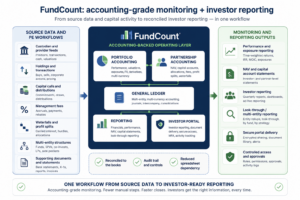
Quick verdict: FundCount is a strong choice when “portfolio management” is not just dashboards. It is portfolio accounting plus a real-time general ledger and reporting workflows, with investor delivery through a portal so outputs can be distributed without manual re-keying.
Best for
- Hedge funds (and fund ops teams) that want portfolio accounting tied to a real-time GL and reporting outputs like NAV reports.
- Teams that want integrated reporting distribution via email or a secure investor portal.
Standout capabilities
- Portfolio accounting that supports complex investments (including derivatives and swaps) and connects directly to custodians and market data feeds.
- Multi-currency, multi-book general ledger designed to support IFRS and GAAP accounting, plus real-time financial reporting outputs (including NAV reports).
- Investor portal designed for statement and document sharing, with messaging and controls like encryption and MFA called out in the product description.
- Data aggregation positioning that emphasizes feeds from custodians and data providers to streamline data management.
How FundCount fits into a hedge fund stack
In many hedge fund operating models, the OMS/EMS drives trading and execution, but finance and ops still need an accounting-grade source for reporting, reconciliations, and investor deliverables. FundCount is positioned to anchor that accounting and reporting layer, with data flowing from the accounting engine into reporting outputs and investor portal delivery.
Pros
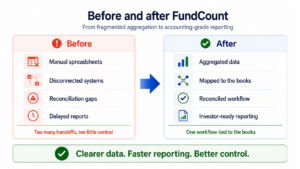
- Strong “books-to-reporting” story because reporting outputs are built on a real-time GL and portfolio accounting workflow.
- Clear portal-based delivery workflow for statements and documents, reducing back-and-forth email distribution.
Integrations
- Custodian and market data feed connectivity is called out in the portfolio accounting positioning.
- Investor portal sits inside the FundCount ecosystem, with data flowing from accounting to investors.
Pricing
- Typically quote-based. Confirm modules, entity counts, asset complexity, and implementation scope.
Questions to ask during the demo
- “Show the end-to-end month-end workflow from positions and cash through reconciliations to finalized NAV reporting.”
- “How do you map instruments and entities into the chart of accounts, and how do changes get audited?”
- “Show how reports are distributed through email vs the investor portal, including approvals, encryption, and MFA.”
- “Show how custodian or data provider feeds flow into the platform, and what breaks look like operationally.”
Tie portfolio data to NAV and investor reporting
Accounting, reporting, and portal in one platform.
SS&C Advent Geneva: Best for full-spectrum hedge fund portfolio, fund, and investor accounting with real-time views
Quick verdict: SS&C Advent positions Geneva as real-time portfolio management and accounting with investor accounting and reporting, spanning front office decision support through trade capture and reconciliation and full portfolio, fund, and investor accounting.
Best for
- Hedge funds and administrators that want a mature, accounting-first platform designed for complex global strategies.
- Teams that need broad instrument coverage and multi-currency support.
Standout capabilities
- “Full spectrum” workflow narrative: portfolio management, trade capture, reconciliation, and full accounting plus reporting.
- General-ledger-centric architecture is explicitly described as core, aimed at the integrity and timeliness of accounting data.
- Real-time P&L, performance, and exposure reporting are called out.
- Broad asset class support, including equities and derivatives, futures and options, FX, and complex derivatives.
Pros
- Clear fit when you want portfolio management outputs tightly connected to accounting and reporting.
- Strong positioning for complex strategies and multi-currency environments.
Cons
- Implementations can be substantial. Validate operating model, internal ownership, and timeline.
Integrations
- Geneva states it integrates easily with external systems, market data providers, and counterparties.
Pricing
- Quote-based (typical for enterprise systems).
Questions to ask during the demo
- “Show trade capture and reconciliation workflows for our prime and custodian setup.”
- “Show real-time P&L and exposure reporting, and how exceptions or corrections work.”
- “How do open and closed periods work in the accounting model, and what is the audit trail?”
- “Which instruments in our strategy mix are the edge cases, and how are they modeled?”
Enfusion: Best cloud-native front-to-back platform with ABOR-style general ledger and reconciliations
Quick verdict: Enfusion positions itself as a cloud-based investment management system that combines portfolio management, trade execution, risk management, and a general ledger in one integrated platform.
Best for
- Hedge funds that want a single integrated front-to-back environment, especially if cloud delivery is a priority.
- Teams that want an ABOR narrative via a double-entry general ledger fed from the PMS.
Standout capabilities
- “Proper double-entry” general ledger that maintains a complete set of books and records (ABOR) with automated debits and credits from the portfolio management system.
- Reconciliations with automated data collection that explicitly references prime brokers, custodians, FCMs, OTC counterparties, and fund administrators in the brochure.
- Real-time tracking of trades, positions, and cash balances, with customizable matching rules and break tolerances described on the accounting page.
Pros
- Strong story for connecting front office through back office on one platform with a unified data set.
- Reconciliation and accounting narrative is explicit and operationally oriented.
Cons
- “All-in-one” platforms still require careful role design and governance. Validate which teams own what data and workflows.
Integrations
- Automated data collection from multiple counterparty types is called out, implying broad connectivity expectations you should verify for your specific primes and providers.
Pricing
- Quote-based.
Questions to ask during the demo
- “Show how the general ledger is populated from portfolio events, and how adjustments are handled.”
- “Show the reconciliation workflow: ingestion, matching rules, break tolerances, and escalation.”
- “What does ‘real-time’ mean operationally for positions and cash, and where are the dependencies?”
- “Which workflows are strongest out of the box, and which require configuration or services?”
Bloomberg AIM: Best OMS-centric portfolio management, trading, compliance, and operations
Quick verdict: Bloomberg positions AIM as a multi-asset solution for portfolio management, trading, compliance, and operations, designed to support buy-side workflows at scale.
Best for
- Hedge funds and asset managers that are OMS-first and want portfolio and workflow tooling closely connected to the Bloomberg ecosystem.
- Teams that need broad trading workflow coverage across pre-trade, execution, and post-trade operations (validate exact modules in your license).
Standout capabilities
- Bloomberg describes AIM as integrated with the Bloomberg Terminal and oriented around the trading workflow.
- A third-party guide describes AIM as covering decision support, compliance, order management, electronic trading and execution, plus post-trade and reporting components (treat as a starting point for diligence, not a substitute for a demo).
Pros
- Strong fit when OMS workflow, compliance, and trading operations are the heart of your tech stack.
Cons
- If you need an ABOR-level accounting system of record for audited reporting, you may still need an accounting-first platform to anchor financial reporting.
Integrations
- Bloomberg emphasizes AIM being integrated with the Bloomberg Terminal, which can matter if your workflow is already built around Bloomberg data and tooling.
Pricing
- Quote-based.
Questions to ask during the demo
- “Show the full lifecycle from portfolio construction to order creation to execution and post-trade operations.”
- “Show how compliance rules work pre-trade and post-trade, and how exceptions are handled.”
- “Where do positions and cash become ‘official’ in our workflow, and how does reconciliation work?”
- “How do you export data to our accounting, reporting, and data warehouse layers?”
BlackRock Aladdin: Best enterprise platform connecting portfolio management, trading, operations, compliance, and risk
Quick verdict: BlackRock positions Aladdin as a platform that unifies the investment management process, with portfolio management and trading connected to compliance, operations, and risk oversight.
Best for
- Institutional and enterprise teams that need a broad operating model across functions, with shared data and process consistency across investments, trading, risk, operations, and oversight.
Standout capabilities
- “Whole portfolio” narrative: unifying the investment process through a common data language and a view across public and private markets.
- BlackRock describes an integrated ecosystem with asset servicers, broker-dealers, trading platforms, and data providers natively integrated into Aladdin.
- Aladdin FAQ emphasizes connecting portfolio management and trading to compliance, operations, and risk oversight so teams can share the same data and process.
Pros
- Strong fit for enterprise environments where standardization across teams and systems is a primary requirement.
Cons
- Broad platforms can be heavy for smaller teams or narrow use cases. Validate the implementation scope and what is truly required for your operating model.
Integrations
- “Natively integrated” ecosystem positioning is explicit, but you should confirm which providers are available for your workflows and regions.
Pricing
- Enterprise quote-based.
Questions to ask during the demo
- “Show how portfolio management, trading, operations, compliance, and risk oversight share the same data in practice.”
- “What is the implementation path for our asset classes and strategies, and what are the typical sequencing steps?”
- “Show integrations with our existing providers (servicers, brokers, trading platforms, data). What is native vs custom?”
- “How do we produce repeatable reporting outputs and prove lineage from the reported number back to the source?”
FAQs
Can hedge fund portfolio management software replace spreadsheets entirely?
Sometimes, but many teams still use Excel for ad-hoc analysis. The strongest platforms reduce manual spreadsheet work by centralizing data and making standard reports repeatable and traceable.
What is the difference between IBOR and ABOR?
IBOR is commonly discussed as the investment and position view designed to provide accurate, timely position data and serve as a control point across providers. ABOR is commonly defined as the official accounting book of record that supports back-office operations and audited financial statements.
What is the biggest implementation risk?
Usually not software. It is data definitions, governance, and ownership. If mappings, reconciliation rules, and reporting standards are inconsistent, you get dashboards that create debates instead of decisions.
Do I need a portfolio platform if I already have a fund administrator?
Often yes, depending on your operating model. Many teams still want an internal system to aggregate positions across providers, improve operational flexibility, and reconcile against custodians or accounting systems.
What should I ask vendors to demonstrate in a live demo?
Ask for a full operational cycle: ingest data, reconcile (positions, trades, cash), show P&L and exposures, close or lock periods (if applicable), generate reporting outputs, distribute through secure delivery, and show the audit trail end to end.
Methodology and last updated
Last updated: May 24, 2026.
This list is not exhaustive. It compares five platforms that represent common hedge fund operating-model choices: accounting-grade platforms (FundCount, Geneva), cloud front-to-back platforms with ABOR narratives (Enfusion), OMS-first platforms (Bloomberg AIM), and enterprise whole-portfolio platforms (BlackRock Aladdin). The evaluation emphasizes workflow coverage, reconciliation, and data integrity, reporting outputs, security and sharing, and integration posture as described in vendor materials.