Many family offices already have access to market data. The harder question is how that data actually moves into accounting and reporting.
A common setup looks like this: Bloomberg or Refinitiv for pricing and FX rates, custodian files for holdings and transactions, broker reports for cash and positions, and Excel for adjustments, overrides, or final reporting. That stack can work for a while. It starts to break when prices, FX rates, entity books, and owner-facing reports stop agreeing with each other.
This article explains how Bloomberg family office accounting workflows and Refinitiv FX rates accounting software decisions should be evaluated in practice. It also shows where market data belongs inside an accounting-backed family office operating model, and what to validate before you automate the process.
Decision summary
| Question | Practical answer |
| What problem are you solving? | You are not just sourcing prices and FX rates. You are making sure market data can support valuations, accounting, reconciliations, and reports across entities and currencies. |
| Where does the current workflow break? | It breaks when Bloomberg prices, Refinitiv FX rates, custodian positions, and Excel workbooks become separate versions of the truth. |
| What should better software do? | A stronger workflow should ingest source data, normalize identifiers and currencies, flag missing or stale values, reconcile against positions and cash, and support reporting. |
| What should buyers validate? | Validate feed coverage, source formats, frequency, entity mapping, exception handling, approval workflows, export requirements, and report replication. |
| Where does FundCount fit? | FundCount helps family offices connect data aggregation, portfolio accounting, general ledger, and family office reporting software into one controlled workflow. |
Bring Bloomberg, Refinitiv, and FX data into one reporting workflow
FundCount helps family offices integrate market data directly into accounting and consolidated reporting.
Why market data matters in family office accounting
Market data affects more than investment dashboards. In a family office, pricing and FX rates can flow into valuations, unrealized gain and loss calculations, multi-currency books, owner reports, partnership reporting, and consolidated net-worth views.
If the office is tracking public securities, private investments, loans, foreign currency cash, or cross-border entities, pricing and FX rates stop being a convenience. They become part of the accounting process. A stale price, a missing FX rate, or an incorrectly mapped security can lead to reporting delays, valuation breaks, and manual rework.
That is why the real question is not, “Do we have Bloomberg or Refinitiv?” The question is, “Can pricing and FX data move from source systems into a workflow the team can reconcile, review, and report from?”
When the current market data workflow starts to break
Most offices do not have one broken tool. They have several useful tools that were never designed to serve as one source of accounting truth.
The warning signs are usually clear:
- Prices come from one source, FX rates from another, and final adjustments live in Excel.
- A valuation report cannot be traced back to the source price or FX rate that drove it.
- The team uses one source for reporting and another for the books.
- Broker or custodian positions do not match the valuation file without manual edits.
- A missing or stale FX rate delays the close or requires a last-minute override.
- The office reports in more than one base currency and relies on spreadsheets to translate values.
- The same security appears with different identifiers, descriptions, or mappings across sources.
- Only one or two people know how the month-end pricing and FX workflow really works.
When those breakpoints appear, the issue is not only efficiency. The issue is control.
How market data should flow into the books
A strong workflow puts market data inside a controlled operating process rather than at the edge of a spreadsheet model.
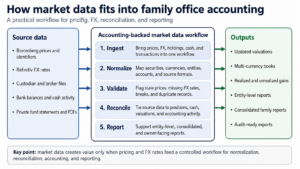
Diagram: A practical workflow for moving prices and FX rates from source systems into accounting-backed reports.
The workflow should move through five steps:
- Ingest prices, FX rates, holdings, cash balances, and transactions from the relevant sources.
- Normalize identifiers, currencies, entities, accounts, and source formats.
- Validate the incoming data by flagging stale prices, missing FX rates, duplicates, unmapped securities, or incomplete records.
- Reconcile market data against positions, cash, valuations, and accounting activity.
- Report from the reviewed result, not from a disconnected spreadsheet override.
That is the difference between having market data and having market data that supports family office accounting.
Bloomberg family office accounting: where pricing data fits
When people search for Bloomberg family office accounting, they are often trying to answer a practical question: how do Bloomberg prices and identifiers fit into a broader reporting and accounting workflow?
Bloomberg can play an important role as a pricing and reference-data source. The challenge is not whether the office can access prices. The challenge is whether those values can be matched to the right securities, entities, and reporting periods without repeated manual intervention.
For family offices, that means validating which Bloomberg fields matter for valuation and reporting, how prices are delivered into the accounting workflow, how stale or missing prices are identified, how overrides are controlled and documented, and how the final price set ties back to positions, books, and reports.
If your team still downloads pricing data, updates a workbook, and then manually checks whether the reports look right, the market-data workflow is still outside the system of record.
Refinitiv FX rates accounting software: what to evaluate
The same logic applies to Refinitiv FX rates accounting software decisions. FX rates matter whenever the office holds foreign currency cash, cross-border investments, offshore entities, or reports to principals in a different base currency than the underlying asset.
The operational challenge is not just getting an FX rate. It is using the right rate, on the right date, for the right purpose.
Your process should distinguish between daily or periodic FX rates used for valuation, transaction-date FX rates used for accounting, reporting-period rates used for consolidated outputs, and exception cases where a rate is missing, delayed, or needs review.
That is why automation matters. If the office handles FX through manual spreadsheets, copied rates, or ad hoc overrides, it becomes harder to explain how translated balances, gains and losses, and consolidated reports were produced.
Normalization comes before reporting
Automation fails when source data arrives in different formats and the workflow skips normalization. Bloomberg, Refinitiv, brokers, custodians, and banks do not always use the same identifiers, naming conventions, security descriptions, or delivery structures.
Before market data can support accounting, the workflow should normalize security identifiers, entity and account mappings, currencies, source timestamps and effective dates, pricing frequency, and the relationship between positions, prices, and accounting periods.
Without normalization, the office may have more feeds but not better reporting. The result is usually more exception handling in Excel, not less.
Reconciliation and exception handling are where trust is built
A market-data workflow should not assume every incoming value is correct. It should help the team identify breaks before those values affect the books and reports.
This is where many family offices struggle. Custodian positions may not line up with a broker file. A security may be missing a mapping. An FX rate may be stale. A private position may need a manual valuation while public positions update automatically. If those issues are discovered only after the report pack is assembled, the close slows down and confidence drops.
A better workflow surfaces exceptions early and gives the team a controlled way to review them. That means seeing which values failed validation, knowing which source supplied the value, reviewing overrides and adjustments, documenting why a change was made, and confirming that the updated result flows through to valuations, books, and reports.
That is how automation supports trust instead of hiding errors behind a feed.
How FundCount fits into the workflow
FundCount built its family office data aggregation capabilities for this exact operating problem. Market data should not live in isolation from the books, and accounting should not depend on spreadsheet bridges between prices, FX rates, positions, and reports.
With its family office software, you can bring source data into one workflow that supports portfolio accounting, general ledger, and family office reporting software. That gives your team a cleaner path from source pricing and FX rates to valuations, accounting records, and owner-facing reports.
Our role is not to tell you to replace every source in your stack. Bloomberg, Refinitiv, brokers, custodians, and banks can continue to serve their source-data role. The key is making sure the data coming from those systems enters a workflow where your team can ingest it, normalize it, reconcile it, review exceptions, and report from one accounting-backed operating layer.
Market data feeds work better with accounting-first reporting
FundCount helps ensure portfolio valuations and FX calculations stay aligned with the books.
How to reduce risk before you automate pricing and FX workflows
Market-data automation should be treated like an operating workflow project, not just a feed project.
Start with a practical inventory: your pricing sources, your FX-rate sources, your custodians and brokers, your entity structure, your report pack, your current overrides, and the exceptions that slow your close today.
Then, validate the workflow in stages.
Our implementation process starts with business analysis, where we document your workflows, required functionality, reporting needs, data sources, and operating structure in a Business Requirements Document. From there, we reduce migration risk by starting with one representative entity, validating the setup, and then expanding across the full structure: all entities, custodian and bank data links, selected modules, custom workflows, report packs, and user training.
That kind of phased approach matters because it lets your team validate pricing, FX logic, mappings, exceptions, and report outputs before relying on the new workflow across the whole office.
Scenario guidance
If your office has a small number of entities, limited cross-border exposure, and straightforward monthly reporting, the current process may still be workable if the team can validate prices and FX rates quickly.
If you rely on Bloomberg or Refinitiv, hold multiple currencies, and produce consolidated family reports, you should evaluate whether your current workflow can trace every report number back to source pricing and FX data without repeated spreadsheet intervention.
If your team is already pulling market data from custodians, brokers, and data providers but still reworks that information in Excel before it reaches the books, it is time to evaluate a stronger data aggregation and reporting workflow.
FAQ
Do family offices need separate systems for market data and accounting?
Not necessarily. Many offices will still rely on external market-data providers and source systems. The key question is whether pricing and FX rates can move into one accounting-backed workflow for review, reconciliation, and reporting.
Why do FX rates create so much reporting friction?
FX rates affect valuation, transaction accounting, translated balances, consolidated reporting, and gains and losses. If those rates are managed manually or inconsistently, small breaks can spread across multiple reports.
What should we validate before automating Bloomberg or Refinitiv feeds?
Validate source coverage, delivery method, field requirements, pricing frequency, FX logic, mapping controls, exception handling, review workflows, export needs, and report replication.
Can spreadsheets still play a role?
Yes. Excel can still support ad hoc analysis or review. It becomes risky when it acts as the system of record for pricing updates, FX-rate overrides, mapping logic, and final reporting formulas.
What should we bring to a demo?
Bring your current report pack, sample pricing and FX sources, your entity chart, your list of custodians and brokers, and a few examples of the exceptions that currently require manual intervention.
Conclusion
Bloomberg prices and Refinitiv FX rates create value only when they support a controlled path into family office accounting. If the office still depends on spreadsheet bridges between market data, valuations, and reports, the issue is no longer only speed. It is whether the team can explain, defend, and reproduce the numbers.
The better approach is to treat market data as part of an accounting-backed workflow: ingest it, normalize it, reconcile it, review exceptions, and report from the controlled result. If that is the gap you are trying to close, the next step is simple: map your pricing sources, FX dependencies, and report requirements, then validate how those inputs should flow through your operating model.