Chronograph is a private capital portfolio monitoring platform used by GPs and LPs. Chronograph GP is positioned around automating portfolio company data collection, analytics, valuation, reporting, and data warehousing for private equity, growth equity, venture capital, infrastructure, real assets, hedge funds, private credit, and other private capital strategies. It also supports use cases such as data management, analytics, reporting, valuations, ESG, data warehousing, and APIs.
But “Chronograph competitor” searches usually come from private equity firms that need one or more of the following:
- Accounting-backed performance reporting, not just portfolio company monitoring
- NAV, capital accounts, waterfalls, allocations, and investor statements tied to the books
- A broader private capital suite that connects portfolio monitoring with fund accounting and investor reporting
- Institutional private markets analytics, benchmarking, valuation support, and portfolio intelligence
- Stronger investor portal, CRM, fundraising, or LP communication workflows
- More flexible portfolio company data collection, KPI tracking, dashboards, and reporting exports
This guide compares 5 Chronograph competitors in total across the things private equity buyers actually validate in demos: features, integrations, pros and cons, pricing approach, use cases, implementation effort, and performance considerations. FundCount is listed first because it covers a common “reason to compare” against Chronograph: accounting, reporting, capital statements, and investor portal publishing in one workflow.
Key takeaways
- If your Chronograph alternative requirement is really accounting-grade PE reporting plus investor portal publishing from one system of record, start with FundCount. FundCount positions its private equity platform around portfolio accounting, partnership accounting, general ledger, alternative investment document intelligence, reporting, investor portal, and data aggregation under one roof.
- If your priority is portfolio monitoring plus fund accounting and investor reporting inside a broader private capital suite, Allvue deserves a top spot on the shortlist. Allvue’s portfolio monitoring platform supports streamlined portfolio company data collection, real-time dashboards, self-service reporting, drill-down analysis, fund accounting integration, investor reporting integration, and IRR Hub scenario analytics.
- If you need institutional private markets analytics, benchmarking, valuations, and AI-enabled monitoring at scale, S&P Global iLEVEL is a strong contender. iLEVEL supports AI-powered workflow automation, performance analysis, benchmarking, valuation workflows, portfolio company drill-down, and private markets reporting.
- If you want portfolio monitoring, valuation, CRM, investor portal, and fund accounting in one alternatives platform, Dynamo is a serious option. Dynamo PMV helps GPs collect portfolio company data, analyze financial statements, create reports, perform valuations, and connect PMV to accounting, CRM, and portfolio management modules.
- If your main pain is KPI collection, self-service portfolio monitoring, benchmarking, dashboards, and Excel-based reporting workflows, Cobalt, a FactSet Company is one of the closest direct alternatives. Cobalt provides custom metric and KPI tracking, flexible data collection, dashboards, advanced analytics, on-demand reporting, cash-flow analytics, an Excel plug-in, and API or data delivery services.
Quick comparison table
| Platform | Best for | Accounting depth | Portfolio monitoring strength | Reporting / portal strength | Integration posture |
| FundCount | PE firms that need reporting, capital statements, NAV, and portal delivery tied to the books | High | Medium | High | Data aggregation, reporting, portal, exports, implementation-specific integrations |
| Allvue | PE and VC firms wanting portfolio monitoring plus fund accounting and investor reporting | High | High | High | Microsoft ecosystem, fund accounting, investor reporting, BI-style workflows |
| S&P Global iLEVEL | Institutional private markets teams needing analytics, benchmarks, valuations, and workflow automation | Medium | High | High | Private markets data ecosystem, services, APIs and reporting workflows |
| Dynamo | Alternatives teams wanting PMV, CRM, investor portal, fund accounting, and IR workflows | Medium to high | High | High | Modular alternatives platform with Excel and PowerBI workflows |
| Cobalt | GPs focused on portfolio company data, KPI tracking, benchmarking, and self-service reporting | Low to medium | High | Medium to high | Excel plug-in, API, data delivery services, CRM and data platform links |
Note: These categorizations are based on current vendor product positioning and public documentation. Validate accounting depth, KPI workflows, valuation governance, integrations, pricing, and publishing controls in demos.
Replace fragmented PE systems with one accounting-first platform
FundCount helps firms run NAV, allocations, and investor reporting from a single source of truth.
5 Chronograph competitors and alternatives
FundCount: Best for accounting-grade PE reporting and investor portal publishing
One-line verdict: Choose FundCount when you want private equity accounting, capital statements, performance reporting, NAV, waterfalls, and investor delivery anchored to the same accounting-backed system.
Best for
- Private equity firms where LP-facing reports must reconcile to the books
- CFO and finance-led teams managing NAV, capital accounts, allocations, waterfalls, and investor statements
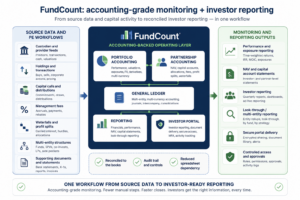
- Firms that need portfolio accounting, partnership accounting, general ledger, reporting, and investor portal delivery in one ecosystem
- Managers that want to reduce spreadsheet work around capital statements, private asset reporting, and quarter-end publishing
Key capabilities
FundCount’s private equity page positions the platform around portfolio accounting, partnership accounting, general ledger, alternative investment document intelligence, reporting, investor portal, and data aggregation. It supports equities, derivatives, private equity, real estate, and debt in the same portfolio view, with performance measures and attribution to help explain what drove returns.
FundCount’s partnership accounting covers contributions, distributions, series, waterfalls, capital statements, and partnership tax outputs from the same underlying data. Its general ledger supports multi-currency and multi-book accounting for IFRS and GAAP, entity consolidation, income statements, balance sheets, and NAV reports.
The investor portal sits inside the FundCount ecosystem, so data flows from the accounting engine to investors without manual re-keying. It supports personalized statements in bulk, structured performance data, bank-grade encryption, MFA, batch workflows, approval workflow options, and two-way encrypted messaging.
Integrations
FundCount should be evaluated around your real source systems: custodians, banks, fund administrators, portfolio company files, private fund statements, PDFs, Excel workflows, BI exports, CRM handoffs, and investor portal delivery. In demos, ask to see source data move through accounting, reporting, and portal publication, not just a static integration list.
Pros
- Strong fit when the real problem is “performance reports and investor statements must match the books.”
- Better fit than portfolio-monitoring-only tools if the firm needs GL, partnership accounting, NAV reports, waterfalls, and capital statements.
- Built-in portal publishing can reduce wrong-version risk and manual LP distribution.
- Public private equity pricing gives buyers a clearer starting point than many quote-only competitors.
Pricing approach
FundCount publicly lists Private Equity pricing starting from $34,899 per year, with digital transformation and hosting fees applying separately.
Implementation and TCO notes
Biggest effort drivers include fund and entity setup, capital account logic, historical transaction migration, waterfall configuration, report design, private asset document workflows, investor portal permissions, and user training.
Performance considerations
Benchmark quarter-end close, NAV report generation, batch capital statement production, investor portal publishing, document intelligence throughput, and corrected-report handling.
Demo questions
- “Show the end-to-end workflow from accounting entries to NAV, capital statements, and investor portal publishing.”
- “Show how contributions, distributions, allocations, and waterfalls tie back to the GL.”
- “Show how a valuation update affects NAV, investor statements, and portal reports.”
- “Show how a corrected statement is reissued without exposing the wrong version.”
- “Show what is native, what is configured, and what requires implementation services.”
Chronograph alternative focused on clarity and control
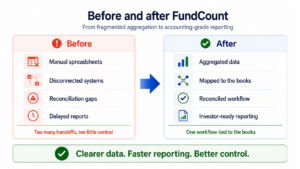
Keep accounting and reporting aligned so LP statements, audits, and reviews are easier to support.
Allvue: Best for portfolio monitoring connected to fund accounting and investor reporting
One-line verdict: Allvue is a strong Chronograph competitor when you want portfolio monitoring, fund accounting, investor reporting, dashboards, and IRR scenario analytics in one private capital suite.
Best for
- PE and VC firms that want to standardize portfolio company data collection
- Teams that need real-time dashboards and self-service reporting
- Firms that want portfolio monitoring integrated with fund accounting and investor reporting
- Managers that need IRR forecasting, scenario analytics, and fund performance transparency
Key capabilities
Allvue’s portfolio monitoring software streamlines portfolio company data collection and fund performance reporting in a cloud-based platform. It gives teams real-time data access, dynamic dashboards, self-service reporting, drill-down analysis, configurable input screens, data checks, and reports.
Allvue’s portfolio monitoring platform also integrates fund accounting and investor reporting capabilities with private equity portfolio monitoring. Its IRR Hub is positioned around performance forecasts and scenario analytics for private equity and venture capital fund managers.
Allvue also emphasizes stakeholder delivery. The platform lets firms share qualitative and quantitative information with internal stakeholders, operating partners, and LPs while customizing the level of detail.
Integrations
Allvue should be validated around fund accounting, investor reporting, portfolio monitoring, Power BI-style workflows, Microsoft Dynamics and Azure architecture, Excel exports, API needs, data warehouses, and portfolio company data templates. The key demo is not just KPI collection. It is KPI collection plus performance reporting plus fund accounting handoff.
Pros
- Strong suite story for PE and VC firms.
- Good fit when portfolio company monitoring and fund performance reporting need to connect.
- IRR Hub is useful for scenario analysis and forward-looking performance work.
- Better fit than single-purpose KPI tools if investor reporting and fund accounting are part of the same project.
Cons / limitations
- Broad suite scope can increase implementation effort.
- Buyers should separate “available module” from “implemented workflow.”
- If the accounting system is already fixed, validate exactly how Allvue will integrate rather than duplicate work.
Pricing approach
Contact vendor. Public product pages reviewed here do not list standard package pricing.
Implementation and TCO notes
Biggest effort drivers include portfolio company templates, KPI taxonomy, fund accounting configuration, investor reporting setup, dashboard design, data validation workflows, and permissioning across deal, finance, IR, and portfolio operations teams.
Performance considerations
Benchmark KPI request cycles, dashboard refresh speed, IRR Hub scenario calculations, drill-down reporting, data validation workflows, and investor reporting output during quarter-end.
Demo questions
- “Show portfolio company KPI collection, validation, and dashboard refresh.”
- “Show how portfolio monitoring data connects to fund accounting and investor reporting.”
- “Show IRR Hub scenario analytics and explain the assumptions.”
- “Show how one portfolio company metric rolls into a fund-level performance report.”
- “Show what is included in the base module versus additional modules.”
S&P Global iLEVEL: Best for institutional private markets analytics, valuations, and benchmarking
One-line verdict: S&P Global iLEVEL is a strong Chronograph alternative when the private equity team needs institutional-grade portfolio monitoring, benchmarking, valuation support, AI-enabled workflow automation, and analytics at scale.
Best for
- Institutional private equity, private credit, infrastructure, and real assets teams
- Firms that need benchmarking, valuation support, and portfolio analytics
- Teams that want private asset and portfolio company drill-down
- Managers and allocators that need services support, implementation help, and private markets data infrastructure
Key capabilities
iLEVEL supports AI-powered workflow automation for manual reporting and data collection processes. Its performance analysis tools let users visualize and analyze portfolio performance through customizable, interactive dashboards.
Benchmarking is a major strength. iLEVEL supports native integration with Cambridge Associates benchmarks, plus other third-party and custom benchmarks. Its valuation suite includes Qval for cap table management, Peer Comparables for public-company benchmarking, and integration with S&P Global Private Market Valuations services.
iLEVEL also supports detailed analysis and reporting across private market portfolios, including drill-down by industry, geography, private asset, and portfolio company. S&P Global says the platform is supported by implementation, support, outsourcing operations, and change-management services.
Integrations
iLEVEL should be evaluated around data collection, valuation workflows, benchmarking, portfolio analytics, private asset drill-down, reporting packs, APIs, OData or BI exports, accounting integrations, and warehouse workflows.
Pros
- Strong fit for institutional private markets teams.
- Benchmarking and valuation ecosystem are major strengths.
- Good option when portfolio analytics need to scale across many funds, assets, and stakeholders.
- Service and implementation support may help larger organizations standardize data workflows.
Cons / limitations
- If your main requirement is official fund accounting, GL, capital statements, and investor portal publishing, validate how iLEVEL connects to your accounting system.
- It can be broader than needed for smaller PE firms that mainly need KPI collection and quarterly reporting.
Pricing approach
Contact vendor. Public product pages reviewed here do not list standard pricing.
Implementation and TCO notes
Biggest effort drivers include data model setup, historical data migration, valuation workflows, benchmark setup, portfolio company data templates, report-pack configuration, integration work, and user training across investment, finance, portfolio operations, and IR teams.
Performance considerations
Benchmark data ingestion, dashboard responsiveness, benchmark refreshes, valuation workflow speed, report-pack automation, and drill-down performance by company, fund, geography, and industry.
Demo questions
- “Show portfolio performance analysis at fund, portfolio company, geography, and industry levels.”
- “Show benchmark setup using Cambridge Associates or custom benchmarks.”
- “Show how a valuation update flows into analytics and reports.”
- “Show AI-enabled data collection and document search with a real example.”
- “Show how iLEVEL connects to our accounting system and data warehouse.”
Dynamo: Best for portfolio monitoring, valuation, CRM, and alternatives workflow breadth
One-line verdict: Dynamo is a strong Chronograph competitor when your portfolio monitoring requirements overlap with valuation, CRM, investor portal, fund accounting, and investor relations workflows.
Best for
- PE firms that want portfolio monitoring and valuation inside a broader alternatives platform
- Teams that need portfolio company portals, data approval workflows, dashboards, and Excel integration
- Firms that want PMV connected to accounting, CRM, and portfolio management modules
- Managers that want fund-level and asset-level value creation analysis in one system
Key capabilities
Dynamo PMV helps GPs collect and store portfolio company data, analyze financial statements, create reports, and perform valuations. It automates the work of gathering, analyzing, and reporting on portfolio performance for financial and KPI operating metrics.
Dynamo offers an out-of-the-box report library, configurable workspaces and dashboards, robust Excel integration, and integration with Dynamo modules such as Accounting, CRM, and Portfolio Management. It also includes a dedicated portal where portfolio companies can access their own data and documents, submit information, and use dashboards.
Dynamo’s feature highlights include flexible valuation and waterfall methods, data approval workflows with reminders, audit trails, portfolio company portal templates, roll-up NAV, IRR, formulas, charts, and PowerBI support.
Integrations
Dynamo should be validated around PMV, accounting, CRM, portfolio management, investor portal, Excel integration, PowerBI, valuation workflows, portfolio company portals, document collection, and internal reporting packs.
Pros
- Strong fit when portfolio monitoring is part of a broader alternatives workflow.
- Portfolio company portal and approval workflows can reduce manual data chasing.
- Excel and PowerBI support may fit teams that still rely on spreadsheet models and BI packs.
- Good option if CRM, investor relations, accounting, and PMV need to be evaluated together.
Cons / limitations
- Broad platforms require careful scoping.
- If your primary requirement is accounting-backed capital statements and NAV reporting, validate Dynamo’s fund accounting depth against an accounting-first platform.
- If your primary requirement is institutional benchmarks and private markets data services, iLEVEL may be stronger.
Pricing approach
Contact vendor. Public product pages reviewed here do not list standard pricing.
Implementation and TCO notes
Biggest effort drivers include module selection, portfolio company templates, KPI taxonomy, valuation setup, Excel and PowerBI workflows, portal configuration, CRM data migration, and cross-team adoption.
Performance considerations
Benchmark data request reminders, approval workflows, portfolio company submission experience, valuation calculations, NAV and IRR rollups, dashboard load times, and exports into Excel or PowerBI.
Demo questions
- “Show portfolio company data collection from request to approval to reporting.”
- “Show valuations in-system and in Excel.”
- “Show the portfolio company portal from the company’s perspective.”
- “Show PMV connected to Accounting, CRM, and Portfolio Management.”
- “Show how NAV, IRR, and value creation metrics roll up into fund-level reporting.”
Cobalt, a FactSet Company: Best for KPI collection, self-service monitoring, and portfolio analytics
One-line verdict: Cobalt is one of the closest direct Chronograph alternatives when the core need is private equity portfolio company data collection, KPI tracking, dashboards, benchmarking, and on-demand reporting.
Best for
- PE and VC firms focused on portfolio company KPI collection and monitoring
- Finance, investor relations, and portfolio operations teams that want self-service dashboards
- Firms that need custom metrics, audit trails, and report exports
- Managers that still need Excel-based valuation or LP reporting workflows connected to a database
Key capabilities
Cobalt’s portfolio monitoring page is built around connected data, advanced analytics, on-demand reporting, and personalization for every user. Its process includes custom metrics and KPI tracking, flexible data collection, dashboards, reporting, advanced analytics, an Excel plug-in, API, and data delivery services.
Cobalt supports unlimited fund metrics, portfolio company financial and operating metrics, and KPIs. It tracks metric history, including who made a change, when, and why, and allows users to add notes and link documents to data changes.
For data collection, Cobalt offers user-configured templates, automated email sequencing, data collection status dashboards, document storage, and managed data services. Its reporting and analytics include cash-flow calculations, cross-portfolio analysis, peer analysis, scenario modeling, PME benchmarking, value concentration analysis, and deal scoring analytics.
Cobalt also includes on-demand reporting, an advanced calculation engine, cash-flow analytics for IRR, TVPI, DPI, and RVPI, an Excel plug-in, API, webhook services, and data delivery services for CRM systems, data platforms, accounting systems, and third-party fund administrators.
Integrations
Cobalt should be evaluated around portfolio company submissions, Excel plug-in workflows, CRM systems, data platforms such as Snowflake or Amazon S3, accounting systems, fund administrators, API, webhooks, benchmarking data, and LP reporting templates.
Pros
- Very close functional alternative to Chronograph for portfolio monitoring.
- Strong KPI collection and metric history controls.
- Useful Excel plug-in for firms that do not want to abandon existing valuation and LP reporting spreadsheets.
- Managed Data Services can help teams that need support collecting and standardizing portfolio company data.
Cons / limitations
- Not a full fund accounting replacement.
- If investor capital accounts, NAV reports, waterfalls, and portal publishing are the core pain, an accounting-first system may be a better starting point.
- Buyers should validate how Cobalt connects to official books, fund admin data, and investor reporting workflows.
Pricing approach
Contact vendor. Public product pages reviewed here do not list standard package pricing.
Implementation and TCO notes
Biggest effort drivers include metric taxonomy, portfolio company templates, historical KPI migration, Excel model setup, API or data warehouse setup, benchmarking configuration, and stakeholder dashboards.
Performance considerations
Benchmark data request cycles, KPI validation, dashboard refreshes, audit trail visibility, Excel plug-in updates, API delivery, PME modeling, and report output speed.
Demo questions
- “Show a portfolio company KPI request from template creation to submission to reporting.”
- “Show metric history, audit trail, notes, and linked documents.”
- “Show IRR, TVPI, DPI, RVPI, PME benchmarking, and scenario modeling.”
- “Show the Excel plug-in updating a valuation or LP reporting template.”
- “Show how Cobalt connects to our CRM, accounting system, fund administrator, and data warehouse.”
Where Chronograph still fits
Chronograph remains a strong fit when the firm wants a private capital platform focused on portfolio company data, analytics, valuations, reporting, data warehousing, APIs, and GP or LP portfolio transparency. Chronograph GP is explicitly positioned around automating portfolio company data collection, analytics, valuation, reporting, and data warehousing, while Chronograph LP brings transparency to private capital commitments from portfolio companies to funds and vehicles.
Chronograph may still be the right choice if:
- Your core pain is portfolio company data collection and validation.
- You need a GP and LP-oriented private capital data platform.
- You want analytics, reporting, valuation, ESG, data warehousing, and APIs in one private capital environment.
- Your fund accounting and investor statement workflows are already handled elsewhere.
- You want portfolio monitoring depth without buying a broader accounting or CRM suite.
Shortlisting competitors may make sense if:
- Reports must reconcile directly to the books.
- You need NAV, waterfalls, allocations, capital statements, and investor portal publishing.
- You want fund accounting, investor reporting, and portfolio monitoring in one suite.
- You need institutional private markets benchmarks or valuation services.
- You want a stronger CRM, investor portal, or broad alternatives workflow.
- You want portfolio monitoring with a heavier Excel plug-in, KPI audit trail, or managed data service model.
Which Chronograph competitor gives the most value?
“Value” depends on where the workflow breaks.
- Best value for finance-led PE firms: FundCount, because it ties portfolio accounting, partnership accounting, GL, reporting, capital statements, and investor portal delivery together, with public PE pricing as a budget anchor.
- Best value for suite buyers: Allvue, because it connects portfolio company data collection, dashboards, IRR Hub scenario analytics, fund accounting, and investor reporting in a broader private capital suite.
- Best value for institutional analytics: S&P Global iLEVEL, because it combines monitoring, performance analysis, benchmarking, valuations, AI-enabled workflows, and service support.
- Best value for alternatives workflow breadth: Dynamo, because it brings PMV, valuation, reporting, Excel, portfolio company portal, accounting, CRM, and portfolio management modules closer together.
- Best value for direct portfolio monitoring: Cobalt, because it focuses on custom metrics, KPI tracking, flexible data collection, dashboards, advanced analytics, benchmarking, Excel workflows, and APIs.
How to choose: decision tree
- If you need accounting-backed NAV, capital statements, waterfalls, and investor portal publishing, start with FundCount.
- If you need portfolio company monitoring tied to fund accounting and investor reporting in a broader suite, shortlist Allvue.
- If you need institutional private markets analytics, benchmarking, valuation services, and AI-enabled workflow automation, shortlist S&P Global iLEVEL.
- If you need portfolio monitoring, valuation, CRM, accounting, investor portal, and broader alternatives modules, shortlist Dynamo.
- If you need direct portfolio company KPI collection, dashboards, benchmarking, and Excel-based reporting workflows, shortlist Cobalt.
FAQs
What is Chronograph used for in private equity?
Chronograph is used for private capital portfolio monitoring. Chronograph GP automates portfolio company data collection, analytics, valuation, reporting, and data warehousing for private equity and other private capital strategies. Chronograph also supports reporting, valuations, ESG, analytics, data warehousing, and APIs.
What is the best Chronograph competitor for private equity firms?
The best competitor depends on your source-of-truth problem. FundCount is strongest if reports and investor statements must tie back to accounting records. Allvue is strong if you want portfolio monitoring plus fund accounting and investor reporting. iLEVEL is strong for institutional analytics and benchmarking. Dynamo is strong for PMV plus alternatives workflow breadth. Cobalt is strong for KPI-heavy portfolio monitoring.
Which Chronograph alternative is best for accounting-backed reporting?
FundCount is the clearest fit in this shortlist because it combines portfolio accounting, partnership accounting, general ledger, reporting, investor portal, and data aggregation in one private equity ecosystem. FundCount also supports waterfalls, capital statements, NAV reports, and portal publishing from the reporting workflow.
Which Chronograph alternative is best for portfolio company KPI collection?
Cobalt, Allvue, and Dynamo are especially relevant. Cobalt is highly focused on custom metrics, KPI tracking, data collection templates, audit trails, dashboards, and Excel workflows. Allvue is strong when KPI collection needs to connect to fund accounting and investor reporting. Dynamo is strong when KPI collection sits inside a broader PMV, valuation, CRM, and accounting suite.
Which Chronograph alternative is best for valuations?
S&P Global iLEVEL is strong for institutional valuation workflows because its valuation suite includes Qval, Peer Comparables, and integration with S&P Global Private Market Valuations services. Dynamo is also relevant for PE firms that want flexible valuation and waterfall methods inside a broader PMV module.
Which Chronograph alternative is best for IRR forecasting and scenario analysis?
Allvue deserves a close look because IRR Hub is housed within Allvue Portfolio Monitoring and is positioned around performance forecasts and scenario analytics for PE and VC fund managers. Cobalt is also relevant for scenario modeling, PME benchmarking, and cash-flow analytics.
Which Chronograph alternative is best for Excel-based workflows?
Cobalt and Dynamo both deserve attention. Cobalt’s Excel plug-in can populate and update spreadsheets with Cobalt data and push Excel model data back into the Cobalt database. Dynamo highlights robust Excel integration and valuations that can be performed in-system or in Excel.
Do PE firms need both portfolio monitoring and fund accounting software?
Usually, yes, unless one platform covers both deeply enough for your operating model. Portfolio monitoring focuses on portfolio company KPIs, financials, valuations, dashboards, and analytics. Fund accounting focuses on books, NAV, allocations, capital accounts, waterfalls, statements, and investor reporting. Chronograph is stronger in portfolio monitoring. FundCount is stronger in accounting-backed reporting. Allvue and Dynamo sit closer to a suite model.
What should vendors show in a live demo?
Use a repeatable script: collect portfolio company KPI data, approve or reject submissions, update a valuation, calculate fund-level performance, generate a reporting pack, publish it securely, and trace one reported number back to the source. Then run a second workflow for NAV, waterfalls, and investor capital statements if those matter. That separates a true operating platform from a polished dashboard.
Methodology and last updated
How we selected the 5
This list focuses on platforms commonly evaluated by private equity firms when comparing Chronograph against alternatives. Some are accounting-first systems. Some are portfolio-monitoring-first platforms. Some are broader private capital suites. Others are stronger for institutional analytics, benchmarking, valuations, or Excel-based data workflows.
Evaluation criteria
- Portfolio company data collection and KPI workflows
- Fund-level performance reporting
- Valuation workflow support
- NAV, capital statements, allocations, waterfalls, and accounting depth
- Investor reporting and portal publishing
- Dashboards, self-service analytics, and reporting flexibility
- Benchmarking, PME, scenario analytics, and cash-flow metrics
- APIs, Excel, BI, warehouse, CRM, and accounting-system integrations
- Workflow governance, approvals, audit trails, and permissions
- Pricing transparency where available
- Implementation complexity and total cost of ownership
- Fit for private equity firms by operating model
Sources
We used current public product, pricing, private equity, portfolio monitoring, valuation, reporting, investor portal, and platform pages from Chronograph, FundCount, Allvue, S&P Global iLEVEL, Dynamo, and Cobalt. The article structure, tone, and sectioning were modeled on the attached alternatives article.
Last updated: May 1, 2026.