Hedge fund reporting software solutions are platforms that help funds produce, control, and distribute investor reporting (such as monthly NAV packs, investor statements, and performance summaries) with governance, auditability, and secure delivery.
In practice, “reporting” is not just exporting a PDF. It includes how data is ingested and validated, how NAV and allocations tie out, how drafts become finals, and how the final package is delivered to investors without version confusion.
It can also include regulatory reporting support, evidence retention for audits, and workflows for investor communications (like tax documents, notices, and investor letters), depending on your strategy and operating model.
Key takeaways
- A NAV report is a controlled reporting pack, not a single NAV number. Strong reporting depends on tie-outs back to accounting records and clear version control.
- Your “best” hedge fund reporting tool depends on where the system of record lives. If your reporting must reconcile to the books, prioritize accounting-connected reporting workflows.
- Investor delivery controls matter as much as the report itself. Batch publishing, permissions, and approvals reduce the risk of “two finals” and ad hoc distribution.
- Regulatory reporting requirements can shape your data model and controls. For example, Form PF has different filing requirements for large hedge fund advisers, and AIFMD requires transparency reporting to competent authorities.
- Most firms run a stack. Expect to validate integrations with your fund administrator, prime broker files, accounting system, and BI or data warehouse (if you have one).
Best for (quick shortlist)
- FundCount: Best for accounting-grade hedge fund reporting tied to integrated accounting workflows and investor portal distribution.
- Dynamo Software: Best for investor lifecycle management, investor communications, and portal-based distribution of reporting and documents.
- Chronograph: Best for hedge fund direct investors that need portfolio monitoring plus reporting, valuation, and auditable data collection workflows.
- FundCount: Also best for private fund style administration, plus an LP portal and document sharing workflows, especially if you want software plus service.
Quick comparison table
| Platform | Best for | Reporting outputs | Monthly NAV workflow support | Investor delivery | Audit trail and governance |
| FundCount | Accounting-grade reporting tied to the books | NAV, capital statements, reporting templates | Strong | Portal + secure distribution | Strong (positioning emphasizes controls, approvals, security) |
| Dynamo Software | IR workflows + investor portal distribution | Investor reporting portal, reporting and communications | Varies (often depends on accounting source) | Portal | Medium to strong (validate on your workflow) |
| Chronograph | Portfolio monitoring for hedge fund direct investors | Reporting + valuation + analytics | Medium (not a full accounting close) | Exports + reporting workflows | Strong (explicit auditability and audit histories) |
| Carta | Software + fund admin service model | Fund performance views + LP portal docs | Varies (depends on structure) | LP portal + document sharing | Medium (validate controls for your needs) |
Footnote: “Strong / Medium / Varies” is editorial shorthand for typical fit. Always validate against your strategy, structure, and reporting basis during demos.
Hedge fund reporting that ties back to NAV
FundCount connects accounting and reporting so investor-ready outputs stay consistent and defensible every period.
What is hedge fund reporting software?
Hedge fund reporting software is the combination of tools and workflows used to turn monthly close inputs into investor-ready reporting. That usually includes a NAV pack, investor statements, and a controlled distribution process.
A practical way to define it is: the system that produces a packaged output of a NAV close, including schedules, tie-outs, and the workflow that takes a draft to a final, distributes it, and archives it.
If you treat reporting as “just a PDF export,” you usually end up with fragile processes: unclear versions, manual reconciliations, and investor allocations that do not tie back to fund totals. Strong reporting systems reduce those risks by enforcing tie-outs and distribution controls.
Why it matters in 2026
Hedge fund reporting is under pressure from three directions:
- Speed expectations are rising
Investors expect clean, consistent reporting without manual delays. This is less about flashy dashboards and more about repeatable workflows that do not break at month-end. - Audit and oversight expectations are getting tighter
A NAV pack should be explainable and defensible. That means tie-outs to accounting records, evidence retention, and the ability to show what changed and why. - Regulatory reporting can force better data discipline
If you have reporting obligations, your reporting stack needs stable identifiers, controlled calculations, and reproducible outputs. For example:
- The SEC’s Form PF materials describe that many advisers file Section 1 annually, while large hedge fund advisers have additional filing requirements, including quarterly filings.
- In the UK and EU context, AIFMD transparency reporting requires AIFMs to report information to competent authorities about the manager and the funds they manage or market.
Note: This is not legal advice. Treat regulatory coverage as a checklist item and confirm scope with counsel, your administrator, and the vendor.
Must-have features checklist
Use this rubric to keep demos focused. If a vendor cannot demonstrate these items clearly, assume you will be filling gaps with spreadsheets.
1) Reporting outputs
- Monthly investor statements and capital account reporting (or equivalent investor statements for your structure)
- NAV pack outputs that include tie-outs and schedules, not just a headline number
- Factsheets and investor letter workflows (if you publish them regularly)
- Exports: Excel, PDF, and data feeds for downstream systems
2) NAV, allocations, fees, and controls
- Month-end close workflow support (draft vs final, approvals, locking)
- Fees and allocations support that matches your structure (classes, series, side pockets, equalization)
- Restatements and reissues with preserved history and clear investor visibility rules
3) Investor communications and delivery
- Portal publishing controls (final vs draft, permissions by investor, bulk distribution)
- Secure delivery and clean document organization
- Evidence of distribution where relevant (who can access what, and when)
4) Audit trail and governance
- Change history: who changed what, when, and why
- Ability to attach supporting documentation to key numbers
- Controlled templates and definitions to reduce “metric drift”
5) Data ingestion and normalization
- Admin, prime broker, and internal source ingestion plan
- Validations, variance checks, and exception workflows
- Stable identifiers across funds, classes, and investor entities
6) Integrations and extensibility
- APIs and exports for BI and data warehouse use cases (if applicable)
- Identity and access controls (SSO, MFA, role-based permissions)
- Clear approach to connecting performance and investor data to delivery workflows
Top 4 hedge fund reporting software solutions
FundCount: Best for accounting-grade hedge fund reporting plus investor portal distribution
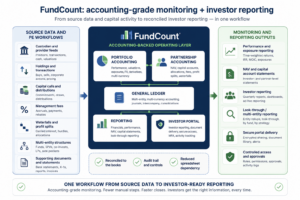
Quick verdict: FundCount positions itself as an integrated accounting and reporting solution for hedge funds, with investor reporting and portal delivery connected to the same workflow.
If your priority is producing investor-ready outputs that reconcile cleanly to accounting records (and distributing them through controlled workflows), FundCount is a strong first shortlist item.
Best for:
- Funds that want NAV, fees, allocations, and investor statements tied to the same source of truth
- Teams that want portal distribution with batch statement delivery and publishing controls
- Complex structures (classes, side pockets, series, master-feeder workflows)
Standout reporting capabilities (validate in demo):
- Striking NAVs by funds, classes, side pockets, partners, or series (as described in FundCount pricing materials).
- Automating P&L and cash flows between entities in master-feeder structures (as described in FundCount pricing materials).
- FundCount describes hedge fund reporting that can be prepared without “closing the books,” emphasizing access to financial information on demand.
- Investor portal delivery that includes batch statement delivery and two-way encrypted messaging (per portal description).
- FundCount describes MFA, encryption, and a single-tenant deployment model for its portal, and states customers retain data control (confirm in your security review).
- Structured data sharing and exports for investor self-service, with dashboards that refresh from shared structured data (per portal description).
Pros:
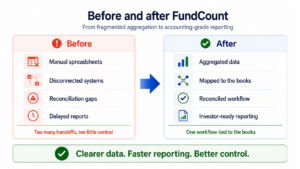
- Strong fit when reporting must reconcile to accounting records, and you want fewer handoffs
- Portal distribution reduces ad hoc email workflows
- Clear emphasis on handling complex entities and fee structures
Cons or trade-offs:
- If you need advanced risk analytics, exposures, or trading-centric reporting, you may still need specialized tools alongside it
- Implementation and integration design will determine how automated your close becomes
Integrations to verify:
- Prime broker and custodian file ingestion and reconciliation workflows
- Fund administrator handoffs (if you use one)
- Excel workflows and template refresh approach (FundCount mentions integrating Excel data for proprietary calculations).
- BI or data warehouse exports if you run a separate analytics layer
- SSO and access control approach for internal reviewers and investors
Pricing: FundCount lists hedge fund pricing “starting from $34,099 / year,” with notes about digital transformation and hosting fees and an availability note for funds not serviced by a fund administrator.
Questions to ask during the demo:
- Show a complete month-end workflow: from inputs to a draft NAV pack, to approvals, to a final investor statement release.
- Demonstrate tie-outs: how does the NAV pack connect back to the trial balance, reconciliations, and investor allocations?
- Show a complex structure example: classes, side pockets, and series. How do fees and allocations behave?
- Show portal publishing controls: bulk statement delivery, permissions, and how you prevent “two finals.”
- Show audit trail and evidence attachment for a changed number, plus how changes are approved.
- Show exports: what can you deliver to Excel and to your reporting archive with version history?
One platform for hedge fund reporting, accounting, and portal
Run the books, generate investor-ready reports, and publish statements through a secure investor portal.
Dynamo Software: Best for investor relations workflows and portal-based investor reporting distribution
Quick verdict: Dynamo positions its hedge fund offering around managing the investor lifecycle, including capital raising, investor communications, and tracking and reporting on investor performance in a centralized location.
If your biggest pain is investor communications, document distribution, and maintaining clean investor profiles, Dynamo can be a strong IR-driven reporting layer.
Best for:
- IR and ops teams that want centralized investor profiles, communications, and reporting distribution
- Firms that need an investor portal experience aligned with CRM data and permissions
- Managers that want to reduce ad hoc document requests by using a structured portal
Standout reporting capabilities (validate in demo):
- Hedge fund positioning emphasizes investor lifecycle management, communications, and reporting investor performance.
- Investor relations product highlights reporting and communicating with current investors, plus an integrated investor portal.
- Dynamo describes a secure, integrated investor reporting portal to share documents and data with prospective and committed investors and reduce ad hoc reporting requests.
- Investor relations materials describe providing LP access to reporting (including financial statements and performance reports) with permissioning based on CRM data (validate exactly how this maps to your investor reporting needs).
- Investor relations materials mention integrating data sources such as PitchBook and Preqin (confirm availability and scope in your package).
- Investor relations page mentions mass mailing workflows and engagement metrics (validate governance controls and compliance review steps).
Pros:
- Strong IR and communications orientation for hedge fund and alternatives managers
- Portal experience can reduce manual email workflows and repeated investor requests
- Clear narrative around investor profiles and relationship context
Cons or trade-offs:
- “Accounting-grade” close and NAV tie-outs may still live in your accounting stack (validate what Dynamo calculates vs what it displays)
- Performance metrics and reporting depth can vary by strategy, confirm hedge fund specific needs in demos
Integrations to verify:
- Your accounting system and where NAV and allocations originate
- CRM and email integration details (Outlook integration is mentioned)
- Data sources for performance reporting and investor-level calculations
- Document management, tax center workflows, and bulk distribution controls
Pricing: Typically quote-based (validate scope, user counts, portal features, and integrations during commercial review).
- Show how monthly investor reporting is published through the portal, including permissions, drafts vs finals, and reissues.
- Show how reporting numbers are sourced: do you calculate them, ingest them, or display them from another system?
- Show investor-level reporting across multiple funds or accounts and how the entity model handles complex structures.
- Show the communications workflow: mass mailing, watermarking or tracking, and the compliance review process.
- Show how tax documents are organized and distributed, and how investors find them.
- Show exports or APIs for downstream analytics or archiving workflows.
Chronograph: Best for hedge fund direct investors that need portfolio monitoring, valuation, and auditable data collection
Quick verdict: Chronograph has a dedicated positioning for “hedge fund direct investors,” describing reporting, valuation, and analytics tools, plus automation for portfolio company data collection and information warehousing.
If you have private positions, direct investments, or portfolio-company KPI collection needs inside a hedge fund platform, Chronograph can be a strong monitoring and reporting layer, especially when auditability and validated inputs matter.
Best for:
- Hedge fund direct investors with private positions and portfolio company KPI collection requirements
- Teams that need validations, variance checking, and audit histories on collected metrics
- Firms that want to bring finance, IR, and portfolio monitoring workflows into a shared data layer
Standout reporting capabilities (validate in demo):
- Chronograph describes automating data collection, analytics, valuations, reporting, and information warehousing for hedge fund direct investors.
- Chronograph emphasizes auditability, including full audit histories, real-time validations, and variance checking.
- Chronograph describes configurable data collection without templates, which can matter if your KPI schema changes over time (validate governance and standardization).
- Chronograph has announced Snowflake integrations with partners (in a private markets context) to automate cash flow ingestion and data replication (validate whether and how this fits your hedge fund reporting stack).
Pros:
- Strong governance posture for KPI collection and auditable reporting workflows
- Good fit for hybrid strategies and private positions where monitoring and reporting are not “just the books”
- Clear emphasis on validation and audit histories
Cons or trade-offs:
- Not positioned as a full hedge fund accounting system for striking NAV, fees, and allocations
- You will likely still need an accounting system and a distribution layer depending on investor delivery requirements
Integrations to verify:
- Accounting system and cash flow sources, including how data is replicated or exported
- Data warehouse connectivity, especially if you use Snowflake or similar
- Export formats: PDF, Excel, data feeds, and how reporting templates are handled
- Identity and access controls for internal teams and investor-facing workflows
Pricing: Quote-based.
- Show portfolio company KPI collection in practice: templates vs dynamic configuration, reminders, validations, and exception handling.
- Show the audit trail: find a metric change and show who changed it, when, and what checks were triggered.
- Show a valuation workflow: inputs, approvals, and how valuations flow into reporting outputs.
- Show how reporting is produced and exported, and what is “official” vs “monitoring.”
- Show data warehousing or replication options if you need a central analytics layer.
- Show how IR and finance teams collaborate in the platform and how responsibilities are separated.
Carta: Best for private fund style reporting with fund admin plus an LP portal and document distribution workflows
Quick verdict: Carta positions Fund Administration as a centralized platform plus service where fund CFOs can view up-to-date fund performance, manage fund activity, and communicate with the fund admin in one place.
It also describes an LP portal experience where investors can access documents and fund-level performance data, plus commitments and related metrics.
Important fit note: Carta’s Fund Admin page explicitly lists venture capital, private equity, and private credit as supported asset classes. If your hedge fund is structured more like an open-ended trading fund, confirm fit carefully.
Best for:
- Managers who want software plus a fund administration service model
- Private fund style vehicles where LP portal access, document sharing, and fund event workflows matter
- Teams that want structured document distribution and portal access rather than manual email workflows
Standout reporting capabilities (validate in demo):
- Carta describes a centralized fund admin platform where you can view performance, initiate fund events like capital calls and distributions, and communicate with your fund admin via secure messaging.
- Carta describes LP portal access where investors can access documents, fund-level performance data, commitments, and related details (validate whether this matches hedge fund investor reporting expectations).
- Carta support materials describe document sharing workflows, including a “PDF divider” process for sending multiple documents to LPs using one source PDF.
Pros:
- Clear platform + service orientation for teams that want to outsource parts of administration
- Strong portal and document distribution story for private fund workflows
Cons or trade-offs:
- Fit can vary for hedge fund strategies, especially if you need trading-centric reporting or specialized fee mechanics
- Validate how “monthly NAV reporting” maps to your exact structure and investor statement requirements
Integrations to verify:
- Expense and general ledger connectivity (Carta mentions connecting expense tools such as Ramp in its fund admin page).
- Document workflows: template management, bulk upload, investor segmentation, and audit logs
- Export formats and archive approach for final reporting packs and reissues
- Identity and access controls for internal reviewers and investor portal users
Pricing: Quote-based and service-dependent (validate in sales process).
- Show the LP portal experience for an investor: what documents, performance data, and reporting history are visible, and how permissions work.
- Show document sharing at scale: bulk distribution, segmentation, and controls to prevent the wrong investor seeing the wrong document.
- Show how fund performance data is computed and refreshed, and what is “real-time” vs periodic.
- Show versioning and reissues: how do you replace a statement and prove investors see only the intended final?
- Show how your admin communication and approvals are recorded in the system.
- Show export options for auditors, tax providers, and internal reporting archives.
How to choose: fast decision tree
Use this decision tree to get to a shortlist quickly:
- If reporting must reconcile to accounting workflows and you want controlled portal delivery for statements and NAV reporting, start with FundCount.
- If your biggest pain is investor communications, investor profiles, and portal distribution connected to IR workflows, evaluate Dynamo Software.
- If you are a hedge fund direct investor with private positions and need auditable KPI collection plus reporting and valuation workflows, evaluate Chronograph.
- If you want a software plus fund admin service model with LP portal and document sharing workflows for private fund structures, evaluate Carta (and confirm fit for hedge fund structures early).
FAQs
What is hedge fund reporting software?
Hedge fund reporting software is the set of tools used to produce investor-ready reporting outputs like NAV packs and monthly statements, plus the controls that turn drafts into finals and distribute them securely. A strong solution also supports evidence retention and tie-outs so the reporting is explainable. Validate whether the platform can show end-to-end traceability from source data to published investor statements.
What is the difference between hedge fund reporting software and hedge fund accounting software?
Accounting software is where the books, allocations, and fee calculations live. Reporting software is how those records become a controlled reporting pack and investor deliverables, including distribution and archiving workflows. In demos, ask which system is the source of truth for NAV and allocations, and which system is just displaying outputs.
What reports do hedge funds typically produce monthly for investors?
Many funds produce monthly investor statements and a supporting NAV pack or reporting set, with variations based on strategy and fund terms. The key is consistency and tie-outs so numbers can be reviewed and defended. In demos, ask to see the default monthly package and the supporting schedules that make it auditable.
How do you automate hedge fund monthly NAV reporting?
Automation comes from standardized inputs, repeatable tie-outs, and controlled template outputs, not just a “generate PDF” button. The workflow should cover data collection, QC, approvals, and distribution, with preserved history for reissues. In demos, ask the vendor to show the full workflow from draft to final and how the final is locked and archived.
What does “accounting-grade reporting” mean for hedge funds?
It means the reporting is tied back to accounting records (trial balance, reconciliations, allocations) and can withstand review by controllers, auditors, and sophisticated investors. A NAV pack should be explainable, with tie-outs and evidence that support the final number. Validate whether the system can show tie-outs and approvals, not just final statements.
Can hedge fund reporting software generate investor statements in bulk?
Some platforms emphasize batch production and distribution of statements, while others focus on portal delivery of documents sourced elsewhere. For example, FundCount’s portal description highlights batch statement delivery, and Carta support materials describe batch document workflows like the PDF divider approach. In demos, ask to generate and distribute 100+ investor statements with correct permissions in one workflow.
Do you need an investor portal for hedge fund investor reporting?
A portal is often worth it if you want controlled distribution, self-service access, and fewer ad hoc requests. Dynamo and FundCount both describe investor portal approaches focused on secure sharing and investor access, and Carta describes LP portal access for documents and performance data. Validate portal permissions, publishing controls, and the investor experience for finding historical documents.
What portal controls matter most for hedge fund reporting?
Look for draft vs final publishing controls, permissioning by investor, version history, and support for reissues without confusion. Version control is a real control because it prevents multiple “final” versions from circulating. In demos, force a reissue scenario and ask the vendor to prove how investors see only the intended version.
Can these tools support master-feeder, classes, series, and side pockets?
Some systems explicitly position for complex structures. FundCount pricing materials mention striking NAVs by classes, side pockets, and series, plus automating inter-entity flows for master-feeder structures. In demos, bring your real structure and ask the vendor to model it end-to-end and show how allocations and reporting roll up.
What audit trail features should hedge fund reporting tools include?
You want to track who changed what, when, and why, plus what validations ran and what approvals occurred. Chronograph’s hedge fund direct investor positioning explicitly emphasizes auditability and full audit histories on collected data, which is useful for governance expectations. In demos, pick one KPI or valuation input and have the vendor show the full audit history and approval path.
What integrations matter most for hedge fund reporting automation?
The “must-have” integrations depend on your stack, but common needs include fund administrator outputs, prime broker files, accounting data sources, CRM permissions, and BI or data warehouse exports. Chronograph has published information about Snowflake integrations in a private markets context, which is relevant if you centralize reporting data in a warehouse. In demos, ask the vendor to walk through the exact data flow from your sources to the final investor report.
Can hedge fund reporting software handle regulatory reporting like Form PF or AIFMD Annex IV?
Some platforms may support data collection and controls that make regulatory reporting easier, but regulatory filings often involve specialist workflows and service providers. The SEC’s Form PF materials describe different filing requirements for large hedge fund advisers, and AIFMD requires transparency reporting to competent authorities in the EU and UK context. Validate whether the platform can export the required data in the format your compliance process needs, and confirm responsibilities with counsel and your administrator.
How should hedge funds evaluate security for reporting and investor portals?
Start with MFA, encryption, role-based permissions, and how the vendor handles data access. FundCount describes a single-tenant portal model and emphasizes customer data control, while other vendors provide portal experiences that should be evaluated for access and permission design. In demos, ask for a security overview and specifically ask how internal vendor access is controlled and logged.
What should I ask vendors to demonstrate in a hedge fund reporting software demo?
Ask for a realistic month-end workflow: draft outputs, QC, approvals, and final publishing. Then force two scenarios: a restatement reissue, and a permissions check where one investor must not see another investor’s documents. Finally, ask for integration proof, showing how source data is ingested and how the final reporting pack can be exported or archived.
Methodology and last updated
What “best” means in this guide
“Best” means best fit for hedge fund reporting workflows, based on:
- Ability to support controlled month-end reporting (draft to final)
- Investor delivery workflows and portal controls
- Auditability and governance features
- Integration realities with accounting, admin, and data sources
- Fit for hedge fund strategy and structure (open-ended trading vs private fund style vehicles)
How the shortlist was evaluated
We used publicly available vendor pages and documentation to understand each platform’s positioning and feature emphasis. Key sources included:
- FundCount hedge fund and pricing pages, plus FundCount’s investor portal description.
- Dynamo’s hedge fund positioning, investor relations, and investor portal materials.
- Chronograph’s hedge fund direct investor positioning and its published data integration announcements.
- Carta’s fund administration positioning plus support documentation for document sharing workflows.
- Regulatory context references for Form PF and AIFMD transparency reporting.
Disclosures
This is an editorial comparison designed to help with shortlisting and demo planning. Always validate capabilities and controls in your own demos, security reviews, and reference calls.
Last updated: March 9, 2026