Not long ago, a quarterly report arriving in a client’s inbox was enough to signal attentiveness and checked the client communication box. A polished PDF, a well-structured breakdown of holdings and performance. It showed professionalism. It showed care. And for a long time, it worked.
But something has shifted. The same clients who once waited patiently for those updates now check their brokerage apps before breakfast. They track spending in real time, get instant alerts when a stock moves, and monitor their crypto portfolio from their watch. Then they turn to their wealth manager and ask a perfectly reasonable question. “Why can’t I see my full picture like this?”
And it is perfectly reasonable. High-net-worth individuals tend to be more digitally fluent, more globally connected, and more accustomed to immediacy than the average investor. Real-time reporting has become the baseline they experience everywhere else in their financial lives. A monthly PDF, however well-crafted, feels like a relic by comparison.
For wealth managers and multi-family offices, this shift in expectations is worth taking seriously. Firms that invest in stronger client communication through dashboards and a family office client portal will find it easier to retain trust and stand out. Those that stick with old-school reporting may discover that even strong performance doesn’t stop clients from wondering what they’re missing.
The growing demand for better client communication
A decade ago, most high-net-worth clients were comfortable receiving a quarterly report and scheduling a periodic call with their advisor. The information they needed was there. It was accurate. And the pace of delivery matched the pace of decision-making.
That dynamic has changed considerably. Today’s HNW investors live in an environment where financial information flows constantly. They can open a brokerage app and see real-time performance. They get push notifications when a holding crosses a threshold. They can pull up asset allocation breakdowns on a phone screen while waiting for a flight. This level of immediacy has reshaped what people consider normal when it comes to financial visibility.
And when those same individuals turn to their wealth manager or family office, they bring those expectations with them. They don’t necessarily want to manage their own portfolios. But they do want to see where things stand without having to ask and wait. The desire for better client communication isn’t driven by distrust. It’s driven by familiarity with what’s already possible elsewhere.
This is especially true among next-generation family members who are beginning to take a more active role in overseeing wealth. Many of them have grown up with instant access to data as a default. For them, a static PDF delivered weeks after month-end doesn’t feel thorough. It feels slow. And that perception gap can quietly erode confidence, even when the underlying performance is strong.
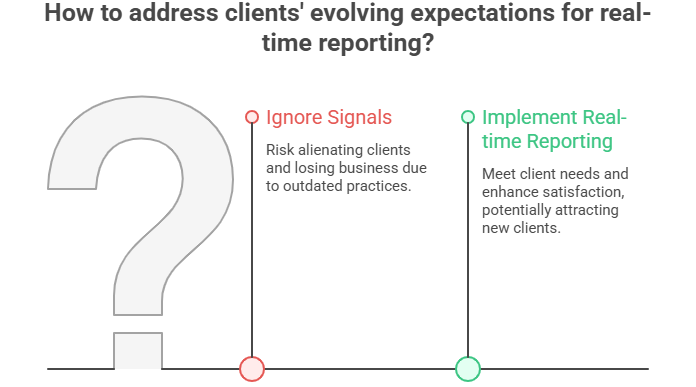
What makes this shift tricky for wealth managers is that it’s rarely expressed as a formal complaint. Clients may not say, “Your reporting is outdated.” Instead, they ask things like, “Is there a way I can just log in and see this?” or “Can you send me something I can check on my phone?” These are small signals, but they point to a larger expectation around real-time reporting that is becoming harder to ignore.
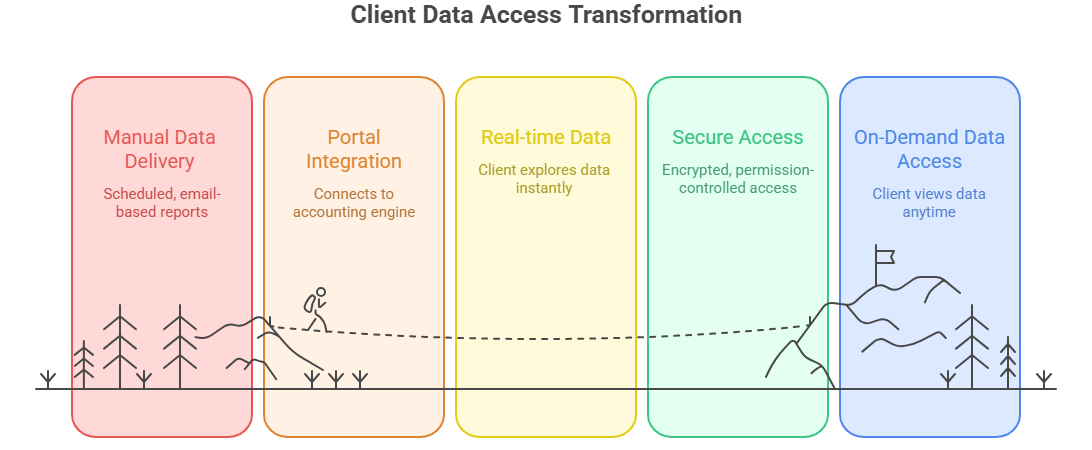
Family offices that recognize this early have started investing in tools that close the gap. Some have adopted client portals where investors can log in, view interactive reports, and access documents on their own time. FundCount’s Investor Portal, for example, allows firms to publish NAV statements and reports directly from their accounting workflow, giving clients self-serve access to the information they care about most, with encryption and layered approvals built in.
The shift toward on-demand visibility isn’t a passing trend. It reflects a broader change in how people interact with their finances. For wealth managers, the question isn’t whether clients want this kind of access. It’s how quickly a firm can adapt its client communication to deliver it.
Why monthly PDFs and static reports fall short
There’s nothing inherently wrong with a well-built PDF report. For years, it was the standard deliverable in wealth management, and many firms still produce them with care. The problem isn’t quality. It’s timing.
A monthly or quarterly PDF is, by definition, a snapshot of the past. By the time the data is gathered, reconciled, formatted, reviewed, and distributed, the information inside it may already be weeks old. For a client watching markets move daily or tracking a capital call on a private equity commitment, that lag creates a disconnect between what they know is happening and what their report reflects.
There are also practical limitations that tend to frustrate clients over time. Static reports can’t be filtered or explored. If a client wants to drill into a specific asset class, compare performance across entities, or isolate a particular time period, they have to reach out and ask someone to pull it together. That back-and-forth adds friction to what should be a straightforward need. It also creates more work for the advisory team, which ends up fielding one-off data requests that a more interactive setup could handle automatically.
Then there’s the formatting issue. A 30-page PDF may contain everything a client needs, but it buries key insights inside dense tables and long appendices. Many clients, especially those managing multi-generational wealth across trusts, partnerships, and holding companies, want a high-level view first and the ability to go deeper when they choose. Static documents don’t offer that flexibility.
For multi-family offices, the challenge compounds. Each client may have different reporting preferences, different entity structures, and different thresholds for what they consider relevant. Producing tailored static reports for every client, every period, becomes a resource-intensive process. And even then, the result is a document that’s outdated the moment it’s sent.
This is where the gap between traditional reporting and modern client communication becomes most visible. The data itself may be sound, but the delivery method limits how useful it actually is to the person receiving it. Firms that rely exclusively on static reports risk appearing less responsive than they actually are, simply because their reporting format can’t keep pace with client expectations.
What clients are actually asking For
The shift in reporting expectations rarely shows up as a bullet point in a client review meeting. It tends to surface more casually, in offhand comments and small requests that are easy to underestimate.
A family member joining a quarterly call for the first time might ask, “Is there a dashboard I can look at between meetings?” A long-standing client forwarding a screenshot from their retail brokerage account might write, “Can we get something like this for my full portfolio?” A next-gen heir stepping into a more active role might simply ask, “Is there an app?”
Most of the time, the client already assumes this kind of access exists and is genuinely surprised when it doesn’t. That surprise is worth paying attention to, because it reveals how far everyday financial technology has moved ahead of what many advisory firms currently offer.
What clients are describing, even if they don’t use the technical language, is a family office client portal. A secure, always-available place where they can log in, see consolidated positions, review recent activity, and access documents without sending an email and waiting for a reply. They want the same sense of control and visibility they get from every other financial platform they use.
It’s also worth noting what they’re not asking for. Most clients aren’t looking to replace their advisor with a screen. They still value the relationship, the judgment, and the personal guidance. What they want is to supplement that relationship with better access to information between conversations. They want to feel informed when they sit down for a review, not like they’re hearing everything for the first time.
There’s a generational layer here too. As wealth transfers accelerate and younger family members become more involved, the expectation of digital access becomes less of a preference and more of a baseline requirement. These individuals have managed banking, investing, budgeting, and payments through apps for most of their adult lives. Asking them to rely on emailed PDFs and scheduled phone calls for their most significant financial relationships feels like a step backward.
For wealth managers, these informal client signals are actually valuable data points. They indicate where the firm’s client communication is falling behind and where a relatively focused investment in technology, like adopting an interactive reporting tool or launching a client portal, could meaningfully improve the client experience without overhauling the entire operation.
How leading family offices are responding
The shift in client expectations hasn’t gone unnoticed. Across the industry, family offices and wealth managers are actively rethinking how they deliver information, and the numbers reflect it. According to the 2025 North America Family Office Report from RBC and Campden Wealth, 69% of family offices have now adopted automated investment reporting systems, up from 46% just one year earlier. That kind of jump signals something more than a gradual trend. It suggests a growing recognition that manual, periodic reporting is becoming an operational liability.
The most sought-after tools, cited by 27% of respondents in the same report, are wealth aggregation platforms and automated reporting systems that consolidate data from multiple custodians and financial institutions into a single, up-to-date view. For firms managing complex, multi-entity structures across trusts, partnerships, and holding companies, this kind of consolidation has a direct impact on how quickly and accurately they can communicate with clients.
One of the more meaningful changes is the move toward client portals. Rather than producing a report and emailing it on a schedule, firms are giving clients the ability to log in and explore their data in real time. FundCount’s Investor Portal, for instance, connects directly to the firm’s accounting engine, meaning the data a client sees in the portal flows straight from the general ledger without manual re-entry. NAV statements, partnership reports, and financial documents can be published from within the reporting workflow and made available to clients through encrypted, permission-controlled access. Clients can view their information when they want, on any device, without waiting for someone to send it.
This kind of setup also reduces internal workload. When clients can self-serve on routine questions like “Where do I stand as of today?” or “Can I see my latest capital statement?”, the advisory team spends less time responding to one-off requests and more time on the work that actually requires their judgment. The operational case for better client communication tools is strong even before you factor in the client satisfaction side.
Some firms are going further, building dashboards that allow clients to interact with their data through filters, visualizations, and drill-downs across asset classes, entities, or time periods. These tools are especially useful for next-generation family members who are beginning to participate in oversight and expect the kind of digital experience they encounter in every other area of their financial lives. The 2025 RBC/Campden report also found that nearly 50% of family offices expect a generational leadership transition within the next ten years. The firms investing in modern reporting infrastructure now are positioning themselves for that handoff.
The competitive edge of transparent client communication
There’s a practical reason why real-time reporting and better client communication matter beyond client satisfaction. They affect retention. And in wealth management, retention is everything.
PwC research found that nearly half of high-net-worth investors (46%) are planning to switch wealth management providers or add new relationships within the next 12 to 24 months. Among investors under 55, the rate is even higher. The primary reasons cited aren’t poor performance. They’re unmet needs, including a lack of digital access, limited transparency, and insufficient personalization.
The generational dimension makes this even more pressing. The Capgemini World Wealth Report 2025 found that 81% of next-generation HNW individuals plan to replace their parents’ wealth management firm within one to two years of inheriting assets. Most cited poor digital offerings or a narrow range of services. With an estimated $124 trillion expected to change hands by 2048 according to Cerulli Associates, and more than $62 trillion of that coming from HNW and UHNW households alone, the ability to retain the next generation is becoming a defining factor for firm survival.
Transparency plays a central role in this. When clients can access their portfolio data, review performance, and track activity without having to initiate a request, trust deepens. They feel like participants in the management of their wealth rather than passive recipients of periodic summaries. And that feeling of involvement makes them far less likely to look elsewhere.
It also changes the nature of the advisory relationship for the better. When clients arrive at a review meeting already informed, the conversation can move to strategy, planning, and forward-looking decisions instead of spending time catching up on what happened last quarter. The advisor becomes more valuable, not less, because the routine information layer is already handled.
For multi-family offices, there’s also a differentiation angle. In a competitive landscape where investment performance between firms often falls within a narrow range, the quality of the client experience becomes a meaningful differentiator. A firm that offers a secure family office client portal with real-time visibility into consolidated positions, interactive reporting, and on-demand document access will stand out against one that still relies on quarterly PDFs and scheduled phone calls.
The data supports this. Envestnet research found that 39% of millennial HNW individuals switched providers in the past year specifically because of a lack of transparency. That number should give any firm pause. It also suggests that the cost of upgrading client communication infrastructure is likely far less than the cost of losing a client relationship, especially one tied to a multigenerational wealth transfer.
The risk of standing still
Nothing in this article is meant to suggest that firms still using traditional reporting are failing their clients. Many of them deliver excellent investment results, maintain deep relationships, and operate with real integrity. The concern isn’t about what they’re doing wrong. It’s about what may quietly erode over time if the way they communicate doesn’t evolve alongside client expectations.
The statistics covered earlier in this piece tell a clear story. Nearly half of HNW investors are considering changing providers in the near future, according to PwC. Capgemini’s research shows that 81% of next-gen heirs plan to leave their parents’ wealth management firm shortly after inheriting. And the most frequently cited reasons for switching aren’t about returns. They’re about access, transparency, and digital experience.
These numbers don’t describe a distant future. The great wealth transfer is already underway, with Cerulli Associates projecting $124 trillion in assets changing hands by 2048. Family offices that haven’t modernized their client communication approach will be meeting this moment with tools built for a different era. And in many cases, the client won’t voice their dissatisfaction directly. They’ll simply move on.
That’s what makes this particular risk easy to underestimate. A client who receives strong returns but limited visibility may stay for a while out of inertia or loyalty. But when a triggering event occurs, whether it’s a generational transition, a market downturn that raises questions, or simply an encounter with a firm that offers a better digital experience, the absence of real-time reporting and accessible communication becomes a deciding factor.
The firms best positioned for the next decade are the ones treating reporting infrastructure as a core part of their client relationship, not an afterthought. That means investing in tools that allow clients to engage with their financial data on their own terms. Platforms like FundCount give family offices the ability to do this without overhauling their entire operation. Because the Investor Portal connects directly to the accounting engine, firms can offer clients self-serve access to consolidated reporting, NAV statements, and financial documents while maintaining the data integrity and security controls they already rely on.
Adopting this kind of technology doesn’t require abandoning the personal, relationship-driven model that defines great wealth management. It strengthens it. When the information layer works well, advisors are freed up to focus on what they do best, and clients feel more connected to their wealth and the people managing it.
The question for most firms is whether they’ll adapt before the cost of waiting becomes harder to recover from.