Asset Vantage is a family office accounting and reporting platform positioned around integrated general ledger, performance reporting, investment data aggregation, secure document management, and consolidated net worth reporting across multiple entities. Its family office page says AV is built for single-family offices that need visibility across complex portfolios, including private investments, venture capital, hedge funds, and illiquid assets. Its pricing page also says pricing is entity-based rather than AUM-based or performance-based, with core pricing covering portfolio accounting, performance reporting, data aggregation, and multi-entity support.
But “Asset Vantage competitor” searches usually come from family offices that need one or more of the following:
- A different accounting and reporting workflow
- Stronger investor portal publishing from the reporting workflow
- More flexible analytics and stakeholder reporting
- Deeper wealth aggregation and entity visualization
- A broader operating platform that includes tax, workflows, bill pay, documents, and audit trails
- Optional outsourced services around reconciliation, reporting, or back-office operations
This guide compares 5 Asset Vantage competitors in total across the things family offices actually validate in demos: features, integrations, pros and cons, pricing approach, implementation effort, performance considerations, and best-fit use cases. FundCount is listed first because it covers a common “reason to compare” against Asset Vantage: accounting, reporting, and portal publishing tied together in one workflow.
Key takeaways
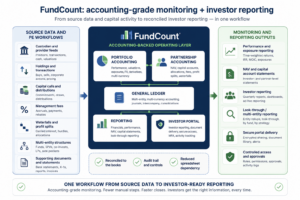
- If your Asset Vantage alternative requirement is really accounting-grade reporting plus investor portal publishing from one system of record, start with FundCount. FundCount positions its family office platform around portfolio accounting, partnership accounting, general ledger, alternative investment document intelligence, reporting, investor portal, and data aggregation, with NAV statements and documents published straight from the reporting workflow.
- If your bottleneck is multi-asset, multi-entity analytics and custom reporting, Addepar deserves a top spot on the shortlist. Addepar emphasizes complete views across asset class, legal entity, and currency, complex ownership structures, real-time custom reporting, alternatives document workflows, and portal or mobile access.
- If your world is UHNW total wealth, global entity mapping, direct data feeds, and secure visibility, Masttro is a close Asset Vantage-style alternative. Masttro positions itself around aggregating, visualizing, and managing complex portfolios across asset classes, jurisdictions, currencies, and entity structures.
- If you want GL-backed reporting plus optional outsourced services, Archway Platform is a strong contender. Archway unifies accounting, investment data aggregation, reporting, partnership accounting, bill payment, client portal delivery, and flexible outsourced services.
- If you want a broad family office operating platform across entity management, accounting, tax, documents, workflows, bill pay, trust accounting, and audit trail, Eton Solutions AtlasFive is built for that single-platform ambition.
Quick comparison table
| Platform | Best for | Accounting depth | Portal / reporting strength | Integration posture | Pricing posture |
| FundCount | Reporting and portal delivery tied to the books | High | High | Data aggregation, AppUniverse, exports, implementation-specific integrations | Public SFO starting price |
| Addepar | Analytics-led reporting across complex portfolios | Low to medium | High | Direct feeds, partner ecosystem, APIs | Quote-based |
| Masttro | UHNW total wealth view and entity mapping | Low to medium | High | Direct custodian feeds, data aggregation, secure sharing | Not AUM-based |
| Archway Platform | Core GL, reporting, portal, and optional services | High | High | Direct feeds, APIs, platform plus services | Quote-based |
| Eton AtlasFive | End-to-end family office operations | High | Medium to high | Platform plus integrations, AI, workflow ecosystem | Quote-based |
Note: These categorizations are based on current vendor product positioning and public documentation. Validate accounting depth, portal controls, integrations, workflow governance, and implementation scope in demos.
AssetVantage alternative focused on reporting you can defend
FundCount keeps accounting and reporting aligned so family office outputs stay consistent and explainable.
5 Asset Vantage competitors and alternatives
FundCount: Best for accounting-grade reporting plus investor portal publishing
One-line verdict: Choose FundCount when you want family office accounting, performance reporting, partnership accounting, and investor-style portal delivery anchored to the same accounting system.
Best for
- Single family offices that run accounting workflows internally
- Offices where reports must tie back to entity books, GL entries, allocations, and reconciled statements
- Teams managing private equity, real estate, debt, derivatives, partnerships, or nested entities
- Offices that want a portal for statements, documents, and secure communication without moving data into a separate delivery tool
Key capabilities
FundCount’s family office page positions the platform around portfolio accounting, partnership accounting, general ledger, alternative investment document intelligence, reporting, investor portal, and data aggregation. It also says FundCount supports equities, derivatives, private equity, real estate, and debt in the same portfolio view, with performance measures and attribution to explain what drove returns.
FundCount’s partnership accounting covers contributions, distributions, series, waterfalls, capital statements, and partnership tax outputs from the same underlying data. Its general ledger supports multi-currency and multi-book accounting for IFRS and GAAP, entity consolidation, income statements, balance sheets, and NAV reports.
FundCount’s investor portal sits inside the FundCount ecosystem, so data flows from the accounting engine to investors without manual re-keying. The portal supports personalized bulk statements, structured performance data, bank-grade encryption, MFA, batch workflows, branding controls, and single-tenant deployment on private cloud or on-premises.
Integrations
FundCount should be evaluated around your real source systems: custodians, brokers, banks, alternative managers, PDFs, Excel files, BI exports, accounting workflows, and portal delivery. Its family office page specifically highlights custodian and data-provider feeds, automated double-entry accounting, mapping control, and private cloud or on-premises deployment options.
Pros
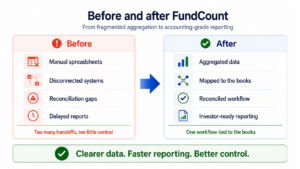
- Strong fit when the real problem is “reports must match the books.”
- Better fit than reporting-only tools if the office needs GL, partnership accounting, allocations, and formal financial statements.
- Built-in portal publishing can reduce manual report distribution and version confusion.
- Public family office pricing gives buyers a clearer starting point than many quote-only competitors.
Pricing approach
FundCount publicly lists Single Family Office pricing starting from $34,099 per year, with digital transformation and hosting fees applying separately.
Implementation and TCO notes
Biggest effort drivers include entity structures, historical transactions, portfolio and partnership accounting setup, alternative investment document workflows, report templates, portal permissions, and user training.
Performance considerations
Benchmark quarter-end report generation, batch statement production, portal publishing, alternatives document processing, dashboard refresh speed, and audit trail completeness.
Demo questions
- “Show the end-to-end workflow from accounting entries to performance reporting to portal publishing.”
- “How do you handle multi-entity rollups and look-through reporting?”
- “Show a private fund statement being processed into accounting and reporting workflows.”
- “Show how a corrected report is reissued without exposing the wrong version.”
- “What is native, what is configured, and what requires implementation services?”
One system behind your family office reporting stack
Pair portfolio and aggregation tools with FundCount for accounting-first reporting and multi-entity consolidation.
Addepar: Best for analytics-led reporting across complex portfolios
One-line verdict: Addepar is a strong Asset Vantage alternative when the top priority is portfolio analytics, flexible reporting, multi-asset data aggregation, and stakeholder-ready presentation across complex ownership structures.
Best for
- Family offices that need consolidated reporting across asset classes, entities, and currencies
- Offices prioritizing analytics and stakeholder reports over native accounting
- Teams that want real-time custom reporting
- Offices that need a modern portal or mobile experience for family members, lawyers, accountants, and advisors
Key capabilities
Addepar centralizes family office financial information in a single place and provides a complete view across accounts and assets, regardless of asset class, legal entity, or currency. It also says the platform supports analysis across complex ownership structures, multi-asset classes, and multi-currency scenarios, with transaction-level drill-down and customized reports that update in real time.
Addepar also highlights alternatives document collection and data management, using AI-driven workflows to process unstructured alternative investment documents into verified data. The platform provides a customizable portal for stakeholders and mobile or iPad apps for secure family access.
Integrations
Addepar should be validated around custodian feeds, private asset workflows, portals, APIs, internal data warehouses, Excel exports, and advisor or stakeholder access. The core demo should show how data enters the platform, how it is normalized, how ownership structures are modeled, and how final reports are delivered.
Pros
- Strong fit when consolidated analytics and flexible reporting are the main pain points.
- Good option when family members, advisors, and investment teams need different views of the same portfolio.
- Useful for complex asset-class, legal-entity, and currency scenarios.
- Real-time reporting is attractive for investment committees and principals.
Cons / limitations
- If you need a native family office accounting system of record, validate what is handled in Addepar versus what remains in a separate accounting core.
- Alternatives automation and private asset workflows should be tested with your real documents and reporting cycle.
Pricing approach
Contact vendor. Public product pages reviewed here do not list standard family office pricing.
Implementation and TCO notes
Biggest effort drivers include custodian onboarding, entity modeling, data normalization, report design, alternatives workflow setup, user permissions, and custom integration work.
Performance considerations
Benchmark report refresh speed, multi-currency calculations, look-through logic, alternatives data workflows, data quality exception handling, and export performance.
Demo questions
- “Show a consolidated report across a trust, LLC, partnership, and individual.”
- “Show what updates in real time versus on batch.”
- “Show how complex ownership structures are modeled.”
- “Show how family members, advisors, and accountants see different views.”
- “Show the data export and API path, not just the integration catalog.”
Masttro: Best for UHNW total wealth visibility and entity mapping
One-line verdict: Masttro is a strong Asset Vantage competitor when the buyer wants global wealth aggregation, entity mapping, private asset visibility, secure communication, and a family-facing total wealth view.
Best for
- UHNW families and family offices that want a real-time picture of total wealth
- Offices with global custodians, private assets, collections, real estate, and complex entities
- Teams prioritizing entity mapping and secure visibility
- Buyers who want pricing that is not tied to AUM
Key capabilities
Masttro says it aggregates, visualizes, and manages complex portfolios across all asset classes, jurisdictions, currencies, and entity structures. Its family office page describes the platform as a way to consolidate every detail of family wealth into one system, with a real-time picture of wealth across asset classes and 100 percent data privacy.
Masttro also highlights 650+ direct data feeds, 7 million daily transactions, 300,000 alternative investments, Global Wealth Map, data aggregation, Alternatives AI, portfolio management, and security. Its data aggregation section says the platform ingests assets in any currency through 650+ custodian connections.
Integrations
Masttro should be evaluated around direct custodian feeds, private investment document processing, entity mapping, cash and liquidity tracking, mobile access, and secure stakeholder communication.
Pros
- Strong fit for total wealth visibility across global assets and entity structures.
- Useful when the family wants intuitive entity mapping and family-facing dashboards.
- Non-AUM pricing can be attractive for large families.
- Strong security and privacy positioning.
Cons / limitations
- Validate accounting depth if your office needs full GL, entity books, financial statements, and reconciled accounting outputs inside the same system.
- Private asset automation and AI workflows should be tested with your own statements, capital calls, and valuation documents.
Pricing approach
Contact vendor. Masttro publicly states that its pricing model is not based on AUM.
Implementation and TCO notes
Biggest effort drivers include custodian connectivity, entity mapping, alternative asset setup, document workflow configuration, user permissions, and stakeholder portal design.
Performance considerations
Benchmark dashboard load times, feed refreshes, private asset updates, mobile experience, entity map responsiveness, and secure report sharing.
Demo questions
- “Show the full wealth map across trusts, LLCs, foundations, and individuals.”
- “Show two custodian feeds, one private fund, and one direct investment in the same dashboard.”
- “Show what is real time, what is daily, and what requires manual review.”
- “Show family member, trustee, advisor, and accountant permissions.”
- “Show how reports and documents are shared securely.”
Archway Platform: Best for GL-backed reporting plus optional outsourced services
One-line verdict: Archway is a strong Asset Vantage alternative when the family office wants a core general ledger, investment data aggregation, reporting, client portal delivery, bill pay, partnership accounting, and the option to outsource back-office workflows.
Best for
- Single and multi-family offices with complex accounting and reporting operations
- Offices that want platform plus services flexibility
- Teams that need 200+ report templates and automated report packages
- Families that want a mobile client portal connected to accounting and reporting
Key capabilities
Archway says its platform is trusted by more than 400 wealthy families and helps single and multi-family offices streamline core accounting, investment, and reporting operations. It covers partnership accounting, bill payment, financial data aggregation, client reporting, and total wealth reporting in a single family office software solution.
Archway highlights automated direct data feeds with custodians, brokerage firms, banks, and other sources, plus flexible APIs. It supports master-feeder, fund-of-funds, and nested entity structures, consolidates data across entities, asset classes, custodians, managers, currencies, and geographies, and tracks assets such as equities, bonds, cash, hedge funds, private equity, and personal assets.
Its reporting library includes 200+ report templates covering financial statements, asset allocation, investment activity, performance, and risk. Archway also supports automated recurring and ad hoc report packages, performance reporting using time-weighted or money-weighted returns, and a mobile client portal with dashboards, configurable data views, and secure document sharing.
Integrations
Validate direct feed coverage, API needs, client portal permissions, document management, bill pay, partnership administration, accounting close workflows, and outsourced service boundaries.
Pros
- Strong fit for family offices that need accounting depth plus reporting maturity.
- Optional outsourced services can help lean teams scale.
- Good portal and report-pack workflow for family members and advisors.
- Strong nested-entity and partnership accounting positioning.
Cons / limitations
- Implementation can be larger than a reporting-only rollout.
- Buyers should clarify which workflows are software-only, service-assisted, or fully outsourced.
- Public product pages reviewed here do not show list pricing.
Pricing approach
Contact vendor. Pricing depends on platform scope, data complexity, report package needs, and service model.
Implementation and TCO notes
Biggest effort drivers include GL setup, historical data, investment data integrations, report package design, portal configuration, bill pay workflows, and service scoping.
Performance considerations
Benchmark close workflows, recurring report package production, multi-entity consolidation, portal delivery, and outsourced service turnaround times.
Demo questions
- “Show one month-end close across multiple entities.”
- “Show a recurring family report package and an ad hoc report.”
- “Show the client portal on desktop and mobile.”
- “Show bill pay approvals and accounting entries.”
- “Show where software ends and services begin.”
Eton Solutions AtlasFive: Best for end-to-end family office operations
One-line verdict: Eton AtlasFive is a strong Asset Vantage alternative when the family office wants a broad operating platform, not just an integrated GL and reporting tool.
Best for
- Complex single and multi-family offices that want one operating platform
- Teams that need entity management, accounting, tax, bill pay, document workflows, and audit trails
- Offices that want integrated data governance and AI-supported workflows
- Larger organizations that want to standardize operations across teams and regions
Key capabilities
Eton Solutions says AtlasFive integrates entity management, portfolio management, GL and fund accounting, transaction processing, document management, and more into a unified digital ecosystem. The same page says the platform is used by single family offices, multi-family offices, wealth owners, RIAs, business managers, and private equity firms, and manages over $1.3 trillion in assets.
AtlasFive is positioned around a single source of truth across investment, accounting, and tax data. Eton also says AtlasFive manages 270+ workflows across investment management, accounting, tax, document management, bill pay, transaction processing, fund accounting, trust accounting, and more.
Its core accounting section includes integrated GL, trust accounting, partnership accounting, and tax ledger. The page also highlights automated data feed processing, automated journal entry creation, daily bank and book reconciliation, financial statement reports with transaction-level drill-down, trust reporting, partnership allocations, NAV, units, MOIC, IRR, and EtonAI extraction from capital call notices, distribution notices, and manager statements.
Integrations
Validate data feed processing, tax systems, accounting workflows, document workflows, bill pay, client reporting, entity management, audit trail, and migration from legacy systems.
Pros
- Strong fit for offices that want an operating system rather than a reporting layer.
- Deep workflow coverage across accounting, tax, documents, bill pay, and entities.
- Strong governance and audit trail story.
- Useful for large or complex offices that want standardization.
Cons / limitations
- Broad platform scope requires careful implementation planning.
- May be too much platform if the office only needs reporting and dashboards.
- Buyers should validate module depth versus best-of-breed alternatives.
Pricing approach
Contact vendor. Public pages reviewed here do not list standard package pricing.
Implementation and TCO notes
Biggest effort drivers include process mapping, workflow configuration, entity migration, document migration, accounting and tax data setup, bill pay design, and organizational adoption.
Performance considerations
Benchmark transaction processing, automated reconciliations, report production, workflow approvals, data access by role, and audit trail retrieval.
Demo questions
- “Show transaction ingestion, journal entry creation, reconciliation, and reporting in one flow.”
- “Show entity management and ownership relationships.”
- “Show trust and partnership accounting.”
- “Show workflow approvals and audit trails.”
- “Show what is native versus configured.”
Where Asset Vantage still fits
Asset Vantage remains a strong option when the family office wants integrated GL plus performance reporting, multi-entity data aggregation, secure document management, and consolidated net worth reporting without AUM-based pricing. Asset Vantage says it centralizes investment data aggregation across multiple entities, supports private investments, venture capital, hedge funds, and illiquid assets, provides performance reporting and full general ledger accounting, and maintains a single source of truth across the family’s net worth.
Asset Vantage may still be the right choice if:
- You want integrated GL and performance reporting in one family office platform.
- Entity-based pricing is a priority.
- You need consolidated net worth across multiple entities.
- You want data aggregation, document management, and portfolio accounting in one environment.
- Your family office operating model matches AV’s pricing and implementation structure.
Shortlisting competitors may make sense if:
- You want investor portal publishing directly from the reporting workflow.
- You need deeper partnership accounting, waterfalls, or NAV-style reporting.
- You want a broader family office operating platform with tax, trust accounting, bill pay, workflows, and AI-assisted document operations.
- You prefer a reporting-first analytics platform rather than an accounting-first tool.
- You need optional outsourced services for reconciliation, bill pay, reporting, or back-office support.
How to choose: decision tree
- If reports must reconcile to accounting records and you want portal publishing from the same workflow, start with FundCount.
- If your top pain is analytics, flexible reporting, custom dashboards, alternatives workflows, and complex ownership analysis, shortlist Addepar.
- If your priority is UHNW total wealth visibility, entity mapping, global assets, and non-AUM pricing, shortlist Masttro.
- If you want GL-backed reporting, client portal delivery, bill pay, and optional outsourced services, shortlist Archway Platform.
- If you want a full operating platform for entity management, accounting, tax, workflows, document management, bill pay, trust accounting, and audit trail, shortlist Eton Solutions AtlasFive.
FAQs
What is Asset Vantage used for?
Asset Vantage is used by family offices for integrated general ledger accounting, performance reporting, investment data aggregation, secure document management, and consolidated net worth reporting across multiple entities. It is especially relevant for offices that want GL and performance reporting in one platform.
What is the best Asset Vantage alternative for family offices?
The best alternative depends on the source of truth you need. FundCount is the strongest starting point if reporting must tie to accounting, partnership mechanics, and investor portal publishing. Addepar is stronger for analytics-led reporting. Masttro is strong for total wealth visibility and entity mapping. Archway is strong for GL-backed reporting plus optional services. Eton AtlasFive is strong for end-to-end family office operations.
Which Asset Vantage competitor is best for accounting-grade reporting?
FundCount is the clearest fit in this shortlist because it combines portfolio accounting, partnership accounting, general ledger, reporting, investor portal, and data aggregation in one family office ecosystem. FundCount also publishes NAV statements and documents from the reporting workflow and protects access with encryption and MFA.
Which Asset Vantage alternative is best for analytics and custom reporting?
Addepar is strongest for analytics-led reporting across complex portfolios, asset classes, legal entities, and currencies. It emphasizes real-time custom reports, complex ownership analysis, alternatives document workflows, and modern stakeholder access.
Which Asset Vantage alternative is best for total wealth visibility?
Masttro is a strong fit for total wealth visibility. Its official pages position the platform around aggregating, visualizing, and managing complex portfolios across asset classes, jurisdictions, currencies, and entity structures, with Global Wealth Map, data aggregation, Alternatives AI, and 650+ direct data feeds.
Which Asset Vantage alternative is best for outsourced support?
Archway Platform is a strong option because it pairs family office software with flexible outsourced services. Its product page references outsourced services for back-office operations, plus direct data integrations, GL, reporting, bill pay, partnership accounting, and a mobile client portal.
Which Asset Vantage alternative is best for a broad family office operating platform?
Eton Solutions AtlasFive is the strongest fit in this shortlist for broad operating workflows. It combines entity management, portfolio management, GL and fund accounting, transaction processing, document management, workflows, trust accounting, tax ledger, and AI-supported data extraction in one platform.
What should vendors show in a live demo?
Use a repeatable script: ingest one custodian feed, process one private investment document, show entity ownership mapping, produce a consolidated report, drill into one number, publish the report securely, then show permissions, approvals, audit trail, and corrected-report handling. That separates a true family office operating platform from a polished reporting layer.
Methodology and last updated
How we selected the 5
This list focuses on platforms commonly evaluated by family offices when comparing Asset Vantage against alternatives. Some are accounting-first systems. Some are analytics-first reporting platforms. Some are total wealth visibility tools. Others are broader operating platforms with workflows across accounting, tax, bill pay, documents, entity management, and client delivery.
Evaluation criteria
- Accounting depth and GL support
- Portfolio, partnership, trust, and entity accounting capabilities
- Multi-entity consolidation and ownership look-through
- Reporting, dashboards, and client or investor portal delivery
- Data aggregation and alternatives workflows
- Security, permissions, approvals, and audit trails
- Integrations, APIs, exports, and ecosystem fit
- Pricing transparency where available
- Implementation complexity and total cost of ownership
- Fit for single and multi-family offices
Sources
We used current public product, pricing, family office, reporting, portal, integration, and platform pages from Asset Vantage, FundCount, Addepar, Masttro, Archway, and Eton Solutions. The article structure, tone, and sectioning were modeled on the attached alternatives article.
Last updated: April 30, 2026.