
Multiple on invested capital (MOIC) measures how much value an investment has generated relative to the capital put into it. It is calculated as total value – realized proceeds plus the current value of unrealized holdings – divided by invested capital, and it is expressed as a multiple. A MOIC of 2.5x means every $1 invested is now worth $2.50.
If you work in fund administration, private equity operations, or LP reporting, the practical question is rarely just “what does the acronym mean?” The question is which cash flows belong in the numerator and the denominator, whether the figure is gross or net of fees and carry, and why the deal-level multiples in the fundraising deck do not tie to the fund-level multiple in the quarterly report.
This article explains what MOIC means, walks through the formula and a step-by-step calculation, works through examples with simple numbers, and shows how MOIC relates to IRR, TVPI, and DPI in reporting practice.
Note: this is general information. The exact definition of invested capital and the treatment of fees, recycling, and carried interest can vary by fund documents, valuation policy, and reporting conventions.
One source of truth for fund performance metrics
Unified accounting and investor reporting for private equity managers and fund administrators.
What does MOIC mean?
MOIC stands for multiple on invested capital. It answers a single question: how many times has the invested capital been returned, counting both the cash already received and the value of what is still held?
- MOIC = total value (realized + unrealized) as of the valuation date, divided by invested capital
The result is written as a multiple with an “x”. A MOIC of 1.0x means the investment is at breakeven. Anything above 1.0x means value has been created; anything below 1.0x means capital has been lost, at least on paper. Typical reported figures look like 1.8x, 2.4x, or 3.1x.
Two properties make MOIC the default headline number in private markets. It is easy to compute and easy to explain, and it works at any point in an investment’s life, because unrealized value can stand in for proceeds that have not arrived yet. The second property is also its main weakness: MOIC says nothing about how long the capital was at work. That is covered in the comparison with IRR below.
Other names you will see
MOIC travels under several near-synonyms: multiple on money (MoM), money multiple, equity multiple, and sometimes cash-on-cash return. These labels usually point at the same idea but are not always identical in practice. “Equity multiple” is the common term in real estate. “Cash-on-cash” is sometimes used for realized cash only, excluding unrealized value. And some teams reserve “MOIC” for deal-level figures while using TVPI at the fund level. Before comparing multiples across documents, confirm how the numerator and denominator were defined – the label alone does not tell you.
The MOIC formula
MOIC = Total Value ÷ Invested Capital
where Total Value = Realized Value + Unrealized Value as of the valuation date.
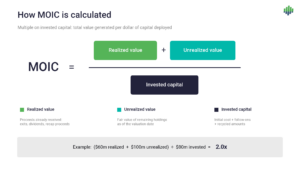
Figure 1. The MOIC formula: realized plus unrealized value, divided by invested capital.
The numerator: realized plus unrealized value
Realized value is everything the investment has actually paid out: sale proceeds, dividends and other distributions, recapitalization proceeds, and interest where relevant. Unrealized value – also called residual value – is the fair value of what is still held as of the valuation date.
The split between the two matters more than most summary pages admit. A 3.0x MOIC that is 2.5x realized tells a very different story than a 3.0x that is 0.5x realized and 2.5x on paper. The first fund has returned most of the value in cash; the second is a set of marks that still has to survive exit. Reviewers and LPs increasingly ask for the split explicitly, which at the fund level is exactly what DPI and RVPI provide.
The unrealized component also inherits every weakness of the underlying valuations. If marks are stale, or holdings are valued as of different dates, the resulting MOIC is precise-looking and wrong.
The denominator: invested capital
At the deal level, invested capital is the total capital deployed into that investment: the initial contribution plus any follow-ons. At the fund level, it is the total capital invested across the portfolio, and it includes recycled capital – proceeds that were reinvested rather than distributed.
Invested capital is not the same as committed capital, which may never be fully called, and it is not the same as paid-in capital, which includes amounts used for management fees and fund expenses rather than deals. These distinctions are where MOIC quietly diverges from TVPI, covered below.
Gross MOIC vs net MOIC
Gross MOIC is computed on investment-level cash flows, before management fees, fund expenses, and carried interest. It reflects how the deals themselves performed and is the figure a GP’s deal-by-deal track record usually shows.
Net multiples reflect what investors keep after those amounts. At the fund level, net figures are typically computed on LP cash flows – contributions in, distributions out, plus NAV – which is why a “net MOIC” in a report is often, strictly speaking, a net TVPI. The gap between gross and net is meaningful: fees and carry commonly pull the net figure well below the gross figure over a fund’s life.
The safe habit is to label every multiple as gross or net and to state the denominator. Recent industry standards push in the same direction: ILPA’s Performance Template asks for both gross and net figures, presented with and without the impact of fund-level subscription facilities.
How to calculate MOIC step by step
The calculation itself is one line of arithmetic. The work is in assembling inputs you can defend.
Step 1: Define the scope and write it down
Decide whether you are calculating a deal-level or fund-level multiple, and whether it is gross or net. Write down what counts as invested capital for this calculation, including how follow-ons and recycled amounts are treated. Most “MOIC discrepancies” between teams are definition differences, not math errors.
Step 2: Gather the invested capital
Sum all capital deployed into the investment or portfolio through the valuation date: initial investments, follow-ons, and recycled amounts under the fund’s recycling provisions. Tie the total to the cash ledger or general ledger rather than to a model.
Step 3: Gather realized proceeds
Sum everything received back through the same date: exit proceeds, dividends, distributions, recapitalization proceeds, and interest. Classify each flow by type – the classification feeds other metrics and standardized reporting templates even though MOIC itself only needs the total.
Step 4: Value unrealized holdings as of the same date
Use fair value marks as of one consistent valuation date across all holdings. If one position is marked as of a different date, the total is not a number you want to publish.
Step 5: Compute and sanity-check
Divide total value (realized plus unrealized) by invested capital. Reconcile the realized component to cash records and the unrealized component to the approved valuation file. At the fund level, cross-check against DPI and RVPI: on a consistent denominator, the realized and unrealized pieces should sum to the total multiple you are reporting.
MOIC calculation examples
Example 1: A fully realized investment
A fund invests $10.0m in a company at entry and adds a $2.0m follow-on, for invested capital of $12.0m. Over the hold it receives $3.0m from a dividend recapitalization, and the company is later sold for proceeds of $27.0m.
- Invested capital = 10.0 + 2.0 = $12.0m
- Realized value = 3.0 + 27.0 = $30.0m
- Unrealized value = $0
- MOIC = 30.0 ÷ 12.0 = 2.5x
Because the investment is fully exited, the multiple is final. No valuation judgment is involved.
Example 2: A partially realized fund
Now a fund-level example as of a quarter-end valuation date.
| Item | Amount ($m) |
| Invested capital (including recycled amounts) | 80.0 |
| Realized value (cumulative proceeds received) | 60.0 |
| Unrealized value (fair value of remaining holdings) | 100.0 |
| Total value | 160.0 |
| Gross MOIC | 2.0x |
The headline is 2.0x, but only 0.75x of it (60.0 ÷ 80.0) is realized; the remaining 1.25x is unrealized marks. Presenting the split alongside the total is what separates a defensible performance page from a marketing number.
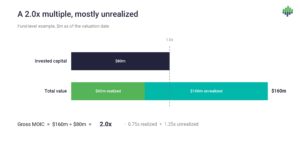
Figure 2. Example 2 visualized: the same 2.0x multiple is 0.75x realized and 1.25x unrealized.
Example 3: Gross vs net on the same fund
Continue the fund above. LPs have paid in $100.0m in total. Of that, $80.0m was invested in deals and $20.0m has gone to cumulative management fees and fund expenses. Assume accrued carried interest of $16.0m – 20% of the $80.0m gain, ignoring hurdles and waterfall timing for simplicity.
- Gross multiple on invested capital = 160.0 ÷ 80.0 = 0x
- Value attributable to LPs = 160.0 − 16.0 = $144.0m
- Net multiple on paid-in capital = 144.0 ÷ 100.0 = 44x
Same fund, same date: 2.0x gross and roughly 1.4x net. Both are correct answers to different questions, and reports only mislead when the label does not say which question is being answered. Real waterfalls, hurdles, and fee offsets will move the net figure; the illustration shows the mechanics, not a benchmark relationship.
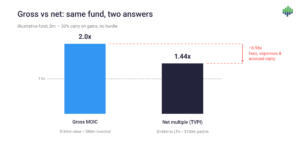
Figure 3. Example 3 visualized: 2.0x gross vs 1.44x net on the same fund at the same date.
MOIC vs IRR, TVPI, and DPI
MOIC answers “how many times is the money back?” It deliberately ignores when the money came back, which is why it is always read alongside other metrics.
MOIC vs IRR
IRR is the annualized return implied by the timing of cash flows. A 2.0x MOIC achieved in three years corresponds to an IRR of roughly 26%; the same 2.0x over ten years is roughly 7%. Identical multiples, very different outcomes. IRR is also far more sensitive to financing mechanics: subscription credit lines that delay capital calls can lift a fund’s IRR materially while leaving the multiple roughly unchanged, or slightly lower after interest costs. That is one reason standardized reporting increasingly asks for performance both with and without subscription facility impact.
MOIC vs TVPI
TVPI (total value to paid-in) has the same structure as MOIC – total value over a capital base – but the denominator is paid-in capital: everything LPs have contributed, including amounts consumed by fees and expenses. MOIC divides by invested capital: what was actually deployed into investments. At the fund level the two are often used interchangeably, and industry templates frequently write “TVPI/MOIC” as a pair, but the figures differ whenever fees, expenses, or recycling create a gap between paid-in and invested capital. If a report shows both, the methodology note should say how each denominator was built.
MOIC vs DPI and RVPI
DPI (distributions to paid-in) counts only cash actually returned to LPs; RVPI (residual value to paid-in) counts only the remaining NAV. Together they sum to TVPI. In practical terms, DPI is the realized portion of the story and RVPI the unrealized portion – the same split highlighted in Example 2. Late in a fund’s life, LPs tend to weight DPI heavily, because a multiple built mostly on residual value still depends on exits that have not happened.
| Metric | Question it answers | Formula | Reflects timing? |
| MOIC | How many times has invested capital been returned, in cash plus current value? | (Realized + unrealized value) ÷ invested capital | No |
| TVPI | How much total value exists per dollar LPs contributed? | (Distributions + NAV) ÷ paid-in capital | No |
| DPI | How much cash has actually been returned per dollar contributed? | Distributions ÷ paid-in capital | No |
| RVPI | How much value remains unrealized per dollar contributed? | NAV ÷ paid-in capital | No |
| IRR | What annualized return do the dated cash flows imply? | Rate that sets the NPV of the cash flows to zero | Yes |
What is a good MOIC?
There is no universal threshold. A “good” MOIC depends on the strategy, the stage, the vintage year, the holding period, whether the figure is gross or net – and how much of it is realized.
As commonly cited reference points: buyout investments are often underwritten to roughly 2.0x-2.5x gross over a typical five-year hold, and a fund-level net multiple around 2.0x or better over a buyout fund’s life is generally regarded as strong. Venture capital works differently: individual deals target much higher multiples – 10x and above – because a large share of the portfolio returns less than 1.0x, and a fund-level multiple around 3.0x is generally considered a strong outcome. Treat these as orientation, not benchmarks. Proper benchmarking compares net figures for the same strategy and vintage year using a recognized data provider.
Two caveats apply to any threshold. First, a multiple without a holding period is incomplete: pair it with IRR. Second, confirm what is being measured before comparing – a 2.0x net, mostly realized figure and a 2.0x gross, mostly unrealized figure are not the same achievement.
Where MOIC shows up in reporting and operations
LP reporting and the ILPA templates
Fund multiples appear in quarterly LP reporting alongside IRR, and the presentation is standardizing. ILPA’s updated Reporting Template and new Performance Template define how TVPI/MOIC figures are calculated and presented, including gross and net breakouts and figures with and without the impact of subscription facilities, with adoption recommended for funds in their investment period from 2026 onward.
The operational consequence sits upstream of the report: the standardized calculations are built from classified cash flows, so capital calls and distributions need correct transaction-type mapping at the point of entry. A drawdown misclassified in one quarter flows through to performance figures reported later.
Track records and fundraising materials
Deal-by-deal gross MOICs are a staple of fundraising decks and due diligence questionnaires. Two consistency rules keep them defensible: the same deal should show the same multiple, calculated the same way, in every document; and gross figures should be presented alongside – and reconcilable to – net figures, which marketing regulations in some jurisdictions require. Follow your compliance function’s guidance on presentation; the accounting team’s job is to make sure the underlying numbers reconcile either way.
The data behind the number
A multiple you can defend requires three things: a complete cash flow record for each investment (initial cost, follow-ons, recycled amounts, and distributions by type), valuations as of one consistent date, and allocation logic when multiple entities, sleeves, or share classes are involved. Deal-level multiples will not tie to fund-level multiples without controlled definitions, because fees and expenses sit at the fund level, recycling blurs the denominator, and multi-currency portfolios add an FX layer. None of this is conceptually hard, but all of it breaks when the inputs live in disconnected spreadsheets.
Common pitfalls when calculating and reporting MOIC
Pitfall 1: Gross and net figures mixed across documents
How it happens: Deal pages quote gross multiples, fund-level pages report net figures, and neither labels the basis.
How to prevent it: Label every multiple as gross or net and state the denominator. Keep one methodology note that all reporting outputs reference.
Pitfall 2: Denominator drift between invested, paid-in, and committed capital
What it looks like: Three systems produce three different multiples for the same fund on the same date.
How it happens: One report divides by invested capital, another by paid-in capital, and a model divides by commitments.
How to prevent it: Define each denominator in the reporting methodology and name metrics precisely – MOIC and TVPI are different metrics, not synonyms with different spellings.
Pitfall 3: Recycled capital counted inconsistently
What it looks like: Invested capital exceeds paid-in capital and no one can explain the gap, or the multiple looks inflated relative to peers.
How it happens: Reinvested proceeds under recycling provisions are treated as distributions in one place and as new invested capital in another, without a written rule.
How to prevent it: Document how recycled amounts enter the numerator and the denominator, and tie invested capital to the cash ledger every period.
Pitfall 4: Stale or mismatched unrealized marks
What it looks like: The fund’s MOIC moves quarter to quarter with no transactions to explain it – or does not move when it clearly should.
How it happens: Holdings are valued as of different dates, or marks lag the reporting date.
How to prevent it: Use one valuation date for every input, and reconcile the unrealized component to the approved valuation file.
Pitfall 5: The multiple presented without time or realization context
How it happens: MOIC is treated as the whole story because it is the easiest number to quote.
How to prevent it: Pair the multiple with IRR and with the realized/unrealized split – DPI and RVPI at the fund level – in every standard reporting pack.
How FundCount supports multiple and performance reporting
Every input to a fund multiple – contributions, distributions, follow-ons, valuations, allocations – is accounting data. FundCount is back-office accounting and investment analysis software that integrates portfolio, partnership, and general ledger accounting on one platform, which maps to the control points above in a few practical ways:
- One cash flow record ties the numerator and denominator to the books. When portfolio accounting activity and the general ledger share one platform, invested capital and realized proceeds reconcile to the same source rather than to parallel spreadsheets.
- Partnership accounting supports net figures at the investor level. FundCount’s partnership accounting tracks capital calls, distributions, fees, and allocations by investor and class – the inputs that net multiples and the TVPI family of metrics are built from.
- Configurable reporting keeps labels consistent. FundCount emphasizes customizable reporting, which helps teams present gross and net multiples with consistent definitions and the realized/unrealized split across packs and periods.
- Delivery through an investor portal closes the loop. FundCount’s Investor Portal is positioned as the distribution layer for reporting, with automated delivery of statements and performance reporting to LPs.
One platform for fund accounting and performance reporting
Keep cash flows, valuations, allocations, and multiples tied to the same source of truth.
Conclusion
MOIC is the simplest headline number in private markets and one of the easiest to misstate. The formula is a single division; the control work is in the definitions – what counts as invested capital, whether the figure is gross or net, and whether the unrealized component reflects one consistent valuation date. As with GAV vs NAV, most discrepancies are definition drift rather than math errors. Treat the multiple like any other reported figure: define it once, tie it to the ledger, label it clearly, and present it with the context – time and realization – that makes it honest.
FAQ
What does MOIC stand for?
MOIC stands for multiple on invested capital. It measures the total value of an investment – realized proceeds plus the fair value of unrealized holdings – relative to the capital invested, and it is expressed as a multiple such as 2.0x.
How do you calculate MOIC?
Divide total value by invested capital: MOIC = (realized value + unrealized value) ÷ invested capital. Realized value is the cash already received; unrealized value is the fair value of remaining holdings as of the valuation date; invested capital includes follow-ons and recycled amounts.
What is a good MOIC in private equity?
There is no universal threshold. Commonly cited reference points are roughly 2.0x-2.5x gross for underwritten buyout deals over a typical hold, with venture strategies targeting higher multiples to offset losses elsewhere in the portfolio. Always compare net figures within the same strategy and vintage year.
What is the difference between MOIC and IRR?
MOIC measures how many times capital has been returned and ignores time; IRR measures the annualized return implied by cash flow timing. A 2.0x over three years and a 2.0x over ten years are the same MOIC but very different IRRs, so the two are read together.
What is the difference between MOIC and TVPI?
Both divide total value by a capital base. TVPI divides by paid-in capital – all LP contributions, including amounts used for fees and expenses – while MOIC divides by invested capital, the amount deployed into investments. The figures diverge whenever fees, expenses, or recycling separate the two denominators.
Is MOIC gross or net of fees?
It can be either. Deal-level track records typically quote gross MOIC, before management fees, fund expenses, and carried interest; investor-facing fund reporting typically includes net figures. Every reported multiple should be labeled as gross or net, since the gap between them is material over a fund’s life.